GST Updates | Circulars 257/03/2026-GST to 264/10/2026-GST | Updated: 29 October 2026
These circulars address practical questions faced by taxpayers, exporters, dealers and tax professionals. This guide explains the reported scope of each circular and identifies the compliance areas businesses should review.
Key Takeaways
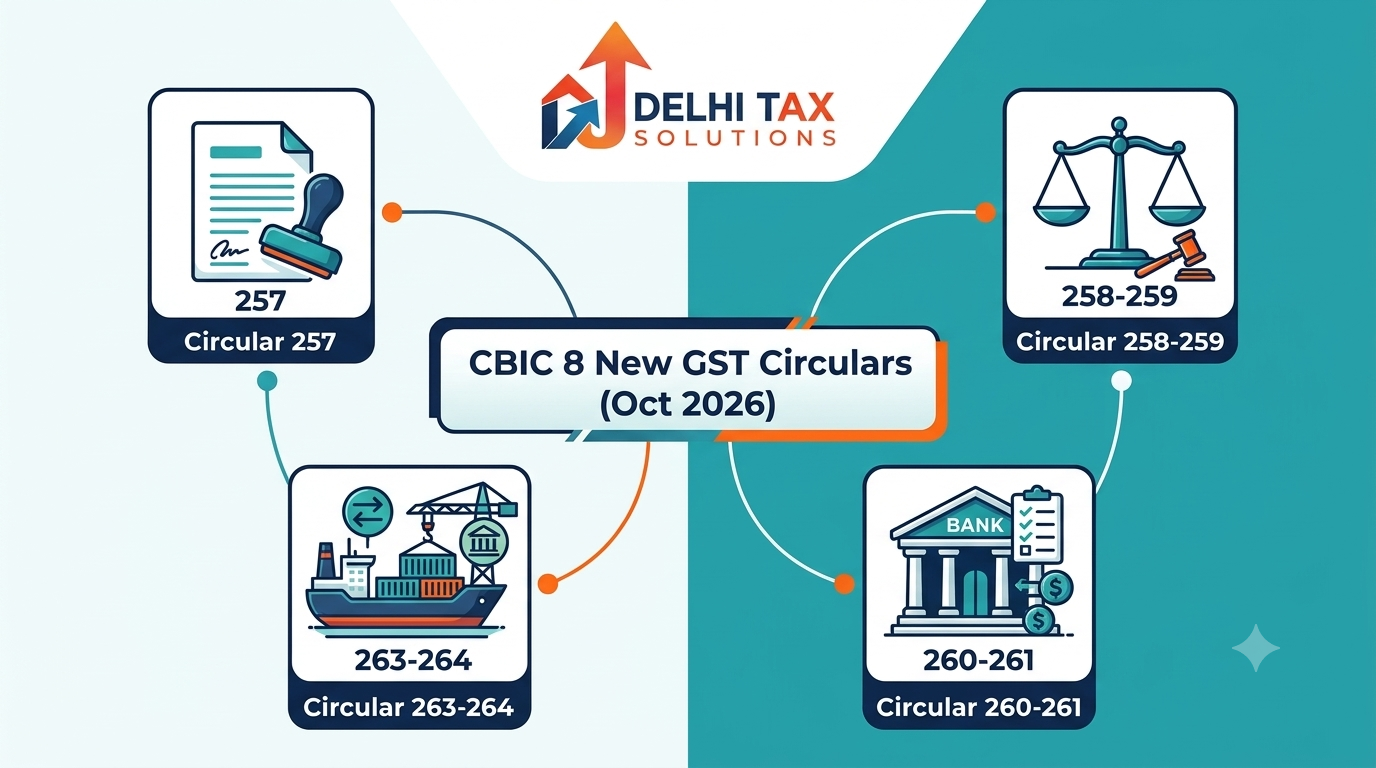
- Circular 257: Guidelines for handling GST registration applications and avoiding irrelevant document queries.
- Circular 258: Clarifications on GST demand, adjudication and appeal proceedings.
- Circular 259: Issues relating to pre-deposits paid for GST appeals.
- Circular 260: Input Service Distributor (ISD) credit distribution and related issues.
- Circular 261: Section 17(4) ITC mechanism for eligible banking companies and financial institutions, including NBFCs.
- Circular 262: ITC admissibility on demo vehicles in the specified dealer-agency model.
- Circular 263: Receipt of export payments and realisation of export proceeds.
- Circular 264: Clarification on the retrospective effect of the omission of Rule 96(10) and related provisions.
Overview of CBIC GST Circulars 257 to 264
The following table summarises the subjects covered by the eight circulars dated 26 October 2026.
| Circular Number | Subject | Who Should Review It? |
|---|---|---|
| 257/03/2026-GST | Handling of GST registration applications | New applicants, businesses and tax professionals |
| 258/04/2026-GST | Demand, adjudication and appeal proceedings | Taxpayers facing GST notices or disputes |
| 259/05/2026-GST | Pre-deposit under Sections 107(6) and 112(8) | Taxpayers filing GST appeals |
| 260/06/2026-GST | Input Service Distributor provisions | Businesses distributing common input service credit |
| 261/07/2026-GST | Section 17(4) and the special ITC mechanism | Eligible banks, financial institutions and NBFCs |
| 262/08/2026-GST | ITC on demo vehicles in the dealer-agency model | Authorised motor vehicle dealers and manufacturers |
| 263/09/2026-GST | Receipt of payment for exports of goods or services | Exporters and businesses claiming export-related refunds |
| 264/10/2026-GST | Omission of Rule 96(10) of the CGST Rules | Exporters with relevant refund issues or pending proceedings |
1. Circular No. 257/03/2026-GST: GST Registration Guidelines
This circular concerns the handling of applications for GST registration. Its stated focus is to make application processing more consistent, limit unnecessary queries and help genuine applicants provide the documents relevant to their applications.
Key areas covered
- Relevant document requests: Registration officers should follow the prescribed documentary requirements and avoid asking for unrelated documents or raising objections based on assumptions.
- Deficiency notices: Relevant deficiencies should be communicated through the prescribed process, including FORM GST REG-03 where applicable. Applicants should respond using the applicable procedure and deadline.
- Application processing: The circular discusses processing timelines, including cases involving Aadhaar authentication and cases where additional verification is required.
- Business address documents: Applicants should provide suitable supporting documents according to whether the premises are owned, rented, used with consent or located in a co-working facility.
- Application accuracy: PAN, legal name, business constitution, promoter details and principal place of business should be consistent with supporting records.
Recommended action: Review your registration application and supporting documents before submission. If a query or rejection is received, examine the stated reason and applicable legal procedure before responding.
2. Circular No. 258/04/2026-GST: Demand, Adjudication and Appeal Proceedings
This circular addresses procedural issues in GST demand and adjudication proceedings, including the preparation of show cause notices (SCNs) and the handling of disputes.
Important compliance points
- Clear show cause notices: An SCN should set out relevant facts, the tax period, applicable provisions, supporting material and the demand being proposed.
- Evidence for allegations: Allegations involving fraud, wilful misstatement or suppression should be supported by the relevant facts and material, rather than assumptions alone.
- Separate grounds: Where different legal grounds or categories of allegations are involved, the notice and demand should be examined to see whether those grounds and amounts are properly identified.
- Opportunity to respond: Taxpayers should review the notice, submit relevant evidence and use the applicable hearing and appeal procedures.
- Procedural consistency: Businesses and officers should apply the relevant provisions of the CGST Act and the circular to the facts of each case.
Recommended action: Preserve the SCN, annexures, tax invoices, returns, reconciliations and previous replies. Obtain professional advice promptly if a demand or appeal deadline is approaching.
3. Circular No. 259/05/2026-GST: Pre-Deposit for GST Appeals
This circular concerns payments made as pre-deposits for appeals under Section 107(6) or Section 112(8) of the CGST Act. Pre-deposit requirements are important because they can affect whether an appeal meets the applicable filing conditions.
What taxpayers should review
- The amount paid and the section under which the appeal was filed.
- Whether the payment has been correctly identified and recorded as a pre-deposit.
- The treatment of pre-deposits when an appeal is decided or when a refund is claimed.
- Any applicable interest or refund-related treatment under the circular and the governing provisions.
- Whether the relevant appeal order, payment proof and refund documentation are available.
Recommended action: Reconcile the appeal order, challan, pre-deposit amount and refund records. Confirm the exact treatment under the complete circular before calculating a refund or interest claim.
4. Circular No. 260/06/2026-GST: Input Service Distributor (ISD)
The ISD mechanism concerns the distribution of eligible input tax credit relating to input services received for or on behalf of distinct registrations. Businesses with multiple GST registrations should review whether common input service credits are being handled under the applicable ISD provisions.
Key areas to examine
- Credit identification: Identify input services received centrally and determine the registrations to which the credit relates.
- Distribution: Check whether the applicable ISD requirements, documentation and distribution method have been followed.
- Reverse-charge credit: Review the treatment of input service tax paid under reverse charge and the applicable transfer and distribution requirements.
- Recipient-level compliance: Each recipient registration should examine its entitlement to the distributed credit and any required reversal.
- Reconciliation: Match invoices, ISD records, returns and credit distributed to recipient GSTINs.
Recommended action: Businesses operating through multiple registrations should review their common-service invoices and confirm that their ISD process matches the applicable requirements.
5. Circular No. 261/07/2026-GST: Section 17(4) for Banks and NBFCs
Section 17(4) provides a special input tax credit mechanism for specified banking companies and financial institutions, including eligible non-banking financial companies (NBFCs), engaged in accepting deposits or extending loans or advances.
Key areas covered
- Eligibility: Determine whether the relevant registration carries out the specified activities and qualifies for the special mechanism.
- Special ITC method: Review the applicable 50% credit mechanism and the conditions governing its use.
- Multiple registrations: Where an entity has multiple registrations, examine which registrations are covered by the applicable option and related conditions.
- Same-PAN transactions: Review the conditions attached to the relevant second proviso and transactions between registrations of the same PAN.
- Return reporting: Confirm that ITC availment and reversals are reflected correctly in the relevant GST returns.
Recommended action: Eligible financial entities should review their registration-wise ITC policy, internal accounting and GSTR-3B reporting with their tax team.
6. Circular No. 262/08/2026-GST: ITC on Demo Vehicles
This circular addresses ITC admissibility for authorised agents appointed by manufacturers to sell motor vehicles, particularly under the dealer-agency model. It revisits the earlier clarification in Circular No. 231/25/2024-GST dated 10 September 2024.
What the clarification means
- The circular addresses the treatment of demo vehicles held by authorised agents in the specified dealer-agency arrangement.
- It clarifies the application of the motor vehicle ITC restriction under Section 17(5)(a) to the covered arrangement.
- The treatment should be assessed in the context of the authorised agent’s role, the purchase and use of the vehicle, and its subsequent sale.
- Taxpayers should retain purchase invoices, capital asset records, dealer-agency agreements and documents relating to the subsequent sale.
Recommended action: Motor vehicle dealers should compare their contractual arrangement and accounting treatment with the circular before claiming or revising ITC.
7. Circular No. 263/09/2026-GST: Receipt of Export Payments
For export transactions, the manner in which payment is received and the applicable foreign exchange requirements can affect whether the relevant conditions for export of services or export-related refunds have been satisfied. Circular 263 addresses payment channels, set-off and realisation of export proceeds.
Key areas covered
- Permitted payment channels: The circular discusses qualifying modes of receiving export payments, including specified INR-denominated arrangements that comply with applicable requirements.
- Set-off: Set-off of export receivables against import payables may be relevant where permitted under the applicable RBI and FEMA framework.
- Reinsurance brokers: The circular addresses the specified net-retention arrangement for commission where the amount is retained from premiums before remittance abroad.
- Realisation period: For exports of goods, the applicable period for realisation under FEMA, including any valid extension, is relevant to Rule 96B.
- Unrealised proceeds and write-offs: The circular discusses the treatment of specified write-offs and the related GST refund recovery position.
Recommended action: Reconcile export invoices with bank records, payment advice, permitted set-off documentation and any authorised write-off. Review Rule 96B exposure before concluding that an export refund is protected.
8. Circular No. 264/10/2026-GST: Retrospective Omission of Rule 96(10)
This circular concerns the omission of Rule 96(10) of the CGST Rules, 2017, which had restricted specified export refund claims in cases involving certain concessional or exemption-based input procurements.
The circular addresses the retrospective treatment of the omission following judicial developments, including the Supreme Court’s decision referred to in the relevant professional summaries. It also discusses corresponding treatment of the omission of Rules 89(4A) and 89(4B).
Why exporters should pay attention
- Historical refund disputes: Exporters with relevant pending proceedings should review whether the dispute concerns the omitted provisions.
- Retrospective date: The circular’s stated retrospective position relates to 23 October 2017. The actual effect on a case depends on the relevant facts and procedural status.
- Pending demands or proceedings: Businesses should identify cases in which Rule 96(10), Rule 89(4A) or Rule 89(4B) has been relied upon.
- Documentation: Maintain refund applications, shipping and export records, invoices, relevant procurement documents and correspondence with the tax department.
Recommended action: Exporters with old refund rejections, demands or pending litigation should obtain a case-specific review before filing a refund request, seeking closure or changing their accounting treatment.
What Should GST Taxpayers Do Next?
Practical Compliance Checklist
- Identify the relevant circular: Check which of the eight circulars relates to your business or pending matter.
- Read the complete text: Verify the circular number, date, legal provisions, conditions and any annexures.
- Review open cases: Identify pending registration applications, SCNs, appeals, ITC disputes and export refund matters.
- Reconcile records: Match invoices, returns, ledgers, challans, bank records and supporting documents.
- Check deadlines: Do not assume a circular extends a statutory deadline or automatically revives a time-barred claim.
- Document decisions: Keep a record of the circular relied upon and the reasons for any change in tax treatment.
- Seek professional advice: Obtain case-specific advice where substantial tax, interest, refund or litigation exposure is involved.
Frequently Asked Questions (FAQs)
1. How many GST circulars did CBIC issue on 26 October 2026?
The circular series covered in this article consists of eight circulars, numbered 257/03/2026-GST through 264/10/2026-GST.
2. Do these circulars introduce a new GST rate?
The eight circulars discussed here primarily concern clarification and administration of existing GST provisions, including registration, appeals, ITC and export refunds. Do not treat them as a general announcement of new GST rates.
3. Does Circular 257 guarantee GST registration within seven working days?
No blanket guarantee should be assumed. Processing timelines depend on the applicable rules, authentication status, verification requirements and the facts of the application. Review the complete circular and relevant provisions for the specific case.
4. Can every motor vehicle dealer claim ITC on demo vehicles?
No. Circular 262 addresses a specified authorised dealer-agency model. The arrangement, use of the vehicle, applicable statutory restrictions and supporting records should be reviewed before claiming ITC.
5. Does Circular 264 automatically release all old export refunds?
No. The retrospective treatment may affect relevant disputes and proceedings, but individual claims remain subject to their facts, records, procedural status and applicable legal requirements.
6. What should a taxpayer do after receiving a GST show cause notice?
Review the notice and annexures, verify the allegations and demand calculation, collect supporting records, and respond within the applicable deadline. Seek professional advice if the matter involves a significant demand or litigation risk.
7. Where can I check the circulars?
Start with the CBIC Tax Information Portal. You may also consult professional summaries, but verify the exact wording against the complete circular before acting on a legal or tax position.
Conclusion
The eight CBIC GST circulars dated 26 October 2026 address several important operational issues—from GST registration and fairer adjudication to appeal pre-deposits, ISD credit distribution, ITC for specified financial entities and demo vehicles, export payments and historical refund disputes.
Businesses should focus on the circulars relevant to their own transactions rather than assume that every clarification applies to every taxpayer. Reviewing the full circular, checking the applicable legal conditions and maintaining complete supporting records are essential before changing a GST return, claiming ITC, pursuing a refund or responding to a notice.
Delhi Tax Solutions can assist businesses with GST registration, return compliance, ITC reconciliation and tax-related documentation.
References and Further Reading
- CBIC Tax Information Portal — official source to check circulars and GST provisions
- Professional summary of GST Circulars 257–264
- TaxO overview of the eight circulars