
💡 Key Takeaways:
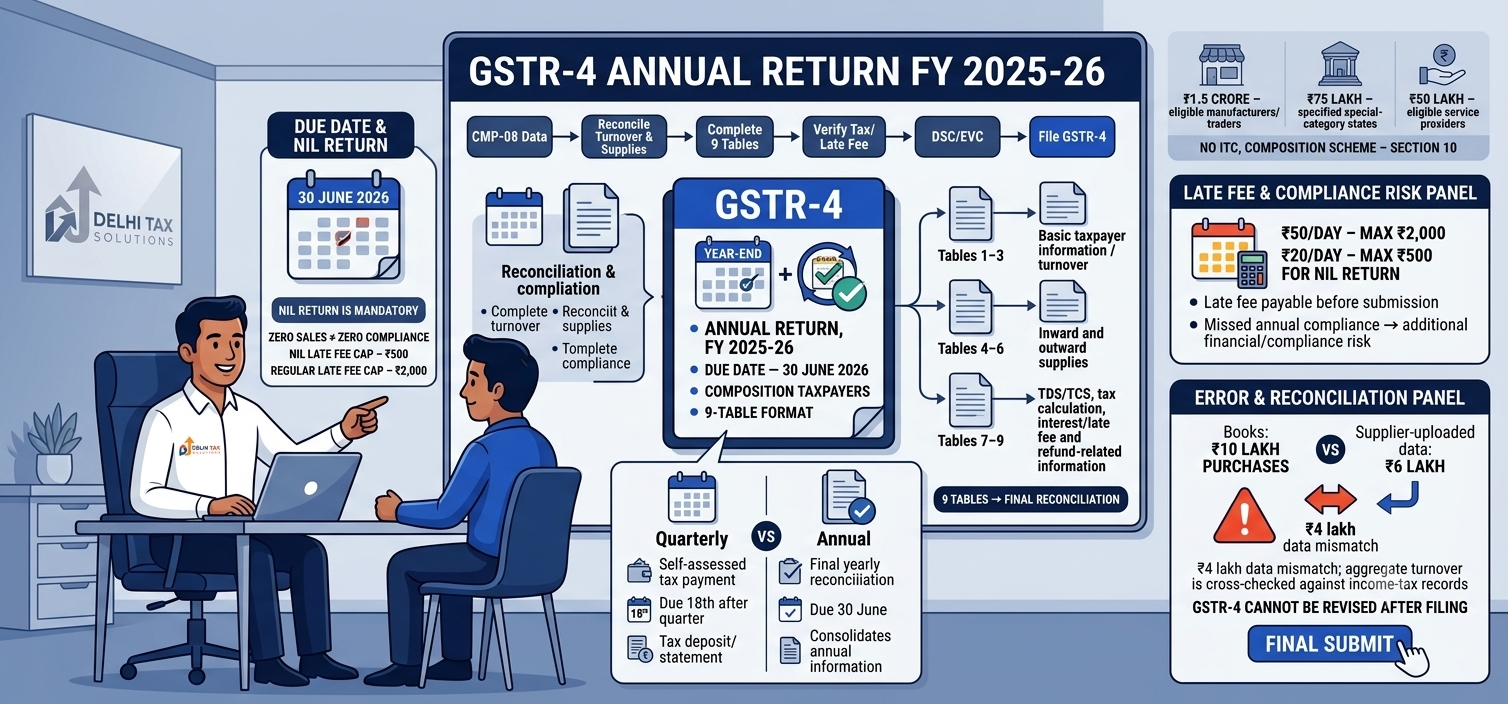
- The exact due date for FY 2025-26 is June 30, 2026.
- Filing is mandatory even if your turnover was absolutely zero.
- Late fees cap at ₹2,000 for standard returns and ₹500 for nil returns.
- Quarterly CMP-08 statements do not replace this final year-end compliance.
- You cannot revise the data once you click the final submit button.
Thousands of Indian small businesses get hit with unnecessary late fees every single year because they misunderstand one simple compliance deadline. If your business operates under the simplified tax structure, filing your annual return is not optional. It is the final wrap-up of your financial year.
The rules have shifted recently. The government has extended timelines, updated portal features, and tightened data-matching protocols. Using outdated information from two years ago will almost certainly trigger a portal error or, worse, a penalty notice. You need the current, up-to-date facts.
This comprehensive guide breaks down everything you need to know about this critical compliance document. You will learn the exact updated due dates, how the 9-table format actually works, and exactly how to avoid heavy financial penalties. Let’s get your business compliant.
What is GSTR 4?
GSTR 4 is the mandatory annual return for businesses registered under the GST Composition Scheme. It summarizes your yearly outward supplies, inward supplies, and tax liabilities into one consolidated document. From FY 2024-25 onwards, the due date to file this return is June 30 of the following financial year. Taxpayers must consolidate the data from their quarterly statements to complete this filing and avoid late fees of up to ₹2,000.
The GSTR 4 Due Date for FY 2025-26
Timing is everything when it comes to Indian tax compliance. Missing a deadline by just 24 hours triggers immediate, automated portal penalties. You cannot negotiate these fees away.
When to File Your Annual Return
For Financial Year (FY) 2025-26, the official gstr 4 due date is June 30, 2026. Previously, the government required businesses to file by April 30. However, following recent GST Council recommendations published via the Press Information Bureau, the deadline was permanently shifted to June 30 starting from FY 2024-25. This gives business owners two extra months to reconcile their books.
Do not wait until June 29 to log in. The official GST Portal frequently experiences heavy server traffic during the final 48 hours of any major compliance window. File early to ensure your data processes smoothly.
Quarterly CMP-08 vs Annual Return
Many business owners confuse the quarterly Form CMP-08 with the final year-end filing. They are two entirely different legal requirements. The CMP-08 is simply a statement used to deposit your self-assessed tax payments every three months. The year-end document is the final reconciliation.
| Compliance Feature | Form CMP-08 | Annual Return |
|---|---|---|
| Frequency | Quarterly (4 times a year) | Annually (Once a year) |
| Primary Purpose | Deposit self-assessed tax | Final yearly reconciliation |
| Due Date | 18th of the month after quarter ends | June 30 of the following FY |
GST Composition Scheme Eligibility & Turnover
Before worrying about the annual return, you must ensure your business actually qualifies to remain in the gst composition scheme. This framework, governed by Section 10 of the CGST Act, exists specifically to reduce the compliance burden for small operations.
Entrepreneurs looking to start a business often prefer this scheme because it removes the headache of issuing detailed tax invoices. Instead of standard monthly filings, you pay a flat percentage on your total sales.
Turnover Limits by Business Category
Your eligibility depends entirely on your aggregate turnover from the preceding financial year. The government strictly enforces these thresholds:
- Regular Manufacturers & Traders: Eligible if annual turnover is up to ₹1.5 crore. Tax rate is 1% (0.5% CGST + 0.5% SGST).
- Special Category States: The limit drops to ₹75 lakh for states like Arunachal Pradesh, Manipur, Meghalaya, Mizoram, Nagaland, Sikkim, Tripura, and Uttarakhand.
- Service Providers: Eligible if annual turnover is up to ₹50 lakh. Tax rate is 6% (3% CGST + 3% SGST).
- Restaurants (No Alcohol): Eligible up to ₹1.5 crore turnover. Tax rate is 5%.
Cross-verify your reported aggregate turnover with your official filings on the Ministry of Corporate Affairs portal if you run a private limited company.
Who Cannot File This Return?
Not everyone can use this simplified system. You are legally disqualified from this scheme—and therefore cannot file this specific document—if you make inter-state supplies of goods. Furthermore, businesses supplying goods through e-commerce operators who collect TCS are ineligible. Finally, Section 10 strictly prohibits composition dealers from claiming Input Tax Credit (ITC).
GSTR 4 Late Fee and Penalties
The government does not offer grace periods. If the clock strikes midnight on June 30 and your return is not submitted, the system automatically starts calculating daily penalties.
Regular Tax Liability Late Fees
According to the latest Central Board of Indirect Taxes and Customs (CBIC) notifications, the standard gstr 4 late fee is ₹50 per day of delay. This is split equally between central and state taxes (₹25 CGST + ₹25 SGST). The maximum penalty you can incur is strictly capped at ₹2,000 for the entire financial year.
You must pay this late fee in cash before the portal will accept your submission. You cannot adjust it against any existing ledger balances.
The Mandatory Nil Return Rules
A massive misconception among small business owners is that zero sales equals zero paperwork. This is factually incorrect. If you hold an active GSTIN under this scheme, you must file a gstr 4 nil return even if your business had absolutely no transactions.
Zero tax liability? You still have to file. No exceptions. Done entirely online. The late fee for missing a nil return deadline is ₹20 per day (₹10 CGST + ₹10 SGST). The maximum cap for a nil filing is ₹500.
Step-by-Step GSTR-4 Format (The 9 Tables)
The official portal requires you to fill out nine specific tables. Understanding the nuances of GST compliance saves business owners thousands in penalties. Let’s break down exactly what data goes where.
Auto-Populated Information (Tables 1 to 3)
The first three tables are incredibly simple. Table 1, Table 2, and Table 3 automatically pull your basic data from the government database. This includes your unique GSTIN, your legal business name, and your trade name. You only need to manually enter your aggregate turnover from the previous financial year if the system fails to auto-populate it.
Inward and Outward Supply Details (Tables 4 to 6)
Table 4 is where the real work begins. Here, you must declare all inward supplies (purchases) made during the year. This includes purchases from registered dealers, unregistered dealers, and any supplies attracting reverse charge mechanisms.
Table 5 is entirely auto-populated. The system pulls all the data you previously submitted across your four quarterly CMP-08 statements. It calculates your self-assessed tax liability for the year. Table 6 requires you to document your tax-rate-wise details of outward supplies (your total sales).
Tax Calculation and Refund Claims (Tables 7 to 9)
Table 7 captures any TDS (Tax Deducted at Source) or TCS (Tax Collected at Source) credits you received from suppliers. If you supply goods to government departments, this section is critical.
Table 8 acts as your master dashboard. It consolidates your total tax payable, any interest accrued, and your late fees. Finally, Table 9 allows you to claim a refund if you accidentally paid excess tax during your quarterly filings. Once you verify Table 8 and 9, you can sign via DSC or EVC and submit.
What Our CA Team Sees in Practice
Based on cases handled by our CA team at Delhi Tax Solutions, the biggest mistakes happen during the data reconciliation phase. Business owners often fail to match the purchases they report in Table 4 with the auto-populated data sitting in their GSTR-2B statement.
If you declare ₹10 lakh in purchases, but your suppliers only uploaded ₹6 lakh worth of invoices against your GSTIN, the portal detects a mismatch. The tax department will issue an automated scrutiny notice asking you to explain the ₹4 lakh difference.
We also see frequent errors regarding presumptive taxation overlaps. Cross-verify your aggregate turnover with your official filings on the Income Tax Department website. The turnover figure you report on this GST return must precisely match the gross receipts you declare on your ITR-4. Any discrepancy between the two portals will trigger an immediate red flag.
If you are just starting out, completing your GST Registration correctly is the first step to avoiding these reconciliation nightmares entirely.
Wrapping Up Your Yearly Compliance
Filing your annual return is the most important compliance task for a composition dealer. You now know that the FY 2025-26 deadline is firmly set for June 30, 2026. You understand that nil returns are completely mandatory, and you know exactly how the 9-table format structures your data.
The ₹2,000 maximum penalty is easily avoidable through proactive book reconciliation. Do not let minor data mismatches between your quarterly statements and your annual filing trigger an automated tax notice.
Talk to a Delhi Tax Solutions expert to get your GST registration and annual returns filed perfectly within 3 days. Staying ahead of the June compliance rush ensures your business operates without regulatory friction in the coming financial year.
Frequently Asked Questions (FAQs)
Q: Can I revise GSTR 4 after filing?
A: No, you cannot revise this annual return once it is successfully filed on the official portal. If you discover a mistake after submission, you must adjust the discrepancies in the subsequent financial year’s return. Our tax advisors highly recommend cross-verifying all turnover data against your quarterly statements before clicking the final submit button to avoid structural errors.
Q: What happens if I miss the GSTR 4 due date?
A: Missing the June 30 deadline automatically triggers a daily penalty. The government charges a late fee of ₹50 per day for standard taxpayers, capped at a maximum of ₹2,000 for the entire financial year. If you have zero tax liability for the year, the penalty drops to ₹20 per day, with a strict maximum cap of ₹500.
Q: Is GSTR 4 mandatory for a nil return?
A: Yes, filing is absolutely mandatory even if you made no sales or purchases during the entire financial year. You must file a nil annual return to keep your composition scheme registration active. Failing to do so will still attract the ₹20 daily late fee and could eventually lead to the cancellation of your GSTIN by the tax department.
Q: How is CMP-08 different from GSTR 4?
A: Form CMP-08 is a quarterly statement used strictly for depositing your self-assessed tax payments every three months throughout the year. In contrast, the annual return is a comprehensive yearly document that consolidates all four quarters into one final tally. You must file both; depositing taxes via the quarterly statement does not exempt you from year-end compliance.
Q: What is the turnover limit for the GST composition scheme?
A: The aggregate turnover limit depends on your specific business type and geographical location. Regular manufacturers and traders can opt in if their annual turnover is up to ₹1.5 crore. For businesses operating in special category states, the limit drops to ₹75 lakh. Meanwhile, service providers operate under a strict ₹50 lakh threshold to remain eligible for the scheme.
About this article: Researched using official government sources, real-time competitor and search-trend analysis, and Delhi Tax Solutions’ in-house tax advisory team. Last updated September 2026. This article is for general informational purposes and is not a substitute for personalised professional tax advice.