
💡 Key Takeaways
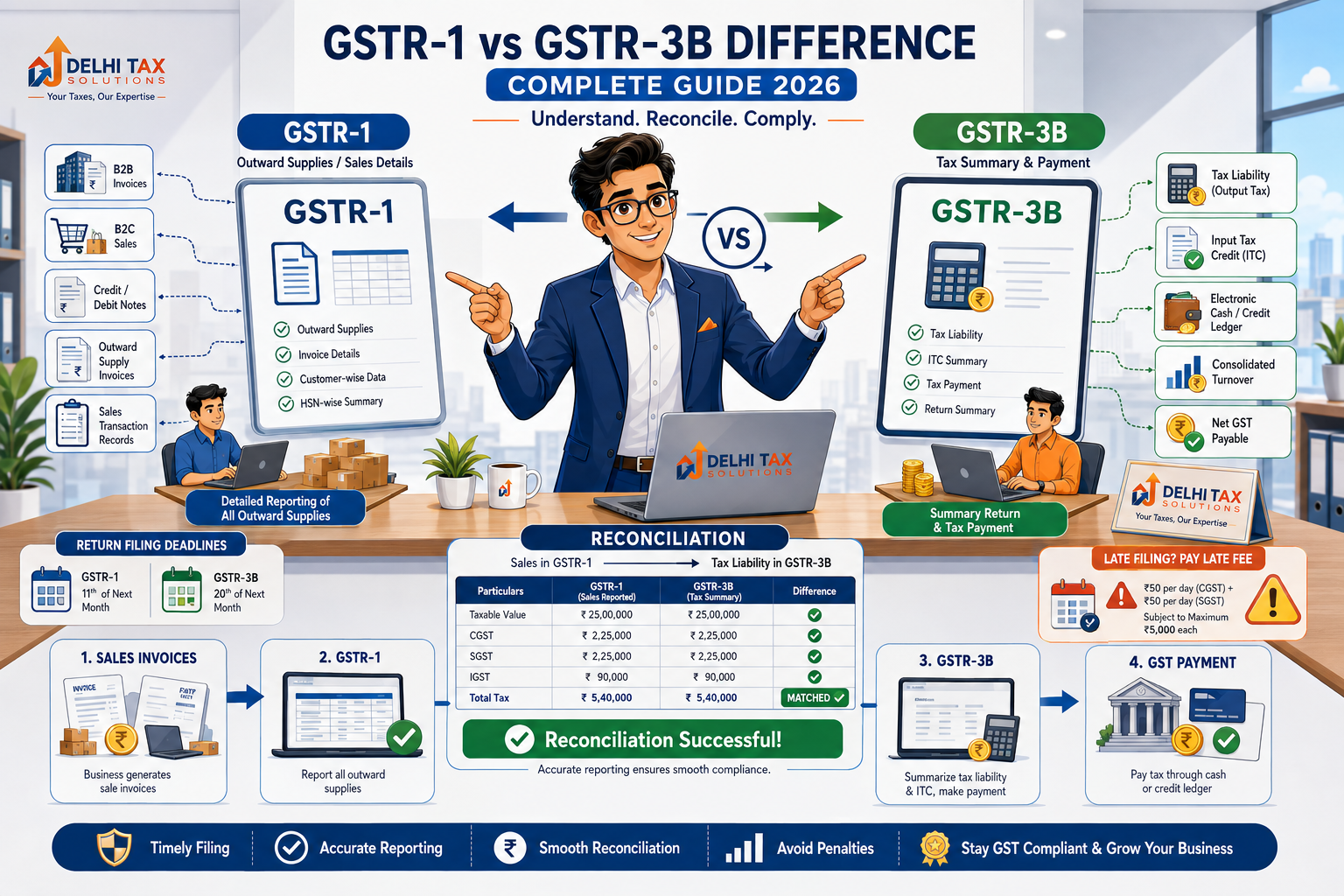
- GSTR-1 reports all outward sales and supplies made during the tax period.
- GSTR-3B summarizes tax liability and claims Input Tax Credit payments.
- Filing GSTR-1 is now mandatory before submitting GSTR-3B forms.
- Delayed filings attract statutory late fees under Section 47 of CGST.
- Expert CA guidance ensures error-free reconciliation and zero penalties.
Navigating the Indian indirect tax system requires absolute precision from every business owner, freelancer, and corporate entity. When operating under the Goods and Services Tax regime, understanding the core GSTR-1 vs GSTR-3B difference protects your enterprise from costly penalties and blocked portal credits. Many startup founders struggle to separate these two essential filings, leading to mismatched data and official notices from tax authorities. Master these compliance rules today to keep your business finances healthy.
Every registered taxpayer must submit periodic returns through the official portal managed by the government. While both forms deal with your business transactions, their underlying legal objectives, statutory sections, and submission timelines vary significantly. Grasping these differences allows you to streamline your monthly bookkeeping, optimize your working capital, and maintain a spotless compliance rating on the common portal.
What is GSTR-1 vs GSTR-3B Difference and Why Do Both Matter?
The GSTR-1 vs GSTR-3B difference lies in their fundamental purpose under the Central Goods and Services Tax Act. Governed by Section 37, GSTR-1 is a detailed statement capturing all outward taxable supplies, B2B invoices, credit notes, and export transactions executed by a registered supplier during a specific tax period. It acts as an itemized sales ledger that populates your buyer’s auto-drafted statement. Conversely, GSTR-3B governed by Section 39 is a simplified summary return where taxpayers declare their consolidated turnover, eligible Input Tax Credit (ITC), and net tax payable after adjusting allowable credits. You cannot offset tax liabilities or pay cash to the government without filing GSTR-3B. Together, these two filings form the backbone of modern digital tax transparency across India.
Navigating GST Return Filing Due Dates 2026
Staying ahead of statutory deadlines is critical to avoiding severe financial penalties and automated system lockouts. Current GST return filing due dates 2026 require standard monthly taxpayers to submit their GSTR-1 statements by the eleventh day of the succeeding month. For GSTR-3B, the statutory due dates typically fall on the twentieth, twenty-second, or twenty-fourth day of the following month, depending on your state jurisdiction and aggregate annual turnover.
According to notifications issued by the Press Information Bureau, automated portal validation now prevents sequential filing errors. Taxpayers operating under the Quarterly Return Monthly Payment scheme enjoy extended deadlines, giving them until the thirteenth day of the month following the quarter for GSTR-1. Meeting these timelines requires disciplined bookkeeping and regular data entry throughout the month. For businesses establishing their commercial presence, securing proper Company Registration sets up an organized financial foundation from day one.
Choosing Between Monthly vs Quarterly GST Return Structures
Selecting the correct filing frequency depends directly on your aggregate annual turnover and operational scale. Analyzing the operational mechanics of monthly vs quarterly GST return options helps small business owners optimize their administrative workload. Taxpayers with an aggregate turnover of up to ₹5 crore in the preceding financial year can opt for the QRMP scheme, filing GSTR-1 and GSTR-3B once every three months while paying fixed monthly tax challans.
Larger enterprises exceeding the ₹5 crore threshold must strictly adhere to monthly filing cycles for all outward supplies and tax liabilities. Regulatory oversight from the Income Tax Department and the GST Council ensures that high-value transactions remain transparent across federal databases. For specialized trading entities, acquiring necessary Business Licenses remains an essential prerequisite before initiating commercial sales.
Avoiding Heavy Penalties and Managing GSTR-3B Late Fee Rules
Failing to submit your statutory returns on time triggers severe automated financial consequences under Indian tax law. Understanding how GSTR-3B late fee structures operate helps you protect your bottom line from unnecessary cash outflows. Under Section 47 of the CGST Act, the standard late fee for delayed return submission is ₹50 per day—split equally between Central GST and State GST—up to a maximum statutory cap that varies based on your turnover.
If your return reflects a nil tax liability, the late fee is reduced to ₹20 per day. Additionally, delayed tax payments attract an annual interest charge of eighteen percent calculated on the net tax liability debited from your electronic cash ledger. Regulatory circulars published on the official GST Portal emphasize that the system automatically freezes further return filing if prior defaults remain uncleared. Professional oversight through expert GST Registration services ensures your compliance calendar stays green year-round.
Compliance Comparison: GSTR-1 vs GSTR-3B
Reviewing the structural and functional contrast below clarifies why both returns are legally indispensable for every registered business owner.
| Compliance Parameter | GSTR-1 (Outward Supplies) | GSTR-3B (Summary Return) |
|---|---|---|
| Statutory Section | Section 37 of CGST Act | Section 39 of CGST Act |
| Core Purpose | Detailed itemized reporting of B2B and B2C sales | Consolidated summary of tax liability and ITC claims |
| Filing Frequency | Monthly or Quarterly (QRMP) | Monthly or Quarterly |
⚡ In a Nutshell
GSTR-1 records every sales invoice you issue to customers, while GSTR-3B calculates your final tax payable and claims your purchase credits. Filing GSTR-1 first is now mandatory before submitting your GSTR-3B summary.
Resolving GSTR-1 Outward Supply Reporting and ITC Mismatches
Accurate data entry during outward supply reporting directly dictates your business credibility and your buyers’ credit eligibility. Mastering GSTR-1 outward supply reporting prevents automated tax notices from reaching your registered address. When you upload invoices, the system generates auto-populated tables that feed directly into your customers’ GSTR-2B statements. If your outward sales figures reported in GSTR-1 do not match the tax liabilities declared in GSTR-3B, the tax administration triggers an automated discrepancy flag.
To prevent input tax credit mismatch penalties, business owners must reconcile their accounting books with portal data every single month. According to guidelines from the Ministry of Corporate Affairs, maintaining transparent corporate financial records is a legal duty for all registered entities. Staying updated on legislative frameworks via Direct Tax Code developments helps organizations plan their tax outflows proactively.
Securing Your Business With Professional Chartered Accountant Guidance
Navigating complex portal reconciliations, HSN code classifications, and changing statutory deadlines requires meticulous professional expertise. Partnering with experienced Chartered Accountants eliminates administrative guesswork, ensures flawless return submission, and protects your enterprise from avoidable penalty notices. Professional advisors verify every transaction before portal upload to guarantee complete regulatory alignment.
Professional oversight guarantees total operational peace of mind for startup founders and growing business owners. Let our experienced advisory team handle your monthly statutory filings so you can focus entirely on scaling your core commercial operations.
Conclusion
Mastering indirect tax compliance is essential for every business owner and corporate entity operating in India today. Remember that GSTR-1 records itemized sales invoices, GSTR-3B calculates your net tax payable, and meeting statutory due dates prevents heavy late fees. Do not let complex tax paperwork compromise your commercial growth. Talk to a Delhi Tax Solutions expert to get your GST returns filed accurately and promptly by our professional CA team. Proactive compliance secures your business future.
About this article: Researched using official government sources and Delhi Tax Solutions’ in-house tax advisory team. Last updated August 2026. This article is for general informational purposes and is not a substitute for personalised professional tax advice.
Frequently Asked Questions (FAQs)
+ Q: What is the fundamental operational difference between GSTR-1 and GSTR-3B?
A: The fundamental difference is that GSTR-1 is an itemized statement detailing all outward taxable supplies, B2B invoices, and credit notes issued by a registered taxpayer during the tax period, whereas GSTR-3B is a summary return where the taxpayer declares consolidated turnover, eligible Input Tax Credit claims, and net tax payable. GSTR-1 feeds data directly to your buyers’ credit ledgers, while GSTR-3B is used to make actual tax payments from your electronic cash or credit ledgers to the government treasury via the official portal.
+ Q: Can a registered taxpayer file GSTR-3B without submitting GSTR-1 first?
A: No, under current digital tax enforcement rules implemented on the common portal, taxpayers cannot file their GSTR-3B summary return without first successfully submitting and filing their GSTR-1 statement for the corresponding tax period. This sequential locking mechanism was introduced to ensure that recipient buyers receive immediate and accurate Input Tax Credit reflections in their GSTR-2B statements, thereby eliminating fraudulent credit claims and reducing audit mismatch notices issued by tax authorities.
+ Q: What are the applicable late fees and interest penalties for delayed GSTR-3B filing in 2026?
A: Delayed GSTR-3B filing attracts a statutory late fee under Section 47 of the Central Goods and Services Tax Act amounting to fifty rupees per day—split equally as CGST and SGST—up to a maximum statutory cap determined by your turnover. For nil return filers, the late fee is reduced to twenty rupees per day. Additionally, any delayed tax payment incurs an annual interest charge of eighteen percent calculated on the net tax liability debited from your electronic cash ledger for the duration of the delay.
+ Q: How do small business owners choose between monthly and quarterly GST return filing structures?
A: Small business owners whose aggregate annual turnover does not exceed five crore rupees in the preceding financial year can opt for the Quarterly Return Monthly Payment scheme. This structure allows them to file GSTR-1 and GSTR-3B once every three months while making simple monthly tax challan payments for the first two months of the quarter. Businesses exceeding the five crore turnover threshold must strictly adhere to mandatory monthly filing cycles for all outward supplies and tax liability settlements.
+ Q: Why does an Input Tax Credit mismatch between GSTR-3B and GSTR-2B trigger official notices?
A: An Input Tax Credit mismatch triggers official scrutiny notices because tax authorities utilize automated data analytics to cross-verify the credits claimed by a taxpayer in their GSTR-3B return against the auto-populated purchase data available in their GSTR-2B statement. When claims exceed eligible vendor-uploaded invoices, it indicates potential fraudulent crediting or bookkeeping errors. Resolving these discrepancies requires prompt reconciliation, vendor follow-ups, and corrective amendments before annual return deadlines.