
💡 Key Takeaways
- Income Tax applies to net profits, whereas GST applies to gross transaction billing value.
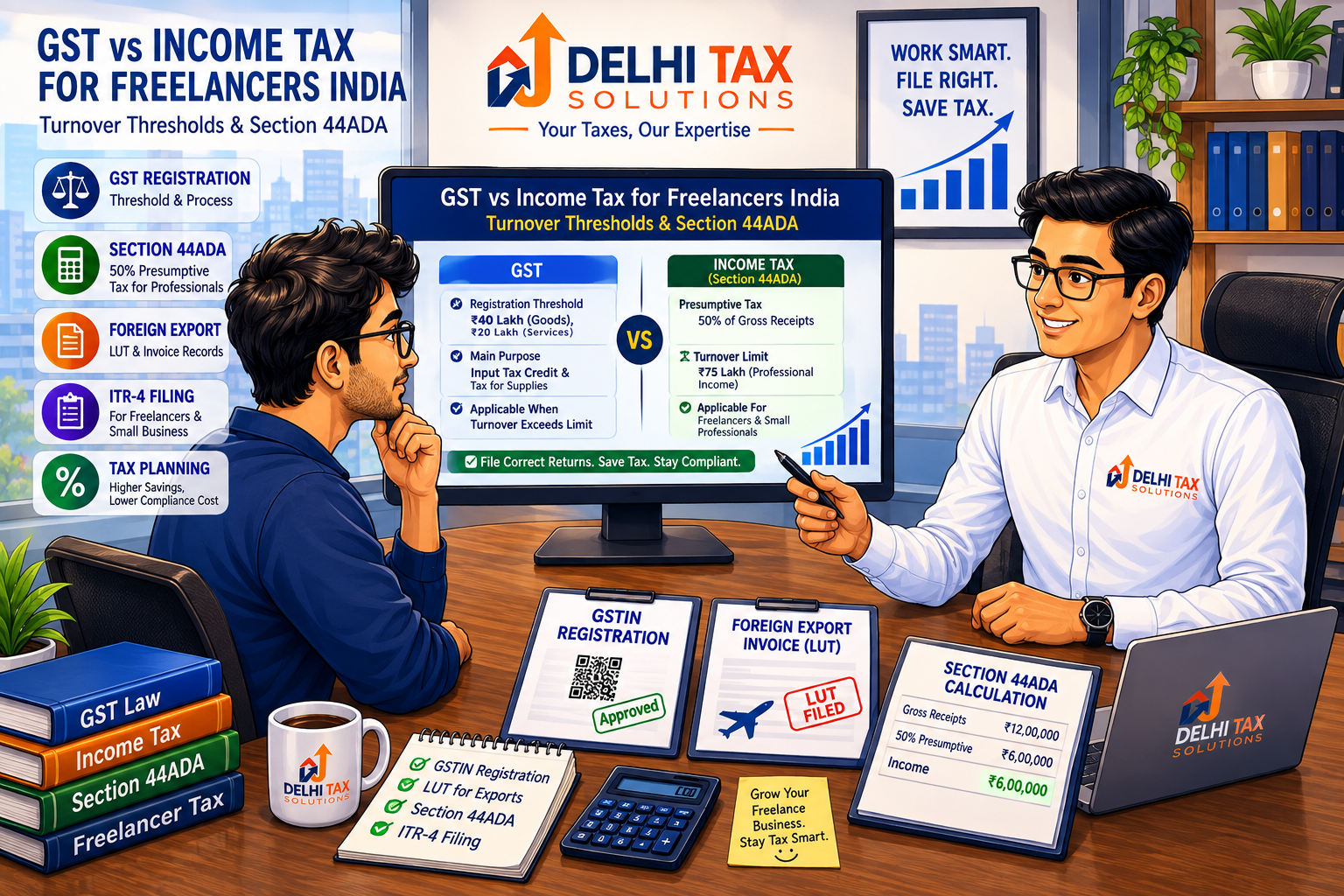
- GST registration becomes mandatory when aggregate annual turnover crosses ₹20 Lakhs (₹10 Lakhs in special category states).
- Section 44ADA allows eligible professionals to pay Income Tax on only 50% of gross receipts up to ₹75 Lakhs.
- Foreign freelance income is zero-rated under GST if an active Letter of Undertaking (LUT) is filed.
- Advance tax installments are mandatory if net annual Income Tax liability exceeds ₹10,000.
Navigating client invoices, international wire transfers, and tax notices can quickly overwhelm independent professionals in India. Over 15 million freelancers contribute to India’s thriving gig economy, yet thousands confuse direct income taxes with indirect transactional taxes every year. Understanding GST vs income tax for freelancers is essential to avoid unexpected penalties, prevent double taxation, and protect your hard-earned profit margins.
Income tax taxes the annual profit you earn from your skills, whereas Goods and Services Tax regulates the invoices you issue to domestic or overseas clients. Misinterpreting these two distinct tax regimes can lead to frozen bank accounts, loss of input tax credits, or severe interest charges under Indian tax statutes. This guide breaks down turnover thresholds, compliance schedules, international LUT filing rules, and presumptive tax benefits under FY 2025-26 (AY 2026-27) regulations.
What Is the Core Difference in GST vs Income Tax for Freelancers?
The core difference between GST and Income Tax for freelancers lies in their taxable base and tax type. Income Tax is a direct tax levied on your annual net professional profit, calculated after deducting eligible business expenses or applying Section 44ADA. In contrast, GST is an indirect transactional tax collected on the gross billing amount of services supplied, applicable once your annual aggregate turnover crosses the statutory ₹20 Lakh threshold limit.
How Does Freelancer GST Applicability Function in Practice?
Every independent professional earning income through software development, digital marketing, consulting, or creative design must evaluate their freelancer GST applicability. Goods and Services Tax is consumption-based, meaning it applies directly to the supply of service rather than your personal take-home earnings.
1. The Nature of Direct vs Indirect Taxation
Income tax assesses your ability to pay based on net annual gains. You file your return once a year with the Income Tax Department. GST acts as a transaction-level duty where you collect 18% tax from domestic clients and deposit it with the government via monthly or quarterly filings on the GST Portal.
2. Business Income Classification under ITR Rules
Under Section 28 of the Income Tax Act, 1961, freelance earnings are classified as “Profits and Gains of Business or Profession” rather than salary. You do not receive Form 16 from clients. Instead, clients deduct TDS deductions under Section 194J or 194C and issue Form 16A certificates quarterly.
3. The Separate Identity of GSTIN
Obtaining a 15-digit GSTIN creates a formal business identification for your freelancing venture. While Income Tax uses your personal PAN, GST operates on state-specific registrations tied to your primary place of business.
What Is the GST Registration Threshold Freelancers Must Monitor?
Tracking your total annual gross collections ensures you meet the official GST registration threshold freelancers must obey under current Indian laws.
1. The ₹20 Lakh Aggregate Turnover Rule
For service providers, GST registration becomes legally mandatory when your aggregate turnover in a financial year exceeds ₹20 Lakhs. If you operate from special category northeastern states (such as Manipur, Mizoram, Nagaland, or Tripura), the threshold limit drops to ₹10 Lakhs. Aggregate turnover includes all domestic sales, exempt revenues, and foreign export billing combined.
2. Voluntary GST Registration Advantages
Freelancers earning below ₹20 Lakhs can register voluntarily to claim Input Tax Credit on business gear like laptops, cameras, and software subscriptions. Applying for early GST registration also builds enterprise credibility when bidding for corporate contracts.
| Feature / Parameter | Income Tax (Direct Tax) | Goods & Services Tax (GST) |
|---|---|---|
| Tax Base | Net profit earned during the financial year | Gross invoice value of services supplied |
| Mandatory Threshold | Basic Exemption Limit (₹3 Lakhs under New Regime) | ₹20 Lakhs aggregate annual turnover (₹10L in special states) |
| Standard Tax Rates | Slab rates (5% to 30%) or 50% under Sec 44ADA | 18% standard rate on professional services |
| Filing Frequency | Annual return + 4 Advance Tax installments | Monthly/Quarterly returns (GSTR-1, GSTR-3B) + Annual Return |
How Do Income Tax vs GST Compliance Freelancer Rules Handle Export Work?
Working with foreign clients introduces unique structural requirements under income tax vs GST compliance freelancer guidelines.
1. Zero-Rated Export Benefits under GST
Freelancing for clients in the US, UK, Europe, or Australia is legally classified as an “export of services” under Section 2(6) of the IGST Act. Exports are zero-rated transactions. Freelancers with a GSTIN can submit a Letter of Undertaking (LUT) online via Form GST RFD-11 before invoicing overseas clients, allowing them to bill without charging 18% IGST.
2. Foreign Inward Remittance Proofs
To treat foreign revenue as tax-free under GST, you must receive payments in convertible foreign exchange via bank wire, Wise, or PayPal. You must obtain a Foreign Inward Remittance Certificate (FIRC) or Advice from your bank to verify export compliance during GST audits.
3. Reporting Overseas Gains in Income Tax Returns
Unlike GST where exports carry 0% tax, foreign earnings are 100% taxable under Indian Income Tax laws. You must declare all inward remittances converted to INR in your annual income tax filing using standard SBI Telegraphic Transfer Buying Rates.
How Do Freelance Tax Rules India 2026 Allow Optimization via Section 44ADA?
Understanding updated freelance tax rules India 2026 allows remote creators to minimize liabilities legally across both direct and indirect tax systems.
1. Simplified Presumptive Taxation Scheme
Section 44ADA of the Income Tax Act provides a simplified presumptive taxation scheme for technical and creative professionals earning up to ₹75 Lakhs gross receipts (provided cash receipts do not exceed 5%). Under this scheme, the tax department assumes 50% of your total billing is profit, while the remaining 50% is treated as tax-free operational expenditure.
2. Combining Section 44ADA with GST Registration
A common misconception is that registering for GST cancels your eligibility for Section 44ADA. You can maintain an active GSTIN to issue 18% GST invoices while simultaneously declaring only 50% taxable profit on your annual ITR-4 filing. [LINK GAP — no live page found: Freelancer Section 44ADA Presumptive Tax Guide]
3. Claiming Input Tax Credit on Business Purchases
While Section 44ADA eliminates the need to maintain detailed expense books for Income Tax, your GST registration lets you claim Input Tax Credit on GST paid for office laptops, broadband connections, and coworking space rentals.
⚡ In a Nutshell
GST applies to gross client billing above ₹20 Lakhs, while Income Tax applies to net profits. You can enjoy 50% presumptive profit benefits under Section 44ADA while maintaining an active GSTIN for zero-rated export invoicing.
What Are Deadlines and Penalties Under Section 44ADA for Freelancers?
Failing to fulfill statutory timelines under Section 44ADA for freelancers or GST frameworks results in automatic late fees and interest levies.
1. Quarterly Advance Tax Deadlines
If your estimated total Income Tax bill after TDS exceeds ₹10,000, paying Advance Tax in four quarterly installments (June 15, September 15, December 15, and March 15) is mandatory. Non-payment attracts penal interest under Sections 234B and 234C of the Income Tax Act.
2. Recurring GST Return Schedules
GST-registered freelancers must submit monthly GSTR-1 (outward supplies) and GSTR-3B (summary return) or opt for the quarterly QRMP scheme. Missing GST deadlines incurs an automatic late fee of ₹50 per day (₹20 per day for nil returns) plus 18% annual interest on unpaid tax balances via official GST filing services portals.
3. Annual Return Filings and Reconciliations
Freelancers must align their 26AS, Annual Information Statement (AIS), and GST turnover figures before July 31 following the financial year end. Corporate guidelines from the Ministry of Corporate Affairs and tax authorities penalize mismatches between reported GST turnover and declared ITR gross receipts.
Final Action Plan for Freelancer Tax Optimization
Mastering GST vs income tax for freelancers allows you to scale your business while staying 100% compliant. GST governs your gross sales invoices above ₹20 Lakhs, while Income Tax taxes your net professional income. Leveraging Section 44ADA cuts your taxable profit in half, and filing an annual LUT protects your international export earnings from 18% IGST withholding.
Avoid expensive audit notices and late filing penalties. Consult our expert CA team at Delhi Tax Solutions today to set up your GST registration, file LUT applications, and optimize your annual ITR return within 3 business days.
About this article: Researched using official government sources and Delhi Tax Solutions’ in-house tax advisory team. Last updated August 2026.
This article is for general informational purposes and is not a substitute for personalised professional tax advice.
Frequently Asked Questions
Q: Is GST mandatory for freelancers earning below ₹20 Lakhs in India?
A: No, GST registration is not mandatory for service freelancers whose aggregate annual turnover is below ₹20 Lakhs (₹10 Lakhs for special category northeastern states). However, if you provide inter-state goods or want to claim Input Tax Credit on business equipment like laptops and software subscriptions, you can register voluntarily under the GST Act.
Q: What is the main difference between GST and Income Tax for freelancers?
A: The main difference lies in the taxable event and tax type. Income Tax is a direct tax levied on your net personal profit earned in a financial year, which can be optimized using Section 44ADA. GST is an indirect transactional tax levied on the gross invoice value of services supplied to domestic clients at a standard rate of 18%.
Q: Can a freelancer claim Section 44ADA and GST registration together?
A: Yes, freelancers can maintain an active GST registration while filing Income Tax returns under Section 44ADA. Registering under GST allows you to legally bill clients and claim Input Tax Credit, while Section 44ADA lets you declare 50% of your gross billing as taxable professional profit without preserving individual expense vouchers.
Q: Do freelancers paying Income Tax on foreign income need to pay GST?
A: Freelancers exporting services overseas do not have to pay 18% GST if they file a Letter of Undertaking (LUT) online before billing. Export of services is treated as zero-rated under GST law. However, all foreign earnings converted to Indian Rupees must be fully reported in your annual Income Tax Return as taxable professional revenue.
Q: What are the penalties for missing GST and Income Tax filing deadlines?
A: Missing GST return deadlines triggers a late fee of ₹50 per day (₹20 for nil returns) plus 18% per annum interest on unpaid GST liability. Missing Income Tax deadlines incurs a late filing fee of up to ₹5,000 under Section 234F, along with 1% monthly penal interest under Sections 234A, 234B, and 234C on unpaid tax balances.
