
💡 Key Takeaways:
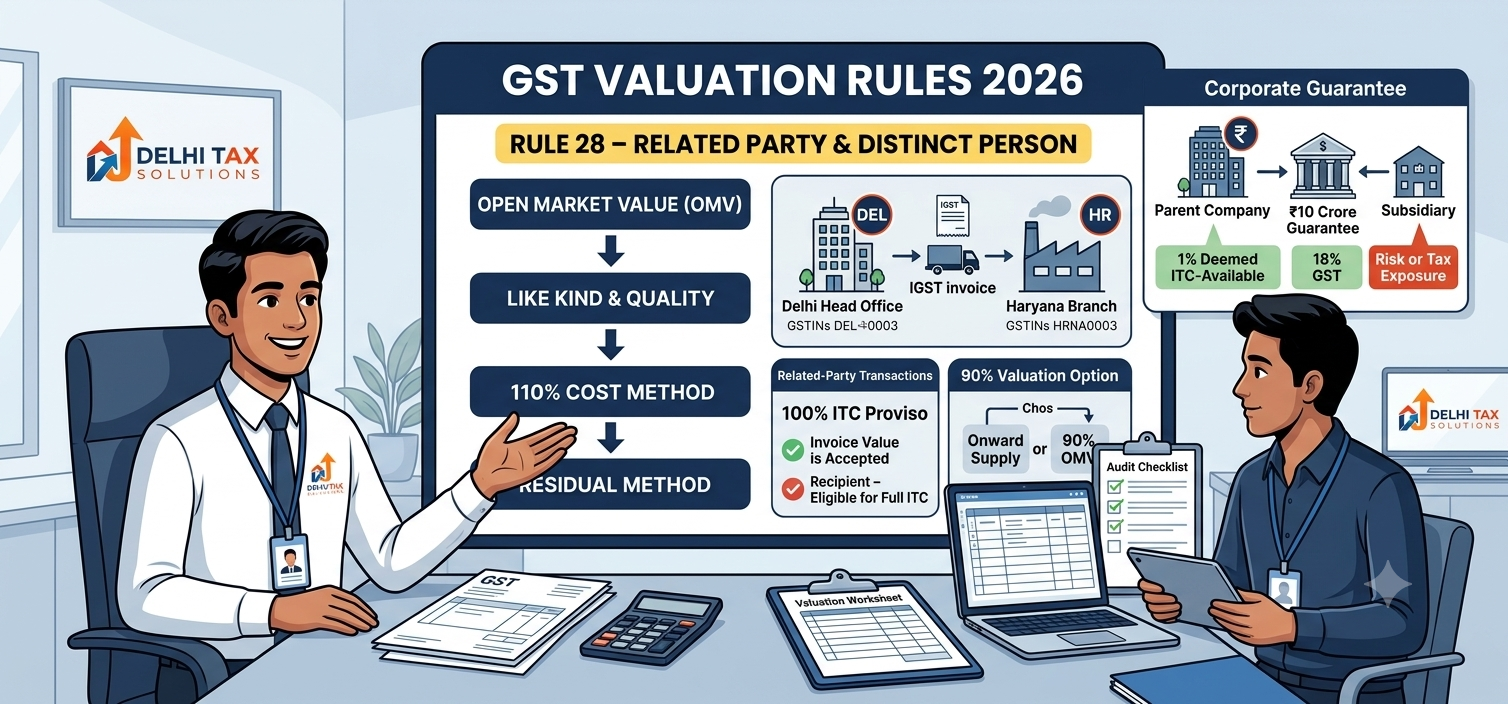
- Rule 28 requires related party transfers to be valued at Open Market Value (OMV).
- If OMV is missing, you must use the value of goods of like kind and quality.
- If full Input Tax Credit (ITC) is available to the recipient, any invoice value is valid.
- Corporate guarantees to banks now attract GST at 1% of the guarantee amount.
Taxing a sale to an independent buyer is simple. The invoice price is the taxable value. But what happens when an Indian business transfers goods to its own branch in another state? Or when a parent company provides free IT services to a subsidiary?
The government knows that related parties can manipulate prices to lower their tax liability. To stop this, the tax department throws out the standard “transaction value” and enforces strict GST valuation rules. If you get this wrong, you invite massive tax demands, heavy penalties, and blocked working capital.
This guide breaks down exactly how to value these transactions under the Central Goods and Services Tax (CGST) Rules. We will walk through the exact hierarchy you must follow, the loopholes that save you money, and what our team looks for during audits.
What Are GST Valuation Rules for Related Parties?
Under GST valuation rules, the value of goods or services supplied between related parties or distinct persons cannot simply be the price paid. Instead, the taxable value must be determined using Rule 28 of the CGST Rules [1]. Taxpayers must follow a strict hierarchy: first determining the Open Market Value (OMV), then the value of like kind and quality, and finally falling back to 110% of the cost of supply. This ensures fair tax collection even if no money actually changes hands.
Who is a ‘Related Person’ or ‘Distinct Person’ Under GST?
Before calculating anything, you need to know if the rule actually applies to your transaction. The GST framework splits these internal transactions into two specific categories.
First, a related person includes businesses or individuals with overlapping control. If two companies share the same directors, or if one entity holds 25% or more of the voting stock in both, they are legally related. Employers and employees also fall into this bucket. If you run a Private Limited company, ensuring compliance here is a massive part of standard company registration in India structuring.
Second, distinct persons refers to different branches of the exact same company. If your Delhi head office holds one GSTIN (GST Identification Number) and your Haryana warehouse holds another, the government treats them as two completely different entities. Transferring laptops from Delhi to Haryana is a taxable supply. You must issue an invoice and charge Integrated GST (IGST), even if it is just moving your own stock.
The Rule 28 Hierarchy: How to Calculate GST Value
You cannot pick your favourite valuation method. Rule 28 of the CGST Rules forces you to follow a specific, step-by-step hierarchy.
Step 1: Open Market Value (OMV)
You must start here. The open market value is the price you would charge a completely independent, unrelated customer for the exact same supply at the exact same time. If you sell a software subscription to the public for ₹50,000, that is the OMV. When you provide that same software to your sister concern, you must value it at ₹50,000 and pay tax accordingly.
Step 2: Value of Like Kind and Quality
Sometimes, an exact OMV does not exist. Perhaps you manufactured a custom machine part specifically for your subsidiary. In this case, you look for a highly similar product in the market. You evaluate goods of similar physical characteristics, quality, and reputation to determine a fair baseline price.
Step 3: The 110% Cost Method (Rule 30)
If there is no market equivalent, you move to Rule 30 cost of supply. You calculate the total cost of manufacturing the goods or providing the service. You then multiply that cost by 110%. For example, if producing a batch of custom chemicals costs ₹1,00,000, the taxable value becomes ₹1,10,000.
If even this fails, Rule 31 (the residual method) allows you to use any “reasonable means” consistent with GST principles.
| Valuation Method | When to Use It | How It Works |
|---|---|---|
| Rule 28(a): OMV | Always the first choice. | Use the price charged to independent buyers for the exact item. |
| Rule 28(b): Like Kind | When exact OMV is missing. | Use the market price of a highly comparable product. |
| Rule 30: 110% Cost | When no market comparison exists. | Cost of production/acquisition × 110%. |
The 90% Rule vs. The 100% ITC Proviso: A Game-Changer
The government provides two major lifelines to businesses to prevent unnecessary tax burdens. Understanding these exceptions is critical for managing your working capital.
First is the 90% rule. If you transfer goods to a related party, and they intend to sell those exact goods to an unrelated customer, you have an option. You can value the initial transfer at 90% of the price the related party will eventually charge the end customer.
The second lifeline is far more powerful. The second proviso to Rule 28 states that if the recipient branch or related company is eligible for full Input Tax Credit (ITC), the value declared on the invoice is legally deemed to be the open market value.
This means if your branch can claim 100% of the tax back, you can invoice the goods at ₹1,000, ₹100, or even issue a Nil-value invoice for internally generated services. Because the transaction is revenue-neutral for the government, they accept whatever value you declare. Many businesses fail to utilize this and unnecessarily block cash flow. If you are setting up a new branch, securing proper GST registration online ensures you can claim these credits smoothly.
Valuation of Corporate Guarantees (2026 Update)
A massive shift recently hit Indian conglomerates. Historically, parent companies provided free corporate guarantees to banks so their subsidiaries could secure loans. Because no money changed hands, companies paid no GST.
The government closed this gap. A new sub-rule dictates that corporate guarantees provided to a banking company on behalf of a related person must be taxed. The value of this service is deemed to be 1% of the guarantee amount per year, or the actual consideration charged—whichever is higher.
If a parent company guarantees a ₹10 Crore loan for a subsidiary, the deemed value is ₹10 Lakhs. GST at 18% (₹1.8 Lakhs) must be paid, even if the parent charged the subsidiary nothing. This rule applies regardless of whether the subsidiary can claim full ITC.
What Our CA Team Sees in Practice
Textbook rules are one thing; surviving an audit is another. Based on cases handled by our CA team, the GST department heavily scrutinizes cross-charge mechanisms between head offices and branches.
Officers frequently pull employee salary allocations. If your head office HR team manages payroll for all state branches, the department views this as a service provided by the head office to the distinct persons. If you have not cross-charged this cost or relied cleanly on the full-ITC proviso, expect a notice.
We also see major issues with the Ministry of Corporate Affairs (MCA) filings. Your GST returns must reconcile with your related party disclosures in your audited financial statements. If you declare a related party transaction to the MCA but show no corresponding GST invoice, the data analytics systems will catch the discrepancy automatically.
In a Nutshell
Always check if the receiving branch can claim full ITC. If yes, the invoice value is safe. If no, you must meticulously document how you arrived at the Open Market Value to defend yourself during an audit.
Conclusion
Handling related party transactions correctly is non-negotiable. Remember to always respect the distinct person concept for branch transfers, strictly follow the Rule 28 hierarchy when full ITC is not available, and account for the new 1% rule on corporate guarantees. Failing to document your valuation strategy leaves your business exposed to severe departmental action.
Do not guess your compliance. Talk to a Delhi Tax Solutions expert to get your GST structure audited and optimized today. You can explore more insights on our tax and finance blogs. Staying ahead of these regulations ensures your business scales without sudden tax shocks.
About this article: Researched using official government sources, real-time competitor and search-trend analysis, and Delhi Tax Solutions’ in-house tax advisory team. Last updated September 2026.
Disclaimer: This article is for general informational purposes and is not a substitute for personalised professional tax advice.
Frequently Asked Questions (FAQs)
Q: What is the open market value under GST?
A: Open market value (OMV) under GST is the full price a buyer would pay to an independent, unrelated supplier for the exact same goods or services under normal market conditions. As per the CGST Rules, it serves as the primary benchmark to ensure related parties do not under-invoice to avoid paying the correct amount of tax.
Q: Are inter-branch transfers taxable under GST?
A: Yes, inter-branch transfers are taxable under GST if the branches are located in different states or hold separate GSTINs within the same state. The GST law treats these branches as “distinct persons.” You must issue a proper tax invoice and charge IGST on the transfer, even though the goods are just moving internally within the same company.
Q: How is the 110% cost calculated under Rule 30?
A: If you cannot determine the open market value or find a product of like kind and quality, Rule 30 applies. You calculate the total cost of manufacturing the product, acquiring the goods, or providing the service, and then multiply that exact figure by 110%. The resulting amount becomes the legally accepted taxable value for GST purposes.
Q: Can I issue a zero-value invoice to my branch?
A: Yes, you can issue a zero-value (Nil) invoice to your branch for internally generated services, provided the receiving branch is eligible to claim full Input Tax Credit (ITC). Under the second proviso to Rule 28, when full ITC is available, whatever value you declare on the invoice—even zero—is legally deemed to be the open market value.
Q: What is the GST on corporate guarantees for related parties?
A: Based on recent amendments to the CGST Rules, providing a corporate guarantee to a bank on behalf of a related party in India is a taxable supply. The taxable value is strictly set at 1% of the total guarantee amount per year, or the actual fee charged, whichever is higher. GST is applied to this deemed value.
