
💡 Key Takeaways
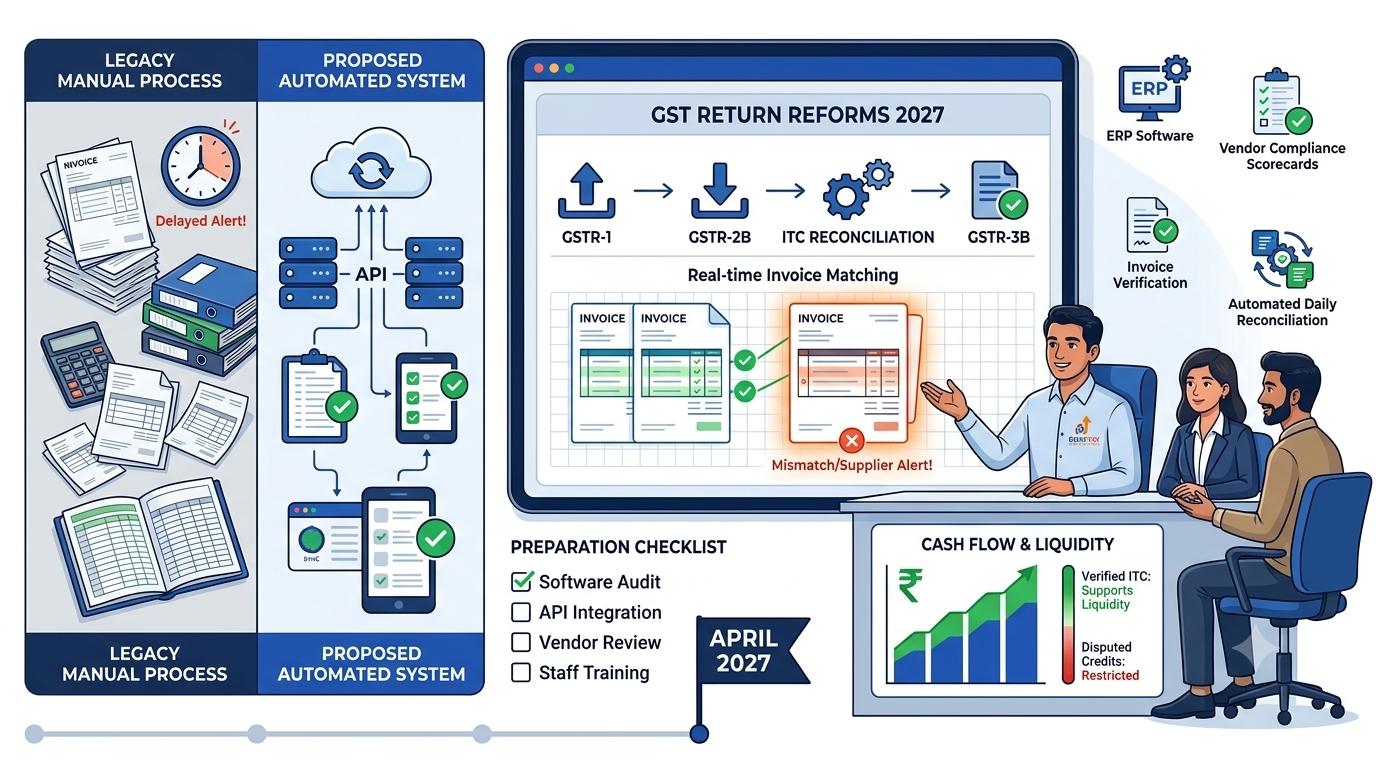
- The April 2027 GST return reforms introduce a fully automated, real-time Input Tax Credit (ITC) reconciliation mechanism.
- Manual invoice matching will be replaced by continuous data synchronization between GSTR-1 and GSTR-2B.
- Working capital bottlenecks will ease for compliant vendors, while non-compliant suppliers face immediate credit blocks.
- Businesses must audit their ERP and accounting software before December 2026 to ensure seamless API integration.
- Delhi Tax Solutions provides specialized corporate advisory to safeguard businesses against sudden tax mismatch notices.
The Indian indirect tax landscape is undergoing a massive structural evolution. Effective April 2027, the GST Council is rolling out comprehensive GST return reforms anchored by a revamped, real-time Input Tax Credit (ITC) reconciliation mechanism. For corporate finance teams, startup founders, and MSME owners, understanding GST return reforms ITC reconciliation 2027 is no longer optional—it is critical for protecting corporate liquidity. Historically, businesses grappled with periodic mismatches between claimed tax credits in GSTR-3B and auto-populated figures in GSTR-2B, leading to cascading tax liabilities and blocked working capital. The upcoming framework promises to replace legacy manual reconciliations with an automated, continuous verification architecture. This guide explores the statutory changes, operational impacts, and actionable steps your organization must take to stay fully compliant.
What Are the 2027 GST Return Reforms?
The 2027 GST return reforms represent a generational upgrade to India’s indirect tax architecture. Moving away from monthly batch filings and retroactive audits, the new framework governed by the Central Board of Indirect Taxes and Customs (CBIC) leverages advanced application programming interfaces (APIs) and artificial intelligence to validate tax transactions at the exact moment of invoice generation. The primary objective is to eradicate fake invoicing networks while offering seamless credit pass-through for genuine commercial transactions.
Under these reforms, the distinction between outward supplies and inward credit claims blurs into a single, continuous ledger. Taxpayers utilizing professional GST Registration & Filing services will find that automated synchronization drastically reduces compliance friction and audit exposure.
The Core Mechanism of Real-Time ITC Reconciliation
At the heart of the 2027 reforms is the real-time ITC matching engine. In previous years, discrepancies between GSTR-1 and GSTR-3B often surfaced weeks or months later, resulting in cumbersome demand notices under Section 73 or 74. The reformed portal introduces instant invoice locking.
When a supplier uploads an invoice on the Invoice Registration Portal (IRP) or GSTR-1 via the official GST Portal, the data streams instantly into the recipient’s GSTR-2B dashboard. If the supplier fails to deposit the corresponding tax liability before filing their GSTR-3B, the system automatically flags the transaction and restricts credit availability for the buyer in real time. For comprehensive corporate tax planning, integrating these workflows with expert Income Tax Return Filing strategies is essential.
⚡ Quick Summary
Real-time ITC reconciliation eliminates retrospective mismatch notices by locking credit availability directly to supplier tax remittance. Automated system checks replace manual reconciliations entirely by April 2027.
Comparison Framework: Legacy GST System vs. 2027 Reformed System
To appreciate the magnitude of the upcoming transition, examine how compliance parameters shift under the 2027 architecture:
| Compliance Pillar | Legacy GST Framework | 2027 Reformed GST Framework |
|---|---|---|
| Invoice Matching Frequency | Periodic monthly batch matching and post-filing reviews. | Continuous, real-time synchronization upon invoice upload. |
| ITC Claim Eligibility | Provisional credit allowed up to permitted percentage tolerances. | Strict 100% GSTR-2B auto-lock with zero provisional variance. |
| Defaulting Supplier Handling | Manual issuance of notice after annual audit reconciliation. | Automated system blocks preventing buyer credit utilization instantly. |
| Software Integration | Offline utility uploads and manual Excel reconciliations. | Direct ERP-to-Portal API connectivity and automated alerts. |
Impact on Working Capital and Corporate Cash Flows
For growing enterprises, working capital is the lifeblood of daily operations. Under the legacy model, delayed supplier filings often trapped legitimate tax credits for months, forcing businesses to fund double tax outlays out of pocket. The 2027 mechanism introduces total transparency. Compliant supply chains will experience accelerated liquidity release because verified credits clear instantly.
Conversely, businesses working with unverified or erratic suppliers will face immediate credit freezes. Consequently, corporate procurement teams must overhaul vendor onboarding protocols, vetting vendor tax compliance histories prior to issuing purchase orders. Establishing strong corporate structures via professional Company Registration services helps establish sound financial foundations from inception.
Step-by-Step Action Plan for ERP and Software Readiness
Adapting to real-time reconciliation requires proactive technological upgrades. Organizations should execute the following transition roadmap well ahead of the April 2027 rollout:
- Audit Existing Accounting Software: Evaluate whether your current ERP (Tally, SAP, Zoho, Oracle) supports direct GST Suvidha Provider (GSP) API integration for real-time GSTR-2B pulling.
- Implement Automated Vendor Scorecards: Institute rigorous supplier evaluation metrics to track GSTR-1 filing punctuality and tax remittance reliability.
- Establish Daily Reconciliation Protocols: Shift accounts payable workflows from monthly reviews to automated daily purchase register matching.
- Train Internal Finance Teams: Educate accounting personnel on error-handling codes and immediate discrepancy resolution workflows.
Conclusion
The April 2027 GST return and ITC reconciliation reforms mark a decisive milestone in India’s digital tax administration journey. By eliminating manual verification bottlenecks and enforcing real-time credit matching, the government is creating a transparent, highly efficient marketplace. While the shift demands rigorous software upgrades and tighter vendor governance, compliant businesses stand to gain significant liquidity and immunity from surprise mismatch notices. Partnering with seasoned experts at Delhi Tax Solutions ensures your enterprise remains ahead of every regulatory curve.
Frequently Asked Questions (FAQs)
+ Q: When do the new GST return and ITC reconciliation reforms take effect?
A: The comprehensive GST return reforms and real-time ITC reconciliation mechanism are officially scheduled for nationwide rollout effective April 2027. Businesses must update their ERP systems and accounting protocols prior to this date.
+ Q: How does real-time ITC reconciliation impact my working capital?
A: Real-time reconciliation improves liquidity for compliant supply chains by unlocking verified tax credits instantly. However, if your suppliers delay their tax filings or GSTR-3B remittances, your credit will be automatically blocked until they rectify their filings.
+ Q: Will provisional ITC claims still be permitted under the 2027 reforms?
A: No, provisional credit allowances and percentage tolerances are being phased out in favor of a strict 100% auto-populated GSTR-2B lock. Credits will only be available if fully reflected and matched on the portal in real time.
+ Q: What preparations should my IT and finance teams make immediately?
A: Teams should audit their ERP software for API compatibility, establish robust vendor performance scorecards, transition from monthly to daily purchase reconciliations, and train accounting staff on automated discrepancy alerts.
+ Q: How can Delhi Tax Solutions assist with the 2027 GST transition?
A: Delhi Tax Solutions provides comprehensive corporate advisory, ERP integration consulting, vendor compliance audits, and end-to-end GST return filing services to ensure your business transitions smoothly without unexpected tax credit blocks.
About this article: Researched using official government notifications, GST Council reform updates, and Delhi Tax Solutions’ in-house indirect tax advisory team. Last updated October 2026.
Disclaimer: This article is for general informational purposes and is not a substitute for personalised professional tax advice.