💡 Key Takeaways:
- Section 46 of the CGST Act mandates formal notices for registered taxpayers defaulting on return filings.
- Form GSTR-3A acts as an official 15-day warning before tax authorities initiate best judgment assessments.
- Ignoring return deadlines leads to accumulating daily late fees and 18 percent annual interest charges.
- Extended non-compliance triggers automatic GST registration cancellation and blocks subsequent return filings.
- Filing overdue returns within 60 days of an assessment order successfully withdraws penalty orders.
Discovering an official tax communication on your dashboard can trigger immediate anxiety for business owners. When routine operations consume all your attention, missing a monthly tax deadline happens faster than expected. However, ignoring digital alerts from the tax administration escalates simple filing delays into severe administrative liabilities. Understanding how tax authorities handle delayed filings protects your venture from sudden legal roadblocks.
Our CA advisory team frequently guides business owners through urgent compliance resolutions across Delhi and the NCR region. This comprehensive guide breaks down every statutory mechanism under section 46 gst regulations for FY 2025-26. You will learn exactly what triggers these official alerts and how to resolve them before penalties compound.
Whether you manage an established manufacturing firm or operate a growing digital startup, maintaining continuous reporting discipline is essential. Proper compliance management keeps your operational credentials secure and avoids unexpected banking complications.
What Is a Section 46 GST Notice and Form GSTR-3A?
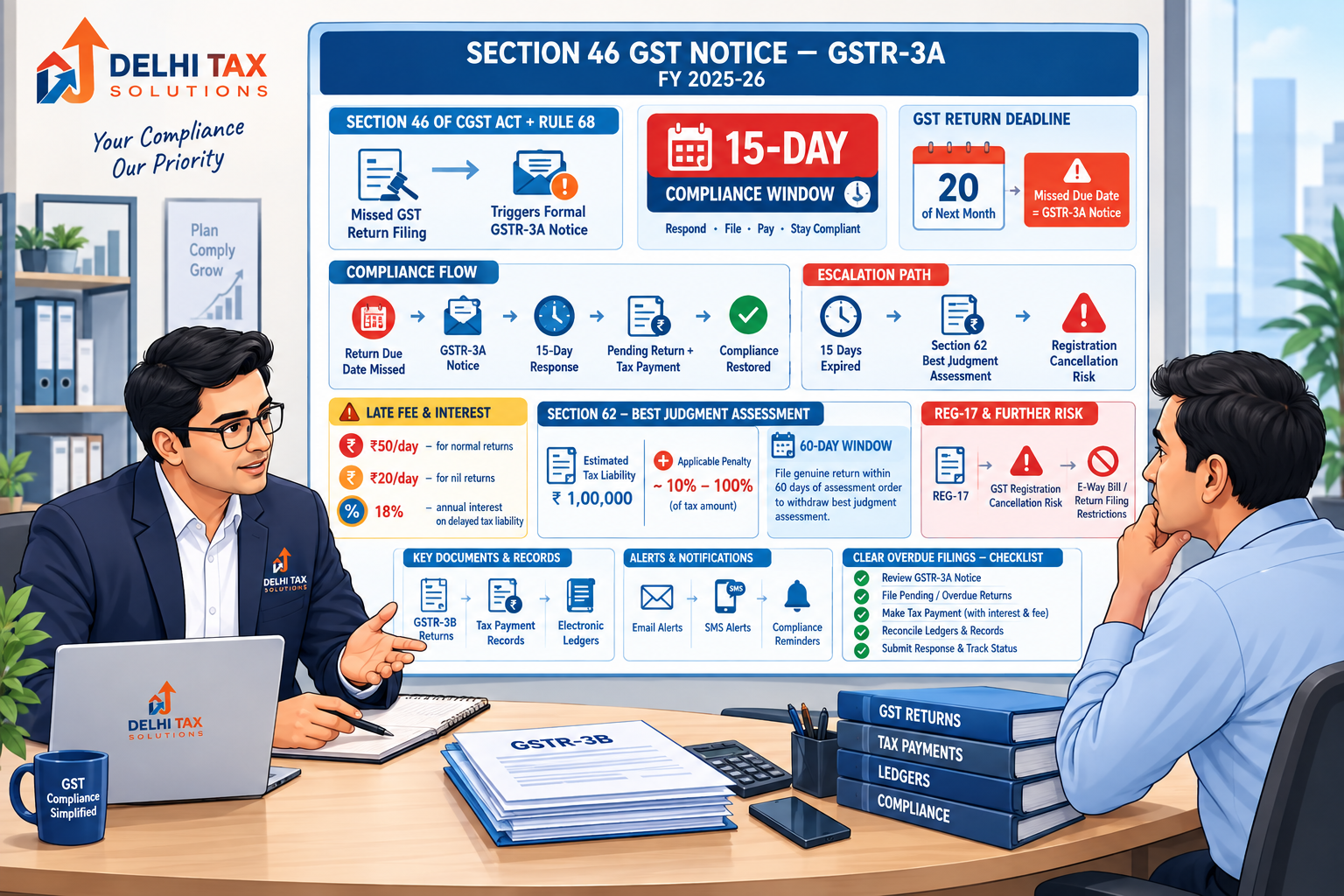
Form GSTR-3A is a system-generated formal notice issued under section 46 of the CGST Act, 2017, combined with Rule 68 of the CGST Rules. It is not a tax return itself, but an official statutory reminder sent to registered taxpayers who have failed to furnish required returns like GSTR-3B, GSTR-4, or annual filings by the prescribed due date. When operational oversight causes a default, the GST network automatically dispatches this communication, granting the defaulting taxpayer a strict 15-day window to regularize their accounts.
The 15-Day Countdown and Statutory Obligations
Receiving a gstr 3a notice initiates a rigid 15-day compliance countdown from the date of issuance. During this window, the taxpayer must log into the official GST Portal, prepare and submit all pending returns, and pay outstanding tax liabilities. Failing to act within this timeframe strips the taxpayer of informal relief, allowing tax officers to initiate formal assessment proceedings under statutory provisions.
Business owners often assume that zero-activity periods require no administrative actions. In reality, failing to file mandatory nil returns triggers identical automated default notices. Establishing structured corporate oversight prevents these oversight errors from recurring. For enterprises restructuring operations or launching new commercial ventures, securing proper foundational permits is vital. Explore our resources on starting a business in India to establish bulletproof administrative foundations.
Penalties, Late Fees, and Interest Escalations
Persistent non filing of monthly returns exposes businesses to compounding financial penalties and statutory interest charges. Under current GST provisions, delayed filings attract a late fee of ₹50 per day—split as ₹25 CGST and ₹25 SGST—which escalates to ₹20 per day for nil returns, up to maximum statutory caps. Furthermore, unpaid tax liabilities attract an 18 percent per annum interest charge calculated from the original due date until the actual date of payment.
| Compliance Stage | Standard Filing Window | Default & Escalation Actions |
|---|---|---|
| Initial Due Date | 20th of the succeeding month (GSTR-3B) | Automated SMS and email reminders sent to signatories |
| Section 46 Notice | Within 5 days post due date | Form GSTR-3A issued, starting a 15-day compliance window |
| Section 62 Assessment | Post 15-day notice expiry | Tax officer calculates best judgment tax liability with penalties |
| Registration Cancellation | Extended consecutive defaults | Show-cause notice issued in Form REG-17 leading to revocation |
Navigating these penalty structures requires immediate corrective action to prevent cash flow drains. When administrative bandwidth is stretched, partnering with professional advisors helps clear backlogs efficiently. Ensuring routine compliance checks are integrated into your financial calendar protects working capital. For comprehensive support, utilizing expert GST return filing services guarantees absolute accuracy and deadline adherence.
Section 62 Best Judgment Assessments and Risks
When a gst return defaulter ignores the 15-day statutory warning, tax officers gain the legal authority to pass a best judgment assessment order under Section 62 of the CGST Act. Using available material, past filings, and marketplace data, the officer estimates the tax liability without further communication. This estimated liability frequently exceeds actual figures because administrative assessments lean toward revenue protection. Additionally, a penalty of ₹10,000 or 10 percent of the tax due—whichever is higher—is levied.
However, the law offers a recovery mechanism: if the taxpayer files the genuine return within 60 days of the assessment order, the best judgment order is deemed withdrawn, though late fees and interest remain payable. Securing proper corporate governance permits prevents such disputes from arising. For foundational compliance, explore our professional company registration services.
Consequences: Registration Cancellation and System Blocks
Extended default in furnishing returns leads directly to the cancellation of your Goods and Services Tax Identification Number under statutory provisions. Once cancellation proceedings begin via Form REG-17, the business loses its legal right to collect tax from customers or claim input tax credits. Furthermore, the GST portal automatically blocks the generation of e-way bills and prevents the submission of subsequent return cycles until all historical defaults are fully regularized.
Maintaining valid auxiliary permits ensures your commercial standing remains uncompromised. Ensuring all necessary business licenses are active protects your enterprise from compounding regulatory interruptions.
What Our CA Team Sees in Practice: Resolving Defaulter Notices
Handling tax default notices requires swift, methodical intervention to prevent severe commercial disruptions. Based on cases managed by our CA team, business owners frequently overlook system-generated alerts until their electronic credit ledgers are frozen or e-way bill generation is blocked. Tax authorities utilize automated data matching via the Central Board of Indirect Taxes and Customs (PIB) networks to track anomalies instantaneously. When taxpayers attempt self-correction without expert guidance, miscalculated interest amounts often trigger secondary notices.
To insulate your venture from these compounding risks, our advisory team recommends establishing a dedicated monthly compliance audit before filing cutoffs. According to official guidelines published by the Ministry of Corporate Affairs (MCA) and the Income Tax Department (Income Tax Department), proactive financial transparency eliminates audit litigation exposure entirely. If your enterprise requires specialized support with complex regulatory disputes, partnering with seasoned practitioners ensures seamless resolution. Proper professional backing safeguards your long-term business viability.
Mastering statutory compliance requirements protects your enterprise from unexpected financial drain and legal friction. Understanding how daily late fees and assessment penalties accumulate allows you to prioritize timely filings. Reconciling your financial ledgers against official portal requirements safeguards your working capital. Managing these complex filings internally can stretch startup resources thin. Talk to a Delhi Tax Solutions expert to get your compliance managed professionally within days. Take control of your corporate security today.
About this article: Researched using official government sources, real-time competitor and search-trend analysis, and Delhi Tax Solutions’ in-house tax advisory team. Last updated September 2026.
Disclaimer: This article is for general informational purposes and is not a substitute for personalised professional tax advice.
Frequently Asked Questions (FAQs)
Q: What is the legal meaning and purpose of a notice issued under Section 46 of the CGST Act?
A: A notice issued under Section 46 of the CGST Act, 2017, combined with Rule 68 of the CGST Rules, is an official system-generated communication known as Form GSTR-3A. Its primary purpose is to alert registered taxpayers who have failed to furnish required periodic returns—such as GSTR-3B or annual filings—by the statutory due date. It acts as a formal reminder, giving the defaulting taxpayer a strict 15-day window to regularize their filings before tax authorities initiate best judgment assessments.
Q: How many days does a taxpayer have to respond after receiving a Form GSTR-3A notice?
A: Taxpayers have a strict statutory window of 15 days from the date of issuance of the Form GSTR-3A notice to furnish their pending returns and discharge all associated tax liabilities. During this timeframe, logging into the GST portal, filing the missing returns, and paying outstanding late fees and interest will automatically resolve the notice and prevent further escalation or punitive tax assessments by the department.
Q: What is a Section 62 best judgment assessment and how does it impact tax liabilities?
A: Under Section 62 of the CGST Act, if a registered taxpayer fails to respond to a GSTR-3A notice within the 15-day period, tax officers can independently assess the tax liability based on available records and material. This best judgment assessment frequently results in a higher tax calculation than actual dues because officials operate with limited data. Additionally, it levies a statutory penalty of ₹10,000 or 10 percent of the tax due, whichever is higher.
Q: Can a business file standard GST returns after receiving a cancellation warning notice?
A: When a business accumulates extended return defaults, tax authorities issue show-cause notices in Form REG-17 for GST registration cancellation. While review proceedings are active, the portal frequently restricts standard operations, blocking electronic waybill generation and subsequent return submissions. To restore normal functionality, the taxpayer must clear all historical filing backlogs, pay accumulated late fees, and submit formal clarification to the jurisdictional officer.
Q: What are the applicable late fees and interest charges for delayed return filings?
A: Delayed return filings attract a daily late fee of ₹50—split equally as ₹25 CGST and ₹25 SGST—for normal returns, or ₹20 per day for nil returns, subject to maximum statutory caps based on turnover. In addition to late fees, Section 50 mandates an interest charge of 18 percent per annum on all delayed tax payments, calculated starting from the original due date up to the actual date of payment clearance.