
💡 Key Takeaways
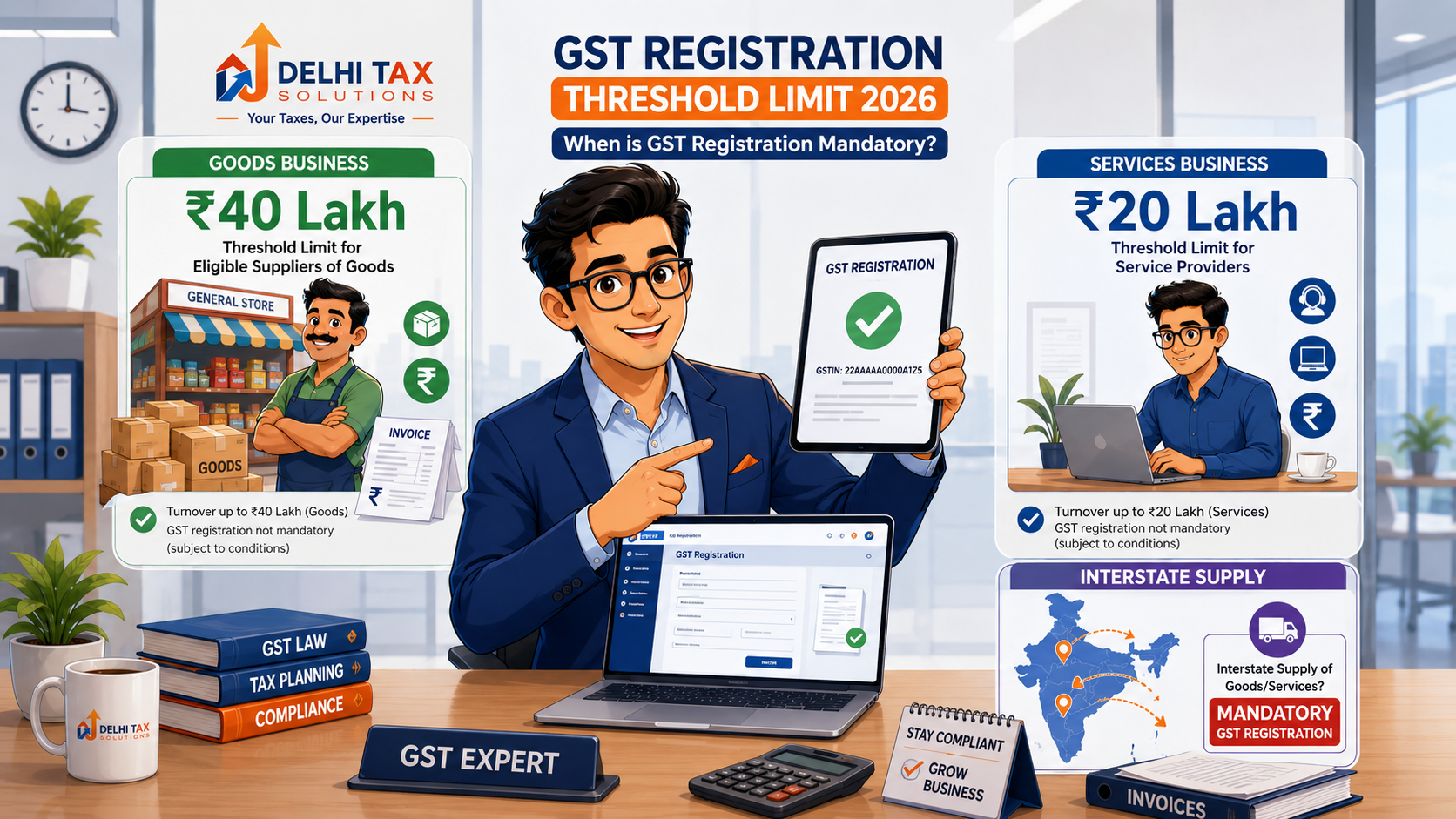
- The standard GST registration threshold limit 2026 is ₹40 lakh for exclusive suppliers of goods.
- Service providers and mixed-supply businesses face a lower turnover limit of ₹20 lakh.
- Interstate supplies mandate compulsory GST registration regardless of annual financial turnover.
- Aggregate turnover calculations include taxable, exempt, and export supplies across India.
- Professional CA guidance ensures seamless portal registration and prevents departmental penalties.
Launching and scaling an enterprise in India requires strict adherence to indirect tax regulations. Over 1.4 million businesses evaluate their tax compliance obligations every fiscal year, making the GST registration threshold limit 2026 a vital benchmark for entrepreneurs and small business owners. When annual commercial revenues approach statutory boundaries, understanding when registration becomes compulsory is essential to avoid severe financial penalties.
Navigating complex indirect tax frameworks without professional guidance frequently results in operational delays or registration missteps. Whether you operate a retail storefront, a digital agency, or a growing manufacturing unit, knowing your exact turnover parameters protects your business standing. The Goods and Services Tax Act establishes rigid monetary limits that dictate when commercial entities must formally integrate with the digital tax network.
What is the GST Registration Threshold Limit 2026 and How Does It Work?
The GST registration threshold limit 2026 refers to the statutory annual turnover cap established by the GST Council under Section 22 of the CGST Act, beyond which commercial entities and service providers must obtain a Goods and Services Tax Identification Number (GSTIN). Specifically, businesses dealing exclusively in goods enjoy a higher exemption limit of ₹40 lakh in eligible states, whereas service providers and mixed-supply operators must register once their aggregate turnover crosses ₹20 lakh. This threshold system ensures that micro-enterprises remain exempt from routine compliance while larger commercial operations contribute transparently to the indirect tax pool.
Analyzing the GST Turnover Limit Goods Services Thresholds
Comprehending the GST turnover limit goods services distinction is critical for accurate compliance planning. For traders, wholesalers, and manufacturers dealing exclusively in physical goods, the exemption threshold is set at ₹40 lakh across most regular states. However, this enhanced limit applies only if the business does not engage in interstate supplies, ice cream manufacturing, pan masala production, or tobacco trading.
For service providers, consultants, and software developers, the statutory threshold remains capped at ₹20 lakh. According to official compliance briefings published by the GST Portal, crossing this monetary limit triggers a mandatory 30-day window to complete digital onboarding. Failing to apply within this timeframe invites statutory late fees and penalty assessments.
Business owners must monitor their monthly invoicing patterns closely to anticipate when they will cross these revenue milestones. Integrating financial management systems with professional GST Registration services helps growing enterprises transition smoothly into the formal tax architecture.
Understanding When GST Registration Mandatory Limit Rules Apply
While revenue thresholds provide relief for smaller operators, certain commercial activities override these limits entirely. Under Section 24 of the CGST Act, adherence to the GST registration mandatory limit is compulsory regardless of turnover if an enterprise engages in specific transactions. For instance, making any interstate taxable supply of goods instantly requires formal registration before dispatching shipments.
Furthermore, casual taxable persons, non-resident taxable persons, e-commerce operators, and businesses supplying goods through digital aggregators must register from their very first rupee of revenue. According to statistical updates issued by the Press Information Bureau, digital onboarding channels have accelerated application processing times significantly across India.
Startup founders and small business owners must ensure their corporate structuring aligns with these rigorous requirements. Securing professional assistance during early Company Registration prevents unexpected regulatory hurdles.
Calculating Aggregate Turnover GST and Qualifying Receipts
Calculating aggregate turnover GST correctly is essential to avoid underreporting revenue. Aggregate turnover is defined as the total value of all taxable supplies, exempt supplies, exports of goods or services, and interstate supplies made by a taxable person having the same Permanent Account Number (PAN), computed across all business verticals pan-India.
Importantly, aggregate turnover excludes central tax, state tax, union territory tax, integrated tax, and cess components. Economic stability relies on strict monetary compliance monitored by regulatory bodies like the Reserve Bank of India. Financial records must reconcile perfectly with banking statements to withstand automated portal audits.
Turnover Thresholds and Registration Rules at a Glance
Reviewing the structured parameters below clarifies the distinct financial thresholds governing GST registration mandates across various commercial sectors.
| Supply Category | Normal States Limit | Special Category States Limit |
|---|---|---|
| Exclusive Supply of Goods | ₹40 Lakh | ₹10 Lakh or ₹20 Lakh |
| Supply of Services | ₹20 Lakh | ₹10 Lakh |
| Interstate Supply | Mandatory (0 Lakh) | Mandatory (0 Lakh) |
⚡ In a Nutshell
If your annual turnover exceeds ₹40 lakh for goods or ₹20 lakh for services, GST registration is compulsory. Remember that interstate sales trigger mandatory registration from rupee one, regardless of your total revenue.
Navigating Special Category States and Unique State Thresholds
While mainland businesses benefit from higher revenue caps, operating in special category states alters compliance obligations significantly. States such as Arunachal Pradesh, Manipur, Meghalaya, Mizoram, Nagaland, Sikkim, Tripura, and Uttarakhand enforce lower turnover thresholds—typically ₹10 lakh or ₹20 lakh depending on whether the entity supplies goods or services. Business owners with multi-state operations must track state-specific rules meticulously.
Taxpayers must also consider how direct tax filings interact with indirect tax disclosures. Reconciling your financial statements with official guidelines from the Income Tax Department ensures absolute consistency across all government portals.
For growing enterprises managing complex tax structures across jurisdictions, reviewing broader tax reforms through Direct Tax Code Updates provides valuable strategic foresight. Maintaining transparent accounts protects your enterprise from multi-state scrutiny.
Ensuring Compliance Through Professional Tax Advisory Services
Navigating intricate GST threshold rules, aggregate turnover calculations, and compulsory registration mandates requires deep technical expertise. Partnering with seasoned Chartered Accountants eliminates administrative guesswork, ensures precise digital filing on the GST portal, and protects your business from punitive non-compliance fines. Expert advisors analyze your revenue streams to optimize input tax credits and tax liabilities.
Professional oversight guarantees complete operational transparency and peace of mind. Let our experienced advisory team handle your regulatory filings so you can focus entirely on expanding your core business operations.
Conclusion
Mastering the GST registration threshold limit 2026 rules is essential for every growing business and service provider in India. Remember that goods suppliers enjoy a ₹40 lakh limit, service providers operate under a ₹20 lakh cap, and interstate supplies trigger mandatory registration immediately. Do not let complex indirect tax compliance compromise your commercial growth. Talk to a Delhi Tax Solutions expert to get your GST registration filed accurately and promptly by our professional CA team. Proactive compliance secures your business future.
About this article: Researched using official government sources and Delhi Tax Solutions’ in-house tax advisory team. Last updated August 2026. This article is for general informational purposes and is not a substitute for personalised professional tax advice.
Frequently Asked Questions (FAQs)
+ Q: What is the GST registration threshold limit for goods versus services in 2026?
A: The GST registration threshold limit for businesses dealing exclusively in the supply of goods is ₹40 lakh in most regular states, provided they do not engage in interstate trade or restricted categories like tobacco and ice cream. Conversely, service providers and mixed-supply businesses operate under a lower statutory turnover limit of ₹20 lakh, requiring mandatory GST registration once gross receipts exceed this financial cap.
+ Q: Is GST registration mandatory if my annual turnover is below the threshold?
A: Generally, businesses with annual turnover below the ₹40 lakh or ₹20 lakh thresholds are not required to register for GST. However, registration becomes compulsory regardless of turnover if your enterprise engages in interstate supply of goods, supplies goods through electronic commerce operators, acts as a casual taxable person, or is required to pay tax under reverse charge mechanisms as specified under Section 24 of the CGST Act.
+ Q: What constitutes aggregate turnover under GST regulations?
A: Aggregate turnover under GST regulations is calculated as the total value of all taxable supplies, exempt supplies, export of goods or services, and interstate supplies made by a taxable person operating under the same Permanent Account Number (PAN) across India. This computation aggregates all business verticals nationwide while explicitly excluding central tax, state tax, union territory tax, integrated tax, and cess components.
+ Q: Do special category states have different GST registration limits?
A: Yes, special category states enforce modified turnover thresholds compared to regular mainland states. States such as Arunachal Pradesh, Manipur, Meghalaya, Mizoram, Nagaland, Sikkim, Tripura, and Uttarakhand maintain lower statutory limits—typically ₹10 lakh or ₹20 lakh—to address regional economic conditions. Business owners operating across multiple states must evaluate each state’s specific threshold before making compliance decisions.
+ Q: What are the consequences of failing to register for GST when crossing the threshold?
A: Failing to obtain GST registration within 30 days of crossing the applicable turnover threshold invites strict penalties under Section 122 of the CGST Act. The offender is liable to pay a penalty equal to 10% of the tax due or ₹10,000, whichever is higher, alongside the recovery of evaded taxes with applicable interest. Furthermore, unregistered entities cannot legally collect tax from customers or claim input tax credits on business purchases.