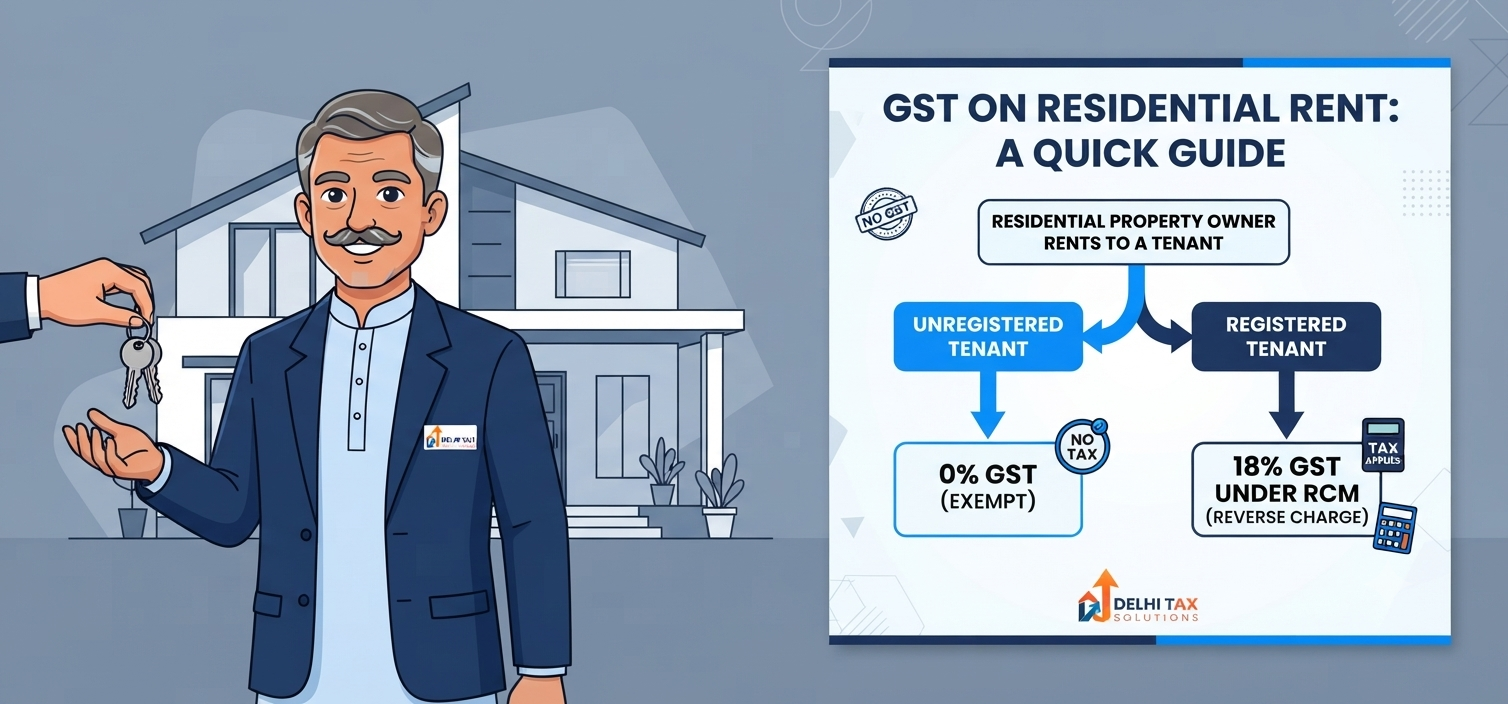
💡 Key Takeaways: GST on Renting of Residential Property
- RCM for Registered Tenants: Effective July 18, 2022 (Notification 05/2022-Central Tax Rate), if a GST-registered person/entity rents a residential dwelling, 18% GST applies under the Reverse Charge Mechanism (RCM).
- Exemption for Unregistered Individuals: Renting a residential house to an unregistered individual for personal residence remains 100% GST-exempt.
- Proprietary Concern Exemption: If a sole proprietor rents a residential property in their personal capacity for personal residence, it is exempt from GST, even if they hold an active GST registration.
- Blocked ITC under Section 17(5): GST paid under RCM on residential rent used for personal residence or employee housing cannot be claimed as Input Tax Credit (ITC) under Section 17(5)(g).
- Payment Mode: RCM liability must be deposited strictly via the Electronic Cash Ledger and cannot be adjusted using existing Electronic Credit Ledger balances.
Historically, renting residential dwellings for use as a residence was entirely exempt from Goods and Services Tax (GST) under Entry 13 of Notification No. 12/2017-Central Tax (Rate). However, to close tax loopholes where commercial entities rented residential properties to reduce operational overheads without tax oversight, the GST Council introduced major amendments.
With the issuance of Notification No. 04/2022 & Notification No. 05/2022-Central Tax (Rate), the tax landscape shifted significantly. Today, taxability depends not just on the nature of the property, but primarily on the GST registration status of the tenant and the intended purpose of use.
Evolution of the Tax Law: Pre-July 2022 vs. Present Framework
Understanding the distinction between historical exemptions and the current legal regime is essential for corporate tenants, landlords, and sole proprietors alike:
- Pre-July 18, 2022 Regime: Renting any “residential dwelling for use as a residence” was unconditionally exempt from GST, irrespective of whether the landlord or tenant was registered.
- Post-July 18, 2022 Regime: Exemption was withdrawn specifically when the service of renting a residential dwelling is provided to a GST-registered person. In such cases, the liability to pay 18% GST was shifted to the registered tenant under Reverse Charge (RCM).
- Post-December 30, 2022 Clarification: Notification No. 15/2022 created a specific carve-out protecting sole proprietors renting homes for personal residence.
Taxability Matrix: Landlord vs. Tenant Scenarios
The following table outlines the GST tax liability, rate, and mechanism across various combinations of landlord and tenant profiles:
| Landlord Status | Tenant Status | Property Purpose | GST Rate & Mechanism |
|---|---|---|---|
| Unregistered / Registered | Unregistered Individual | Personal Residence | NIL (Exempt) |
| Unregistered / Registered | GST-Registered Company / Firm | Employee Housing / Guest House | 18% RCM (Tenant pays GST) |
| Unregistered / Registered | GST-Registered Sole Proprietor | Personal Residence (Personal Account) | NIL (Exempt) |
| Unregistered / Registered | GST-Registered Person / Entity | Commercial / Office Use | 18% RCM / Forward Charge |
Reverse Charge Mechanism (RCM) Mechanics for Tenants
When a GST-registered business (such as a Private Limited Company, Partnership Firm, or LLP) leases a residential flat or house—whether for operating a branch office, accommodating directors, or housing employees—it triggers RCM under Section 9(3) of the CGST Act.
Key Compliance Steps for RCM on Rent:
- Self-Invoicing: Under Section 31(3)(f), because the landlord is typically unregistered, the registered tenant must issue a self-invoice for the rental value incurred during the tax period.
- Cash Payment: The 18% GST liability under RCM must be remitted strictly by depositing cash into the Electronic Cash Ledger. It cannot be discharged using accumulated ITC balances.
- Reporting in GSTR-3B: Declare the taxable rental value and corresponding RCM tax under Table 3.1(d) (Inward supplies liable to reverse charge) of Form GSTR-3B.
Input Tax Credit (ITC) Rules on Residential Rent
A critical point of concern for corporate taxpayers is whether the 18% GST paid under RCM on residential rent can be claimed back as Input Tax Credit (ITC).
1. Blocked ITC under Section 17(5)(g)
Under Section 17(5)(g) of the CGST Act, ITC is explicitly blocked on goods or services used for personal consumption. If a registered company pays residential rent for a property utilized as a residence for directors or staff, the tax authorities view this as personal consumption or employee fringe benefit. Consequently, ITC is strictly blocked, and the 18% RCM paid becomes a direct operational expense.
2. Allowed ITC for Commercial Use
If a registered business rents a residential dwelling strictly to use as an official commercial business office (where local municipal laws permit commercial operations in residential zones), the ITC may be claimed, provided direct nexus with outward taxable business supplies can be demonstrated.
For more details on navigating blocked credits and eligibility criteria, review our exhaustive analysis on Input Tax Credit Rules under Section 17(5).
The Proprietary Concern Exemption (Notification 15/2022)
Initial confusion arose in mid-2022 when sole proprietors holding GST registrations for their businesses found themselves technically liable for RCM on their personal residential home rents. To rectify this unintended burden, the Ministry of Finance issued Notification No. 15/2022-Central Tax (Rate).
Under this amendment, no GST or RCM applies if:
- The tenant is a sole proprietor registered under GST.
- The residential dwelling is rented in their personal capacity for their own personal residence.
- The rental expenses are not accounted for as business expenditure in the books of the proprietary concern.
To ensure full compliance across both commercial and personal property transactions, taxpayers can review additional guidelines on the official GST Portal or consult notifications on the CBIC Portal.
Confused About RCM Applicability on Corporate Property Leases?
Failing to report RCM on residential rent in GSTR-3B can lead to statutory interest charges under Section 50 and heavy penalties. Ensure your corporate lease agreements and self-invoices are tax-compliant.
The expert tax team at Delhi Tax Solutions provides complete GST advisory, RCM audits, lease agreement reviews, and automated return filing services tailored for businesses.
Frequently Asked Questions (FAQs)
+ Q: Does a landlord need to register for GST if their rental income exceeds ₹20 Lakhs from residential property?
A: If the landlord only rents residential properties to unregistered individuals for residential purposes, the supply is exempt and does not attract GST liability. However, exempt rental income counts toward aggregate annual turnover for threshold calculations (₹20 Lakhs for services). If total turnover exceeds the threshold due to commercial rent or other services, registration is required, though residential rent remains exempt/RCM-driven.
+ Q: What is the GST rate on commercial property rent compared to residential rent?
A: Renting of commercial property (shops, offices, godowns) attracts 18% GST under Forward Charge if the landlord is GST-registered. If the landlord is unregistered and the tenant is registered, RCM on commercial rent applies under Section 9(3) w.e.f. October 2024 updates.
+ Q: Can a company pay RCM on residential rent using its Electronic Credit Ledger?
A: No. According to Section 49(4) of the CGST Act, input tax credit standing in the Electronic Credit Ledger can only be used toward paying output tax. RCM liabilities must be paid strictly via cash deposit through the Electronic Cash Ledger.
+ Q: What happens if a GST-registered employee rents a home in their personal name?
A: If an employee (who happens to hold a personal GST registration for freelance or side business work) signs a personal lease agreement for their personal residence, no GST/RCM applies under Notification 15/2022, provided the rent is not claimed as a business expense.
About this article: Based on the CGST Act, 2017, Notification No. 12/2017, Notification No. 05/2022-Central Tax (Rate), and Notification No. 15/2022-Central Tax (Rate). Updated for 2026.
Disclaimer: This article is strictly for educational purposes and should not be construed as official legal or professional tax advice. Please consult a qualified tax advisor or Chartered Accountant to assess your specific lease agreements.