
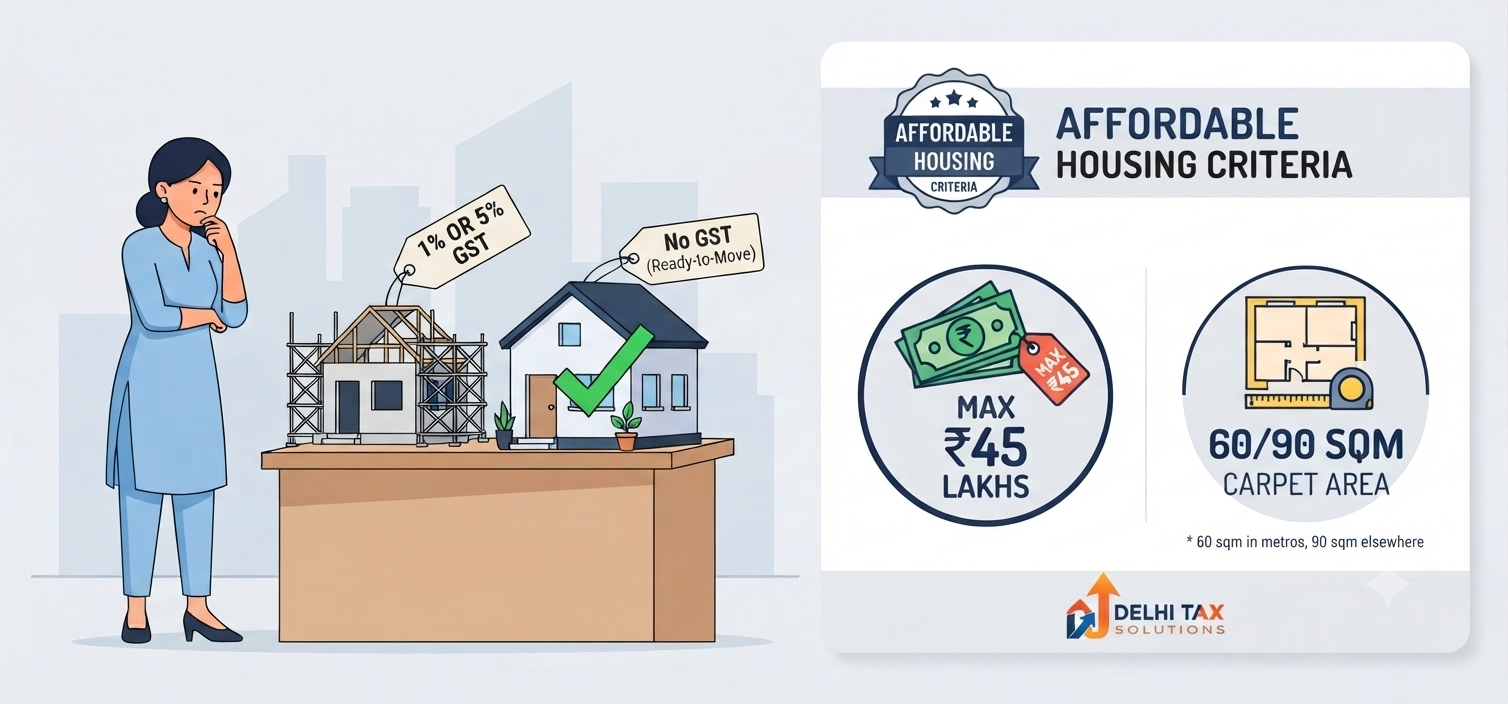
💡 Key Takeaways: GST on Real Estate
- Zero GST on Ready-to-Move: Properties that have received a Completion Certificate (CC) or have been occupied before the sale are outside the purview of GST.
- 1% for Affordable Housing: Under-construction properties qualifying as “affordable housing” are taxed at an effective rate of 1% without the benefit of Input Tax Credit (ITC).
- 5% for Non-Affordable Housing: Other residential under-construction properties attract a 5% GST rate without ITC.
- 80% Mandatory Procurement: Builders must procure at least 80% of their inputs and input services from registered suppliers to avail the concessional 1% or 5% rates.
- Commercial Real Estate: Commercial properties (shops, offices) within a residential real estate project (RREP) can also attract the 5% rate if the commercial carpet area is under 15% of the total project.
The taxation framework for the real estate sector in India underwent a massive overhaul to address buyer grievances regarding opaque tax structures and inflated property costs. Prior to April 2019, buyers were forced to navigate a complex system where developers charged higher GST rates (8% or 12%) while simultaneously claiming Input Tax Credit (ITC)—a benefit that was rarely passed on to the end consumer.
The revised GST framework completely eliminated ITC for developers in the residential segment in exchange for sharply reduced tax rates of 1% and 5%. For homebuyers, investors, and real estate developers, understanding this bifurcation is crucial for accurate cost estimation and legal compliance.
Under-Construction vs. Ready-to-Move Properties
The most fundamental rule of real estate GST revolves around the timeline of the property purchase and the issuance of the Completion Certificate (CC) by the competent local authority.
1. Ready-to-Move Properties (No GST)
According to Schedule III of the CGST Act, the sale of land and the sale of a building are classified as neither a supply of goods nor a supply of services. Consequently, if a buyer purchases a fully constructed property where the entire consideration is paid after the issuance of the Completion Certificate or after its first occupation (whichever is earlier), 0% GST is applicable. The buyer is only liable for local Stamp Duty and Registration charges.
2. Under-Construction Properties (GST Applicable)
If a buyer enters into an agreement with a builder and pays any part of the consideration before the property receives its Completion Certificate, the transaction is treated as a “Supply of Service” (Construction Service) under Schedule II of the CGST Act. Such transactions are strictly subject to GST.
The 1% and 5% Tax Slabs Explained
For under-construction residential properties, the GST Council established two distinct tax brackets based on the valuation and size of the property.
| Property Category | Effective GST Rate | Input Tax Credit (ITC) | Condition |
|---|---|---|---|
| Affordable Housing | 1% | Not Allowed | Must meet carpet area and value thresholds. |
| Non-Affordable Housing | 5% | Not Allowed | All other residential apartments. |
| Commercial Properties (Standalone) | 12% | Allowed | Offices, shops, godowns not part of an RREP. |
Note: The rates mentioned above are “effective” rates, which already factor in a one-third (33.33%) deduction towards the value of the undivided share of land transferred to the buyer.
Defining “Affordable Housing” for the 1% Rate
To qualify for the highly concessional 1% GST rate, the property must strictly fulfill two criteria simultaneously:
- Gross Value Limit: The total gross amount charged by the builder (including the value of land, parking, and common amenities) must not exceed ₹45 Lakhs.
- Carpet Area Limit (Metropolitan Cities): The carpet area must not exceed 60 square meters (approx. 645 sq. ft.). Metropolitan cities include Delhi NCR, Bengaluru, Chennai, Hyderabad, Mumbai, and Kolkata.
- Carpet Area Limit (Non-Metropolitan Cities): In all other cities and towns, the carpet area must not exceed 90 square meters (approx. 968 sq. ft.).
If a property costs ₹40 Lakhs but the carpet area in Delhi is 65 square meters, it breaches the metropolitan area threshold and will attract the 5% GST rate instead of 1%.
Strict Compliance Rules for Builders: The 80% Procurement Mandate
While the elimination of ITC simplified matters for buyers, it introduced strict compliance mechanisms for builders to prevent the generation of black money in the construction supply chain.
To offer properties at the 1% or 5% rate, the developer must ensure that at least 80% of the value of inputs and input services used in supplying the construction service are purchased from GST-registered suppliers. If there is a shortfall (e.g., the builder only procures 70% from registered vendors), the builder must pay GST on the remaining 10% under the Reverse Charge Mechanism (RCM) at a flat rate of 18%. Furthermore, if cement is purchased from an unregistered supplier, it attracts a penal 28% GST under RCM, regardless of the 80% threshold.
For more detailed technical insights regarding how developers handle legacy ITC from older projects, refer to our technical explainer on Input Tax Credit (ITC) Rules.
Joint Development Agreements (JDA) and TDR
Modern real estate heavily relies on Transfer of Development Rights (TDR) and Joint Development Agreements (JDA) between landowners and developers. Under the current regime, the supply of TDR or Floor Space Index (FSI) by a landowner to a developer for the construction of residential apartments is exempt from GST, provided the constructed apartments are sold before the completion certificate and the appropriate 1% or 5% GST is collected from the final buyers.
Taxpayers and developers looking for official gazette notifications regarding TDR exemptions can verify the documentation published by the Central Board of Indirect Taxes and Customs (CBIC) and policies aligned with the Ministry of Housing and Urban Affairs (MoHUA).
Structuring a Real Estate Project?
Real estate taxation involves complex calculations regarding the valuation of undivided land shares, Joint Development Agreements (JDAs), and managing reverse charge liabilities on construction materials.
Avoid severe penal demands and optimize your project’s tax outflow. Partner with the expert Chartered Accountants and legal professionals at Delhi Tax Solutions for comprehensive real estate GST structuring, RERA compliance, and audit defense.
Frequently Asked Questions (FAQs)
+ Q: Do I have to pay GST on buying a resale flat?
A: No. Resale flats fall under the category of ready-to-move properties that have already received their Completion Certificate (CC). Therefore, no GST is applicable on the purchase of a resale property. You only pay stamp duty and registration fees.
+ Q: Can a builder charge me 5% GST and also claim Input Tax Credit?
A: No. The 5% rate for standard residential properties and the 1% rate for affordable housing come with a strict condition that the builder cannot claim any Input Tax Credit (ITC). If a builder claims ITC while charging 5%, it is a violation of the law.
+ Q: Is GST calculated on the entire property value, including land?
A: The rates of 1% and 5% are effective rates. The government allows a standard deduction of one-third (33.33%) of the total agreement value towards the cost of the land. The effective 1% and 5% rates are applied to the total gross amount after this statutory assumption is factored into the law.
+ Q: Are stamp duty and registration charges included in the GST calculation?
A: No. Stamp duty, registration charges, and other statutory local body taxes are excluded from the taxable value for GST calculation. They are levied entirely separately by the state government.
About this article: Based on the CGST Act, 2017 and subsequent notifications governing real estate projects. Updated for 2026.
Disclaimer: This article is intended for educational and informational purposes only and does not constitute formal legal or tax advisory. Real estate taxation involves complex valuations; please consult a qualified Chartered Accountant before entering into property transactions.