
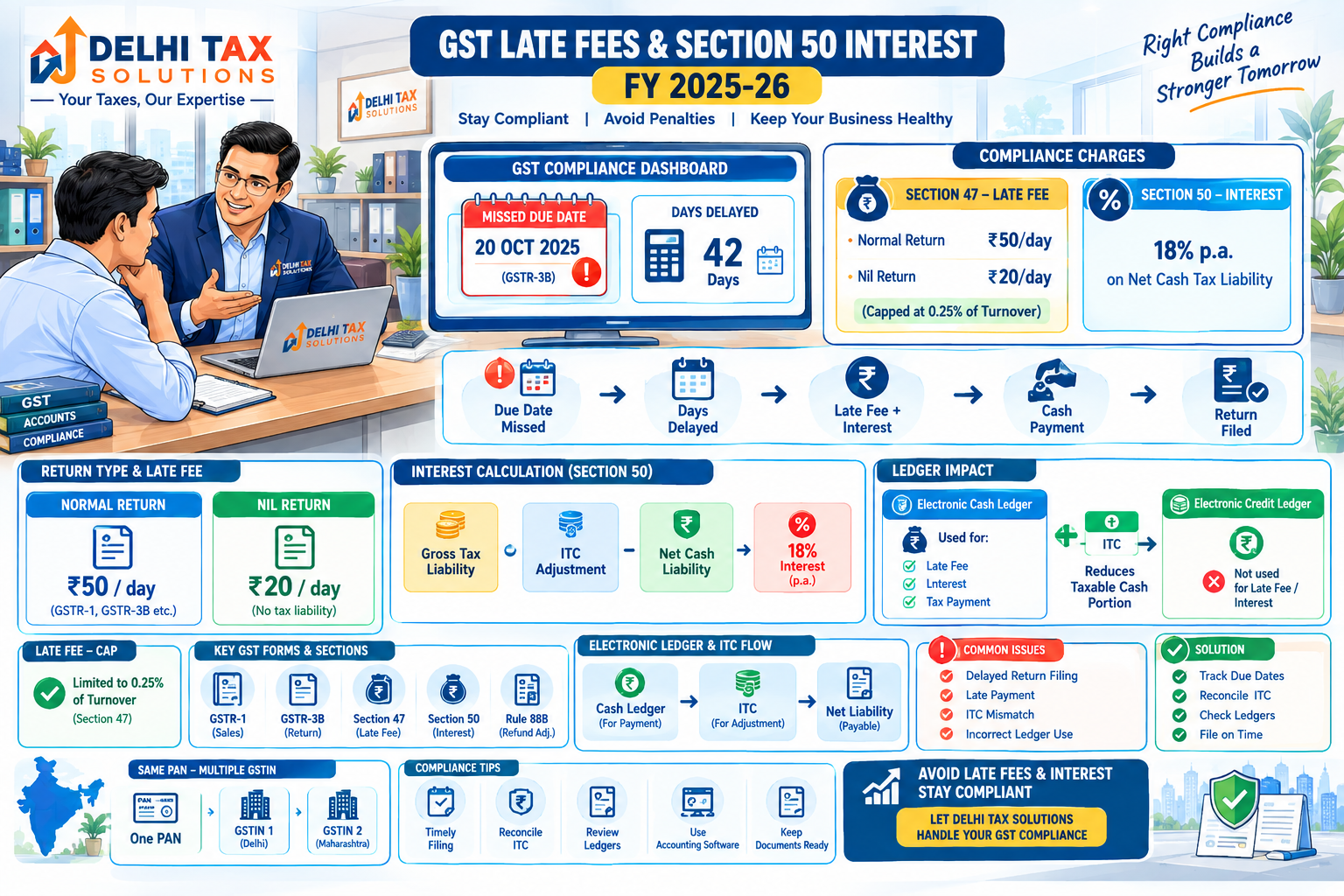
💡 Key Takeaways:
- Standard GST returns attract a daily late fee of ₹50 per day for delayed submissions.
- Nil returns enjoy a reduced late fee of ₹20 per day under current tax rules.
- Interest under Section 50 is charged at 18 percent per annum on net cash tax liability.
- Late fees are capped automatically by the portal based on total turnover thresholds.
- Timely monthly filings protect working capital from compounding statutory penalties.
Managing business cash flow becomes challenging when unexpected compliance penalties hit your balance sheet. Missing standard filing deadlines triggers automated late fees and compounding interest charges instantly. Small business owners often struggle to reconcile how daily charges accumulate on delayed submissions. Understanding statutory penalty structures helps prevent unnecessary cash outflows and protects your operating margins.
Our CA team regularly helps growing enterprises resolve compliance backlogs and minimize unexpected financial liabilities. This detailed guide breaks down every aspect of a gst late fee and how statutory calculations work for FY 2025-26. You will learn the exact daily penalty rates, interest formulas, and practical compliance steps.
Whether you manage accounts internally or work with external advisors, mastering these rules ensures complete financial predictability. Proper adherence keeps your business clear of automated departmental recovery notices.
What Is a GST Late Fee and How Is It Calculated?
A GST late fee is a statutory penalty levied under Section 47 of the Central Goods and Services Tax Act for failing to submit periodic returns by the prescribed due date. According to notifications issued by the GST Council, standard returns like GSTR-3B and GSTR-1 attract a penalty of ₹50 per day—split equally as ₹25 under CGST and ₹25 under SGST. For businesses filing Nil returns with zero tax liability, the reduced penalty is ₹20 per day—split as ₹10 CGST and ₹10 SGST. These charges accumulate automatically on the electronic portal until the pending return is successfully filed.
Understanding Section 50 Interest on Delayed Tax Payments
Beyond daily late fees, delayed tax remittances attract mandatory interest charges under section 50 interest provisions. When a taxpayer files a return late and possesses outstanding tax liabilities, interest accrues at 18 percent per annum. This charge compensates the exchequer for delayed revenue collection. Taxpayers must calculate and deposit this interest voluntarily through the cash ledger.
Calculating this interest requires multiplying your net cash tax liability by the exact number of delayed days, divided by 365 days, and applying the 18 percent rate. To streamline these financial operations, maintaining structured accounting records is essential. Startups scaling operations must establish robust tracking systems early. Proper record-keeping simplifies every monthly filing cycle. For foundational support on setting up compliant entities, explore our resources on starting a business in India.
Gross Versus Net Cash Liability Under Rule 88B
A critical statutory reform under Rule 88B clarified that interest under Section 50 applies exclusively to the net tax paid in cash through the electronic cash ledger, rather than the gross tax liability. If your tax liability is fully offset by valid Input Tax Credit (ITC) available in your electronic credit ledger, interest does not apply to that offset portion. However, any delay in depositing actual cash for remaining tax dues triggers the full 18 percent charge.
| Compliance Element | Section 47 Late Fee | Section 50 Interest |
|---|---|---|
| Nature of Penalty | Fixed daily monetary fine for delay | Compounding interest on unpaid tax |
| Statutory Rate / Amount | ₹50/day (Normal) or ₹20/day (Nil) | 18% per annum on delayed cash tax |
| Calculation Basis | Number of days past official due date | Net cash liability × days × 18% |
| Maximum Capping | Capped based on annual turnover slabs | No maximum cap; scales with delay duration |
Navigating these calculations requires absolute precision to avoid accumulating unexpected liabilities. For companies expanding across multiple states, ensuring accurate ledger balancing prevents severe audit discrepancies. Maintaining clean foundational registrations supports error-free monthly accounting. Securing proper company registration helps establish these structured financial controls from inception.
Capping Limits and Relief Measures for Late Fees
To prevent disproportionate financial burdens on small taxpayers, the government enforces maximum caps on cumulative late fees. As per notifications by the Central Board of Indirect Taxes and Customs (CBIC), maximum late fees for standard returns are capped based on aggregate turnover slabs. For businesses with lower annual turnovers, caps provide significant relief against runaway daily charges.
However, these caps apply solely to late fees under Section 47 and do not exempt taxpayers from Section 50 interest liabilities. Businesses must settle all accumulated fees before filing subsequent returns on the official GST Portal. Ensuring all auxiliary permits remain valid further stabilizes your compliance standing. Proper maintenance of business licenses prevents operational disruptions that indirectly cause filing delays.
Common Compliance Pitfalls and How to Avoid Them
Failing to monitor return deadlines remains the leading cause of unexpected financial drain for small businesses. Many entrepreneurs assume that filing Nil returns incurs zero consequences, forgetting that even minor delays accumulate ₹20 daily penalties. Another frequent error is attempting to offset late fees using electronic credit ledger balances, which is legally impermissible. Late fees and interest must always be discharged via the electronic cash ledger.
To eliminate these risks, establish automated calendar alerts 48 hours prior to statutory due dates. Regular internal audits ensure your monthly documentation matches ledger entries perfectly. Proactive management protects your operating capital and keeps your enterprise entirely secure. Ensuring routine filings are handled precisely streamlines your annual reporting. For ongoing operational reliability, utilizing professional GST return filing services is highly recommended.
What Our CA Team Sees in Practice: Preventing Compounding Penalties
Dealing with sudden portal blockages due to unpaid late fees disrupts daily business operations. Based on cases handled by our CA team, businesses often panic when automated notices demand heavy interest on delayed cash remittances. Tax authorities utilize advanced data analytics via the GSTN portal to flag delayed filings instantaneously. When balances remain unpaid, system restrictions prevent the generation of e-way bills and fresh return filings.
To insulate your business from these bottlenecks, our advisory team recommends maintaining a dedicated cash reserve for monthly tax obligations. According to Press Information Bureau releases and CBIC administrative guidelines, proactive compliance significantly reduces litigation exposure. If your enterprise requires specialized guidance with complex tax filings, partnering with seasoned professionals ensures absolute accuracy. Proper expert support keeps your operations secure and fully compliant.
Mastering annual tax compliance requires continuous attention to detail and rigorous deadline tracking. Understanding how daily late fees and interest charges accumulate protects your enterprise from unexpected cash outflows. Reconciling your financial ledgers against monthly return requirements safeguards your working capital. Managing these complex filings internally can stretch your resources thin. Talk to a Delhi Tax Solutions expert to get your compliance managed professionally within days. Take control of your financial security today.
About this article: Researched using official government sources, real-time competitor and search-trend analysis, and Delhi Tax Solutions’ in-house tax advisory team. Last updated September 2026.
Disclaimer: This article is for general informational purposes and is not a substitute for personalised professional tax advice.
Frequently Asked Questions (FAQs)
Q: What is the daily penalty amount for late filing of standard GST returns like GSTR-3B?
A: The standard daily penalty for late filing of regular returns such as GSTR-3B and GSTR-1 is ₹50 per day. This amount is split equally as ₹25 under the Central Goods and Services Tax Act and ₹25 under the State Goods and Services Tax Act. For Nil returns with zero tax liability, a reduced fee of ₹20 per day applies. These charges continue to accumulate automatically on the official portal until the pending return is successfully submitted.
Q: How is interest calculated under Section 50 of the CGST Act when tax payments are delayed?
A: Interest under Section 50 of the CGST Act is calculated at 18 percent per annum for the exact period of delay. The computation starts from the day immediately succeeding the official due date until the actual date of tax remittance. Taxpayers must compute this interest based on their net cash liability and deposit the exact amount voluntarily through their electronic cash ledger before filing the delayed return.
Q: Is interest charged on gross tax liability or net cash liability after adjusting Input Tax Credit?
A: Interest under Section 50 is charged strictly on the net tax liability paid in cash through the electronic cash ledger. It is not levied on the portion of tax liability that is successfully offset by valid Input Tax Credit available in your electronic credit ledger. This taxpayer-friendly provision, formalized under Rule 88B, ensures that interest applies only to actual cash delays rather than paper-offset amounts.
Q: What is the maximum late fee cap applicable for filing Nil GST returns on the portal?
A: For Nil GST returns where both outward and inward supplies are zero, late fees are capped at a maximum ceiling of ₹500 per return (₹250 CGST plus ₹250 SGST). This protective capping prevents minor administrative oversights from snowballing into unmanageable financial penalties for dormant or small-scale registrations. However, regular returns with active tax liabilities have higher turnover-linked caps governed by Section 47.
Q: Can the GST Council waive accumulated late fees during special compliance amnesty windows?
A: Yes, the GST Council periodically recommends special amnesty schemes that provide conditional waivers or reduced upper caps for accumulated late fees on retrospective pending returns. These one-time relief windows are formally notified by the government to help taxpayers clear historical compliance backlogs without facing crippling financial penalties. Businesses must complete their filings within the specified amnesty notification dates to claim these waivers.
