
💡 Key Takeaways: GST for Freelancers
- ₹20 Lakh Threshold: Freelancers do not need a GST registration until their aggregate annual turnover exceeds ₹20 Lakhs (₹10 Lakhs in Special Category States).
- Inter-State Services: Freelancers supplying services across state borders are also exempt from mandatory registration as long as their turnover is under ₹20 Lakhs.
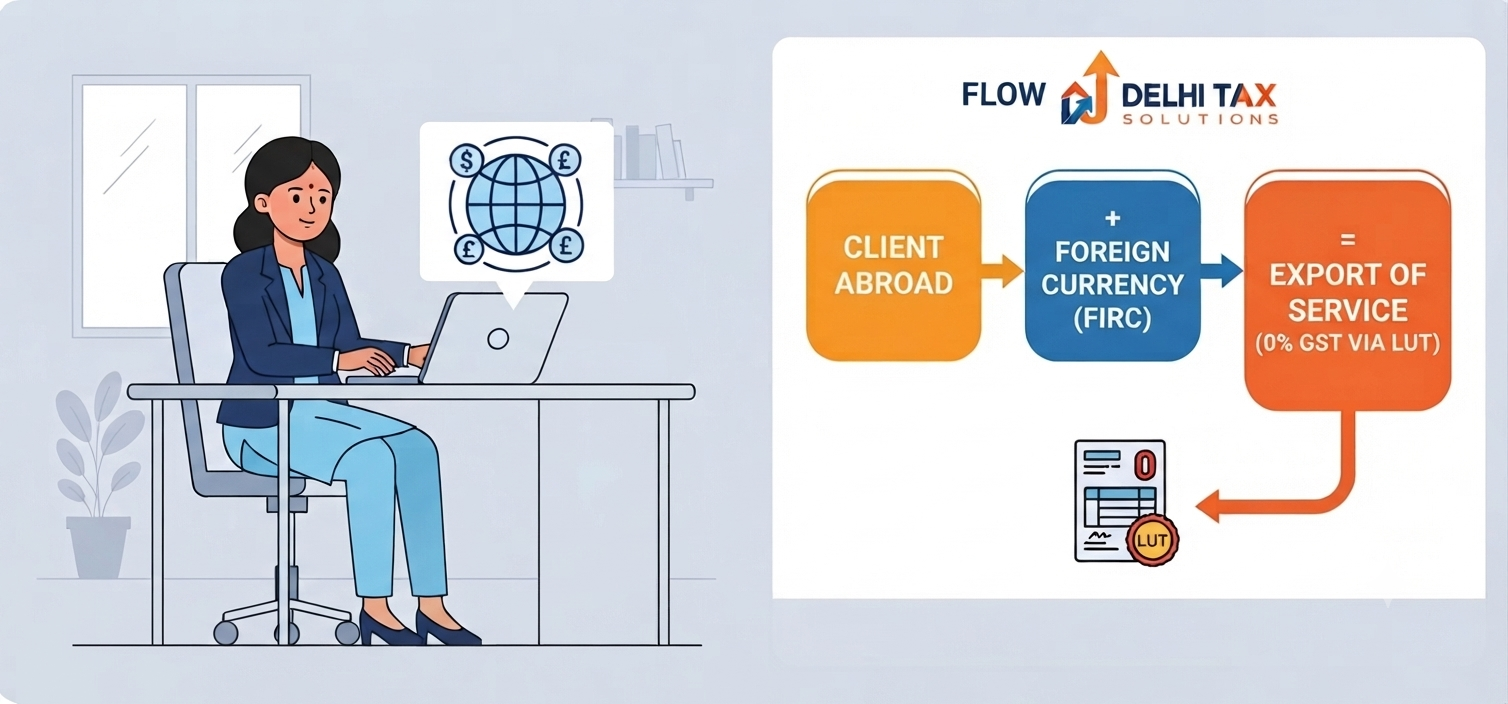
- Export of Services: Work done for clients outside India, paid in convertible foreign exchange, qualifies as a “Zero-Rated Supply.”
- Letter of Undertaking (LUT): Freelancers can export their services without charging 18% IGST by filing an annual LUT (Form GST RFD-11).
- Foreign Remittance Proof: Receiving funds via legitimate banking channels (FIRC or FIRA) is mandatory to classify the transaction as an export.
The gig economy has transformed how professionals offer their skills. Software developers, graphic designers, digital marketers, and management consultants are increasingly working with clients globally through platforms like Upwork, Fiverr, or via direct contracts. However, when it comes to taxation, independent professional work is legally classified as the “Supply of Services” under the Central Goods and Services Tax (CGST) Act, 2017.
While standard IT or professional services attract an 18% GST rate, the rules change significantly based on your annual turnover and the geographical location of your clients. This comprehensive guide breaks down exactly when you need to register, how to legally invoice foreign clients without charging tax, and the essential compliance requirements for independent freelancers.
The ₹20 Lakh Registration Threshold
A common misconception is that earning even a single rupee as a freelancer requires immediate GST registration. The GST framework provides a basic exemption limit to protect small-scale independent professionals.
- Standard States: You are only required to register for GST if your aggregate turnover in a financial year exceeds ₹20 Lakhs.
- Special Category States: For states like Manipur, Mizoram, Nagaland, and Tripura, this threshold is reduced to ₹10 Lakhs.
Crucially, the government has exempted service providers from mandatory registration for inter-state supplies. This means if you are sitting in Delhi and providing services to a client in Mumbai, you still do not need GST registration until your total revenue crosses ₹20 Lakhs. Note that aggregate turnover includes all your business receipts, whether taxable, exempt, or export income.
Freelancing for Foreign Clients: Export of Services
The most lucrative aspect of modern freelancing is earning in foreign currency. Under GST law, if you sit in India and provide services to a client located in the USA, UK, or Dubai, the transaction is treated as an Export of Service.
Export of services is classified as a “Zero-Rated Supply” under Section 16 of the IGST Act. This means the GST rate applicable is technically 0%. However, to legally qualify as an export, your transaction must strictly meet five specific conditions outlined in Section 2(6) of the IGST Act:
- The supplier of service (freelancer) is located in India.
- The recipient of service (client) is located outside India.
- The Place of Supply of the service is outside India.
- The payment for such service has been received in convertible foreign exchange (or Indian Rupees wherever permitted by RBI).
- The supplier and recipient are not merely establishments of a distinct person.
Upwork, Fiverr, and the Importance of FIRC
When you use platforms like Upwork or receive direct wire transfers via PayPal or Wise, you are satisfying the condition of receiving convertible foreign exchange. However, tax authorities require documentary proof.
To prove that your income is indeed foreign remittance, you must maintain a Foreign Inward Remittance Certificate (FIRC) or a Foreign Inward Remittance Advice (FIRA) issued by your authorized dealer bank. Without this document, GST officers may treat your foreign income as domestic income and raise an 18% tax demand during scrutiny. If you are unsure about proper documentation, you can refer to our general GST Registration Process guide to understand compliance requirements from day one.
How to Export Services Without Paying GST (LUT Filing)
Once you cross the ₹20 Lakh threshold and obtain a GST number, you have two legal methods to export your services:
Method 1: Export with Payment of IGST (Refund Route)
You charge 18% IGST on your invoice, pay it out of your own pocket to the government, and later claim a refund. This severely impacts cash flow and is generally avoided by freelancers.
Method 2: Export Under Letter of Undertaking (LUT)
This is the preferred route. By filing a Letter of Undertaking (LUT) in Form GST RFD-11 on the GST portal before the start of the financial year, you legally commit to the government that you are exporting services. This allows you to generate invoices without charging any IGST to your foreign clients.
Invoicing Rules for Freelancers
When generating an invoice for a foreign client under LUT, your invoice must contain specific statutory declarations. Ensure your invoice includes:
- Your GSTIN.
- The Client’s Name and International Address.
- The exact phrase: “Supply meant for export under Bond or Letter of Undertaking without payment of integrated tax.”
- Currency details (e.g., USD, EUR) alongside the INR equivalent on the date of invoicing.
For official rules on invoice formats and LUT procedures, you should refer directly to the Central Board of Indirect Taxes and Customs (CBIC) or log into the official GST Portal to file your RFD-11.
Need Help Managing Your Freelance GST Compliance?
Scaling your freelance business internationally brings complex tax requirements, from securing FIRC documentation to filing accurate zero-rated GST returns (GSTR-1 and GSTR-3B).
Focus on your clients while we handle the tax compliance. Get expert guidance on LUT filings, GST registration, and foreign remittance documentation from the Chartered Accountants at Delhi Tax Solutions.
Frequently Asked Questions (FAQs)
+ Q: Do I need GST registration if my freelance income is ₹15 Lakhs?
A: No. If you are located in a standard state and your aggregate turnover (from both domestic and international clients) is under ₹20 Lakhs in a financial year, you do not require mandatory GST registration.
+ Q: What is LUT and why is it important for Upwork freelancers?
A: A Letter of Undertaking (LUT) allows registered freelancers to export services without paying 18% IGST upfront. If you work on Upwork and cross the ₹20 Lakh limit, you must file an LUT annually to legally invoice your foreign clients without charging tax.
+ Q: Can I claim Input Tax Credit (ITC) if I only export services?
A: Yes. Because export of services is a “zero-rated supply,” you are legally entitled to claim ITC on business expenses (like laptops, software subscriptions, or internet bills) and file for a cash refund of the accumulated ITC.
+ Q: What happens if I receive payment from a foreign client in Indian Rupees (INR)?
A: Generally, export payments must be in convertible foreign exchange. However, if the payment is received in INR through a recognized mechanism explicitly permitted by the Reserve Bank of India (RBI), it still qualifies as an export of service.
About this article: Based on Section 16 of the IGST Act, Section 22 of the CGST Act, and LUT guidelines. Updated for 2026.
Disclaimer: This article is intended for educational and informational purposes only and does not constitute formal legal or tax advisory. Freelancers are advised to consult a Chartered Accountant for accurate tax planning.