💡 Key Takeaways: GST for Restaurants & Cloud Kitchens
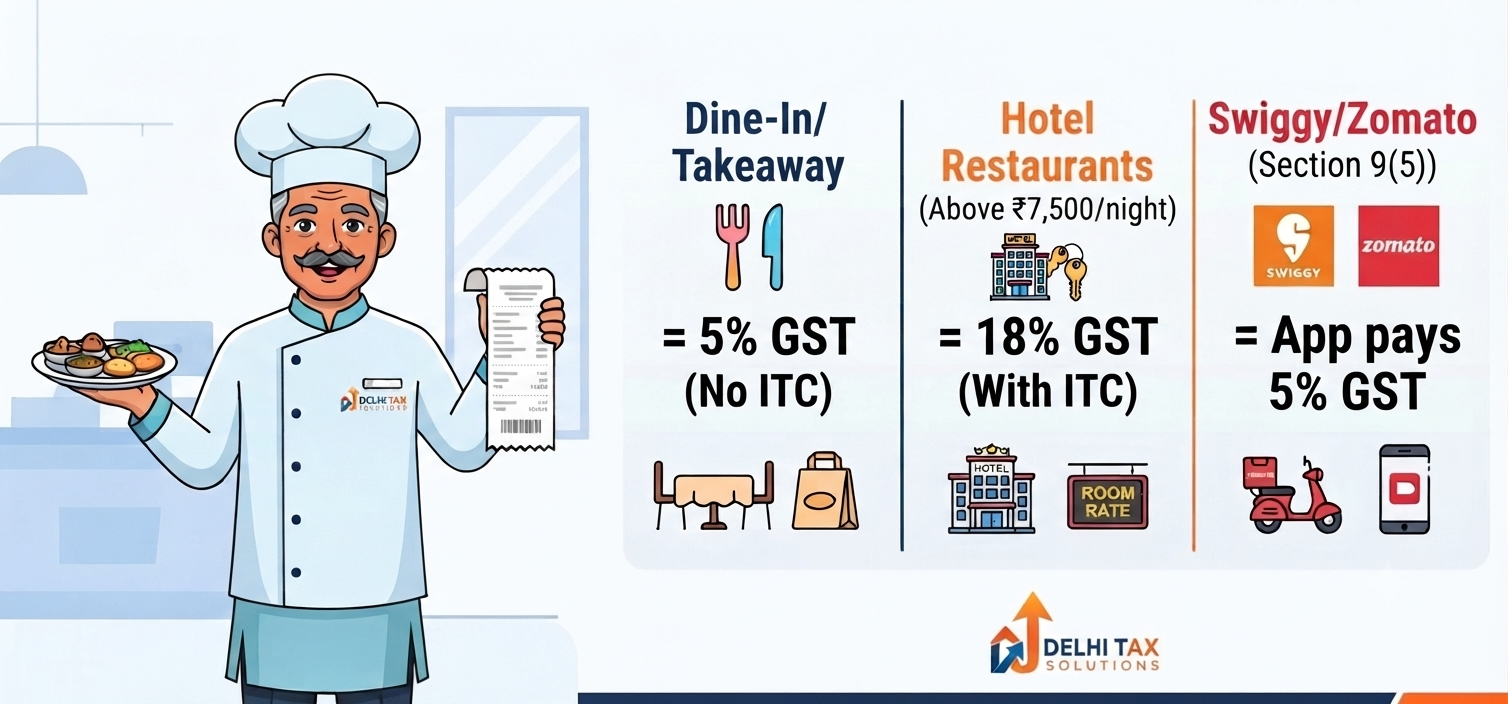
- Mandatory 5% GST (No ITC): Most standalone restaurants, cafes, and cloud kitchens must charge exactly 5% GST on food and beverages. However, they are entirely barred from claiming Input Tax Credit (ITC) on raw materials, rent, or capital goods.
- Food Delivery (Section 9(5)): Since January 1, 2022, E-Commerce Operators (Swiggy, Zomato) are responsible for paying the 5% GST on food delivered through their apps. Restaurants do not charge GST to the customer for these orders.
- 18% GST (With ITC): Restaurants operating within hotels/premises where the declared room tariff is over ₹7,500 per night charge 18% GST and are eligible to claim full ITC.
- Outdoor Catering: Standard outdoor catering services are taxed at 5% without ITC.
- Composition Scheme Option: Restaurants with annual turnovers up to ₹1.5 Crores can opt for the Composition Scheme, paying a flat 5% (2.5% CGST + 2.5% SGST) out of pocket, without charging GST to customers.
The Food & Beverage (F&B) industry in India is dynamic, evolving rapidly with the surge of cloud kitchens and food delivery aggregators. From a tax perspective, the Goods and Services Tax (GST) Council has engineered a specific framework for restaurants aimed at simplifying customer billing while minimizing tax evasion.
Whether you run a traditional dine-in establishment, an A/C or Non-A/C cafe, or a purely digital cloud kitchen, understanding the 5% scheme without Input Tax Credit (ITC) and the Section 9(5) delivery aggregator rules is vital for compliance and pricing strategy.
The Standard Restaurant Tax Rate: 5% Without ITC
To reduce the end-cost to consumers dining out, the GST Council made a sweeping decision to decouple GST rates from air-conditioning status and liquor licenses. The prevailing rule for the vast majority of restaurants is straightforward but comes with a major caveat regarding operational expenses.
The Rule
All standalone restaurants, cafes, cloud kitchens, and takeaway counters must charge 5% GST (2.5% CGST + 2.5% SGST) on food and beverages served.
The Blocked Input Tax Credit (ITC)
In exchange for the lower 5% output tax rate, the government explicitly blocked Input Tax Credit (ITC). This means restaurants cannot offset their output tax liability using the GST paid on inward supplies. You cannot claim ITC on:
- Commercial rent for the kitchen/restaurant premises (18% GST).
- Capital goods like commercial ovens, freezers, and furniture (18%-28% GST).
- Raw materials and processed ingredients.
- Professional services and advertising expenses.
Because ITC is blocked, the GST paid on these expenses must be absorbed as a direct operational cost and factored into the menu pricing.
Exceptions: When Does 18% GST Apply?
The 5% without ITC rule is nearly universal, but there are specific exceptions where restaurants must charge 18% GST with the benefit of full Input Tax Credit:
- High-Tariff Hotels: Restaurants situated within a hotel, inn, or club where the declared room tariff for any unit exceeds ₹7,500 per night.
- Select Catering: Outdoor catering services provided to a high-tariff hotel (above ₹7,500) or provided within such premises.
Swiggy, Zomato & Cloud Kitchens: Section 9(5) Rules
On January 1, 2022, a monumental shift occurred for cloud kitchens and restaurants relying on food aggregators like Swiggy and Zomato. Under Section 9(5) of the CGST Act, the tax liability for “restaurant services” supplied through an E-Commerce Operator (ECO) was shifted from the restaurant to the ECO.
How Section 9(5) Works:
- Aggregator Pays the Tax: Zomato and Swiggy are treated as the “supplier” of the food for GST purposes. They collect the 5% GST from the customer and remit it directly to the government.
- Restaurant Invoicing: The restaurant does not charge 5% GST on the food bill sent via the aggregator. The sale is treated as a supply made through an ECO.
- Informing GSTR-3B: In the restaurant’s GSTR-3B, food sold through Swiggy/Zomato must be declared under Table 3.1.1(ii) (Supplies made through ECO liable to pay tax u/s 9(5)). It is not taxed in the restaurant’s hands.
| Delivery / Service Type | Who Charges GST on Food? | Who Pays the Gov? |
|---|---|---|
| Dine-In / Direct Takeaway | Restaurant (5%) | Restaurant |
| Direct Delivery (Self-Fleet) | Restaurant (5%) | Restaurant |
| Via Swiggy / Zomato | Aggregator (5%) | Aggregator (under Sec 9(5)) |
Important Note on Pre-Packaged Items: If an aggregator delivers a pre-packaged FMCG item (like a bottled Coke or packed chips) where no “restaurant service” is involved, Section 9(5) does not apply. The restaurant remains liable to pay standard GST on those items. Furthermore, Swiggy/Zomato will charge 18% GST to the restaurant for delivery and platform commission fees. Since ITC is blocked for restaurants under the 5% scheme, this 18% GST is a sunk cost for the restaurant.
The Restaurant Composition Scheme
Small cafes, food stalls, and independent cloud kitchens with an annual turnover up to ₹1.5 Crores (₹75 Lakhs for special category states) can opt for the GST Composition Scheme.
Under this scheme, the restaurant pays a flat 5% tax (2.5% CGST + 2.5% SGST) out of their total turnover directly from their pocket. They cannot issue tax invoices, cannot charge GST to the customer, and cannot claim ITC. Compliance is simpler, requiring only a quarterly return (CMP-08) and an annual return (GSTR-4).
Crucial Restriction: Restaurants that supply food through E-Commerce Operators (Zomato/Swiggy) are currently barred from opting into the Composition Scheme under Section 10 of the CGST Act. If you want to list on aggregators, you must hold a regular GST registration.
Compliance & GSTR-1 / 3B Filing
Filing returns for a restaurant requires careful segregation of sales channels to avoid double taxation:
- B2C Sales (Dine-in): Reported normally in GSTR-1 and GSTR-3B with 5% liability.
- Aggregator Sales: Must be segregated and reported specifically in Table 3.1.1 of GSTR-3B to ensure the GST portal does not calculate tax on sales that Swiggy/Zomato have already paid for under Section 9(5).
Review standard return filing procedures in our comprehensive GSTR-1 & GSTR-3B Filing Guide.
Streamline Your Restaurant & Cloud Kitchen Tax Compliance
Reconciling Swiggy/Zomato payouts, segregating Section 9(5) sales in GSTR-3B, and managing blocked ITC expenses can be chaotic in a fast-paced kitchen environment.
The F&B tax experts at Delhi Tax Solutions handle POS integrations, multi-channel sales reconciliation, and precise GST filings for cafes and cloud kitchens across India.
Frequently Asked Questions (FAQs)
+ Q: Do I charge GST on food delivery charges if my restaurant delivers the food using our own staff?
A: Yes. If the restaurant charges a separate delivery fee on the bill, it is considered a composite supply where the principal supply is food. Therefore, the delivery charge will attract the same GST rate as the food (typically 5%).
+ Q: Is a bakery subject to 5% GST without ITC like a restaurant?
A: It depends on the setup. If the bakery has a dine-in/eating facility and provides “restaurant services,” it charges 5% GST without ITC. If it only sells packaged baked goods over the counter (manufacturing/trading), normal GST rates (e.g., 5%, 12%, 18%) apply to individual items, and full ITC can be claimed.
+ Q: Can a restaurant under the 5% scheme claim ITC on Swiggy’s 18% commission fee?
A: No. Since the 5% scheme expressly mandates “without ITC,” the 18% GST charged by Swiggy/Zomato on their platform and delivery commission invoices cannot be claimed as input credit and must be treated as a business expense.
+ Q: Is an unregistered restaurant liable for GST if they sell through Zomato?
A: No. Even though Zomato pays the 5% tax under Section 9(5), E-commerce operators typically mandate that all restaurants onboarded onto their platform possess a valid GSTIN to process payouts and maintain compliance with marketplace regulations.
About this article: Based on Notification No. 11/2017-Central Tax (Rate), Section 9(5) of the CGST Act, and Notification No. 17/2021-Central Tax (Rate). Updated for 2026.
Disclaimer: This article is strictly for educational purposes and should not be construed as official legal or professional tax advice. Please consult a qualified tax advisor or Chartered Accountant to assess your specific business setup.