
💡 Key Takeaways
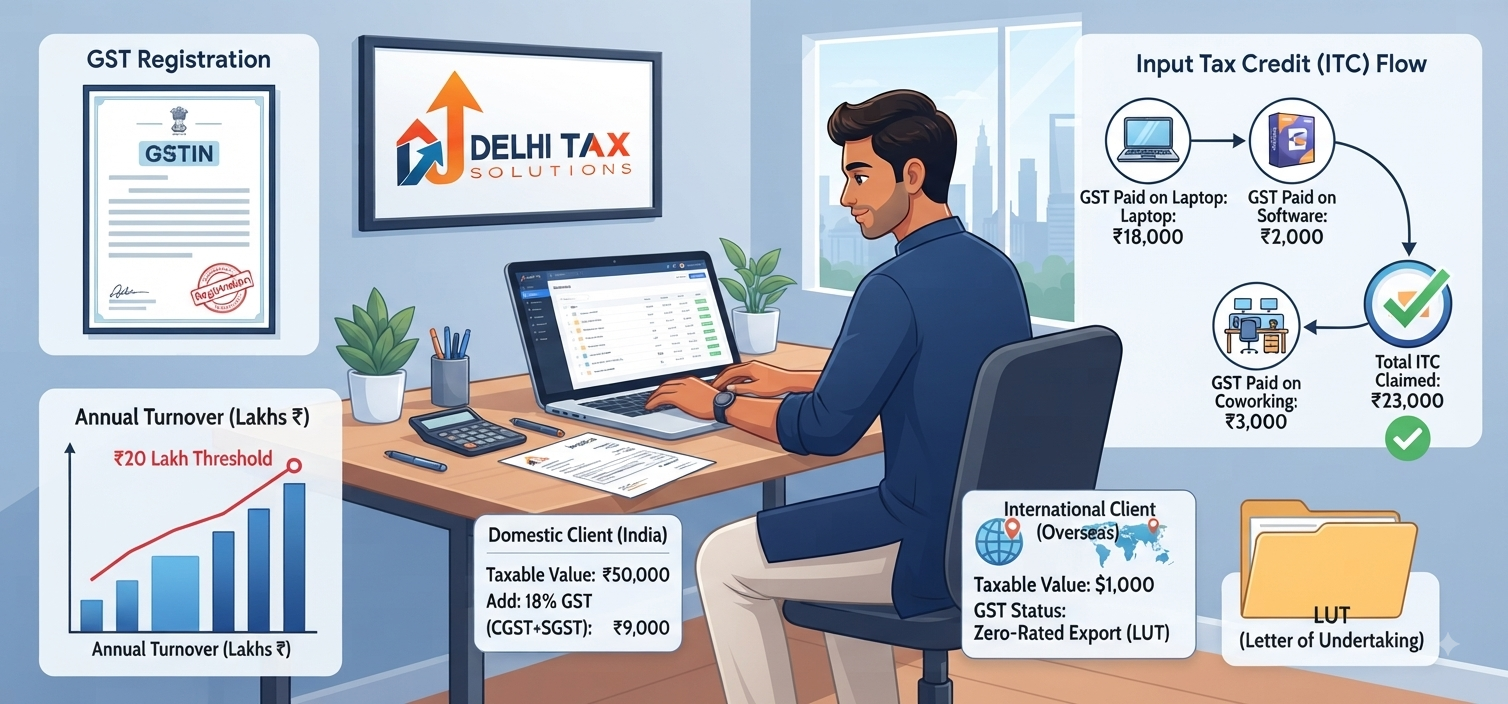
- Service providers enjoy a ₹20 lakh aggregate annual turnover threshold before mandatory registration kicks in.
- Exporting digital services to international clients can be executed tax-free using a valid Letter of Undertaking.
- Inter-state supply of services mandates immediate GST registration regardless of total annual turnover limits.
- Independent consultants can claim Input Tax Credit on eligible business assets like laptops and software.
- Professional guidance from expert tax advisors protects your gig-economy career from costly regulatory notices.
Navigating compliance as an independent professional requires understanding how GST for freelancers India frameworks impact your monthly billings. When scaling a digital agency or offering specialized advisory services, compliance errors can lead to unexpected tax notices. Many remote workers assume indirect taxes only apply to brick-and-mortar retail stores, ignoring federal regulations governing digital transactions. Grasping these statutory guidelines protects your hard-earned revenue and keeps your consultancy fully audit-ready.
Operating in India’s expanding gig economy means balancing client deliveries with rigorous tax reporting schedules. The Goods and Services Tax Council enforces clear rules regarding service thresholds and digital exports. Understanding these statutory provisions allows independent operators to price their services accurately and avoid compounding penalties on delayed filings.
What Is GST for Freelancers India and When Is Registration Mandatory?
GST for freelancers India refers to the mandatory indirect tax compliance framework governing independent service providers, digital consultants, and gig workers under the CGST Act. Governed by federal tax administration rules, registration becomes compulsory once a service provider’s aggregate annual turnover crosses ₹20 lakh across India, or ₹10 lakh in specified special category states. Freelancers must obtain a unique Goods and Services Tax Identification Number (GSTIN) on the common portal and file periodic return forms to remain compliant.
How Does Freelancer GST Registration Operate on the Portal?
Completing freelancer GST registration requires submitting digital documentation through the official portal to secure your operational credentials. Independent professionals must provide their Permanent Account Number, proof of business address (such as a coworking agreement or home utility bill), and valid bank account details.
According to administrative guidelines published by the Press Information Bureau, digital onboarding has been streamlined to minimize paperwork for gig workers. For consultants scaling into larger commercial entities, securing proper Company Registration establishes a professional corporate foundation.
What Is the Applicable GST on Consulting Services in India?
Determining the correct GST on consulting services ensures that your client invoices reflect accurate tax components under the law. Professional consulting, software development, content writing, and digital marketing services generally attract a standard tax rate of 18 percent. Freelancers must correctly classify their services using specific Harmonized System of Nomenclature (HSN) codes on every tax invoice issued.
As outlined in official notifications by the Income Tax Department, maintaining clear alignment between direct income declarations and indirect tax filings is critical. For specialized commercial activities, acquiring required Business Licenses remains an essential prerequisite before executing commercial sales.
What Is the GST Threshold for Service Providers Under the Law?
Comprehending the GST threshold for service providers under Section 22 of the CGST Act prevents premature registration for low-earning independent workers. While goods suppliers enjoy higher turnover limits in certain states, service providers generally operate under the ₹20 lakh aggregate annual ceiling. However, engaging in inter-state supply of services eliminates this threshold exemption entirely, making registration mandatory from the very first rupee of interstate billing.
Guidance from the Ministry of Corporate Affairs emphasizes that monitoring aggregate turnover across all business verticals is legally required. Professional assistance through expert GST Registration services keeps your compliance records strictly aligned with current federal thresholds.
How Does Export of Services GST India Operate for Remote Workers?
Managing the export of services GST India framework allows remote freelancers working with overseas clients to operate without levying domestic consumption taxes. Under zero-rated supply rules, independent consultants can export services without paying integrated tax by submitting a digital Letter of Undertaking (LUT) on the portal prior to raising international invoices. Foreign inward remittances must be received in convertible foreign exchange to qualify as a valid export.
| Client Geography | Applicable Tax Rate | Compliance Requirement |
|---|---|---|
| Domestic Clients (Same State) | 9% CGST + 9% SGST (18% total) | Standard tax invoice & GSTR-3B filing |
| Domestic Clients (Inter-State) | 18% IGST | Mandatory registration & B2B reporting |
| International Clients (Exports) | 0% (Zero-Rated Supply) | Valid LUT filing & foreign remittance proof |
⚡ In a Nutshell
Freelancers exceeding ₹20 lakh turnover or engaging in inter-state work must register for GST. International exports can be made tax-free using a digital LUT filing on the official portal.
Can Independent Consultants Claim Input Tax Credit on Business Assets?
Utilizing input tax credit for independent consultants allows registered freelancers to recover tax paid on business-related purchases. When you purchase hardware like laptops, software licenses, or pay coworking desk rentals, the tax paid can be offset against your output tax liabilities. Implementing sound financial practices aligned with Direct Tax Code principles safeguards your business during regulatory reviews.
Partnering with seasoned tax professionals eliminates administrative guesswork and guarantees complete regulatory alignment across all business filings.
Conclusion
Navigating indirect tax compliance is an essential milestone for every independent professional and digital consultant operating in India today. Remember that the ₹20 lakh turnover threshold, zero-rated international export rules, and proper Input Tax Credit management form the bedrock of clean compliance. Do not let complex tax regulations expose your freelance career to unexpected administrative penalties. Talk to a Delhi Tax Solutions expert to get your GST registration and filings managed accurately by our professional CA team. Proactive compliance secures your business future.
About this article: Researched using official government sources and Delhi Tax Solutions’ in-house tax advisory team. Last updated August 2026.
Frequently Asked Questions (FAQs)
+ Q: Do independent consultants and gig workers need GST registration in India if their annual turnover is below ₹20 lakh?
A: Independent service providers whose aggregate annual turnover remains below ₹20 lakh (or ₹10 lakh in special category states) are generally exempt from mandatory registration under Section 22 of the CGST Act. However, if a freelancer engages in inter-state supply of services—such as billing a client residing in another state—registration becomes compulsory from the first transaction regardless of turnover limits. Freelancers below the threshold can also voluntarily register on the official GST Portal to claim Input Tax Credit on business expenses.
+ Q: How is GST calculated and charged on professional consulting services rendered to domestic versus international clients?
A: For domestic clients located within the same state, registered freelancers must charge 18 percent GST divided equally as 9 percent CGST and 9 percent SGST. For inter-state domestic clients, 18 percent IGST is levied on the invoice. Conversely, professional consulting services exported to international clients qualify as zero-rated supplies under federal export rules, meaning 0 percent tax is charged provided the freelancer submits a valid Letter of Undertaking and receives foreign inward remittances in convertible currency.
+ Q: What is a Letter of Undertaking (LUT) and why is it essential for freelancers exporting digital services?
A: A Letter of Undertaking (LUT) is a digital document filed on the GST portal by registered exporters of services, allowing them to supply services internationally without paying integrated tax upfront and later claiming refunds. Without an active LUT, freelancers would be forced to pay 18 percent tax on export invoices and endure prolonged refund processing delays with tax authorities. Filing an LUT annually ensures smooth, tax-free cash flow for independent contractors serving global clients.
+ Q: Can independent professionals claim Input Tax Credit on business expenses like laptops, software subscriptions, and coworking spaces?
A: Registered independent professionals can claim Input Tax Credit on business-related expenses incurred for executing taxable outward supplies. Eligible assets include laptops, specialized software licenses, professional equipment, and coworking desk rentals, provided the vendor issues a valid tax invoice reflecting the freelancer’s GSTIN. This claimed credit can be utilized to offset outward tax liabilities, significantly reducing operational overhead for growing independent businesses.
+ Q: What are the specific HSN codes and return filing obligations required for registered freelance consultants under the GST framework?
A: Registered freelance consultants must report their services using appropriate Harmonized System of Nomenclature (HSN) codes—such as Chapter 99 codes for professional and technical services—on all tax invoices. In terms of return obligations, registered freelancers must file Form GSTR-1 for outward supplies and Form GSTR-3B for summary tax liabilities on a monthly or quarterly basis depending on their aggregate annual turnover under regular or QRMP schemes.