
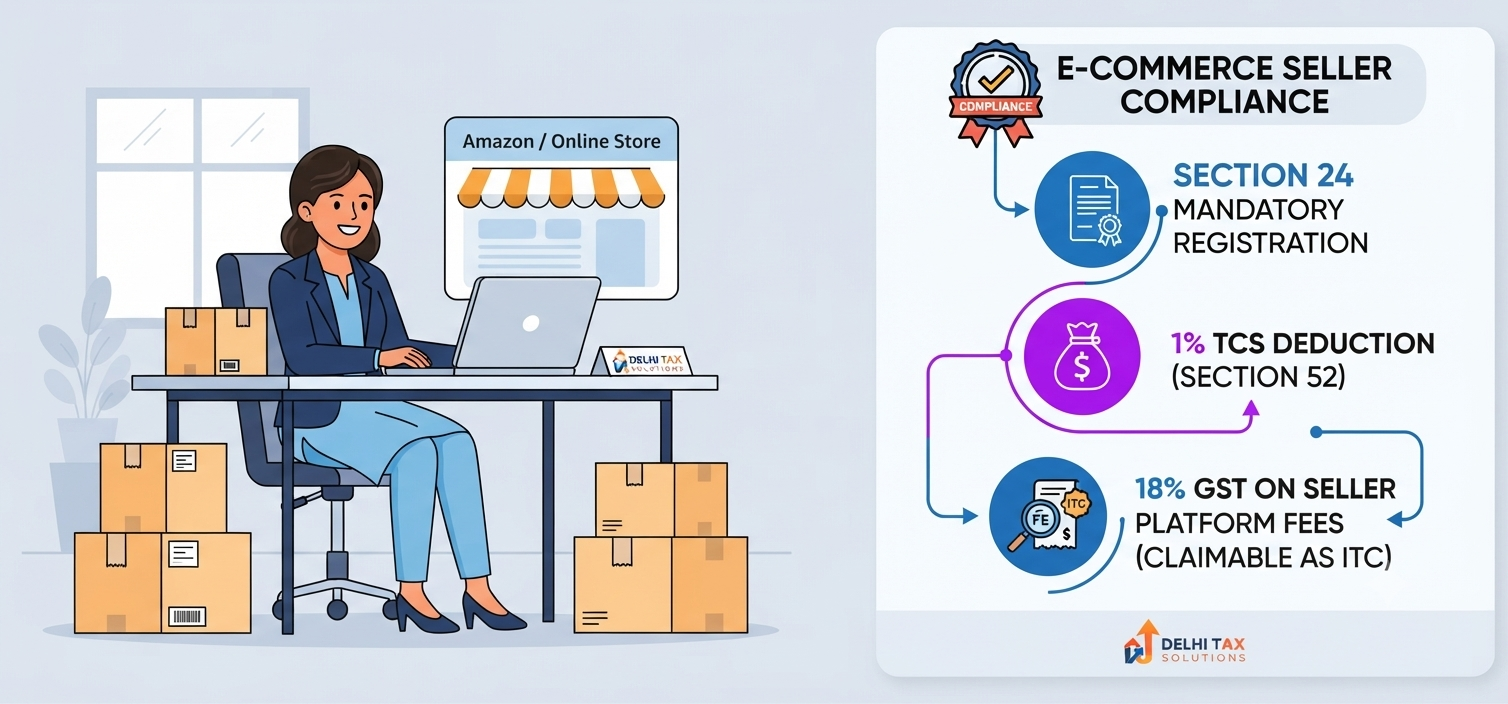
💡 Key Takeaways: GST for E-Commerce Sellers
- Mandatory Registration under Section 24: Inter-state e-commerce sellers supplying goods through marketplaces (e.g., Amazon, Flipkart) must obtain GST registration regardless of annual turnover.
- Intra-State Small Seller Relief: Small sellers conducting strictly intra-state sales of goods up to ₹40 Lakhs (₹20 Lakhs for services) can operate without GST registration subject to obtaining an Enrolment ID.
- 1% Tax Collection at Source (TCS): E-commerce Operators (ECOs) deduct 1% TCS (0.5% CGST + 0.5% SGST or 1% IGST) on net taxable sales, which sellers can credit directly to their electronic cash ledger.
- Input Tax Credit (ITC) on Marketplace Fees: Sellers pay 18% GST on Amazon referral fees, closing fees, and logistics charges, all of which are 100% claimable as ITC against outward sales liabilities.
- No Composition Scheme: Sellers operating through TCS-deducting e-commerce operators are strictly barred from opting for the GST Composition Scheme.
The rapid expansion of e-commerce in India has opened massive avenues for micro, small, and medium enterprises (MSMEs) as well as direct-to-consumer (D2C) brands. However, selling through E-Commerce Operators (ECOs) like Amazon, Flipkart, Meesho, or Myntra brings a distinct legal framework under the Central Goods and Services Tax (CGST) Act, 2017.
Unlike traditional brick-and-mortar retailers who enjoy turnover threshold exemptions (up to ₹40 Lakhs for goods and ₹20 Lakhs for services), online sellers face specific statutory mandates. Understanding compulsory registration under Section 24, Tax Collection at Source (TCS) under Section 52, and claiming Input Tax Credit on platform fees is crucial to maintaining operational compliance and avoiding liquidity traps.
Mandatory GST Registration: Section 24 Rules & Exemption Thresholds
Section 24 of the CGST Act sets out specific categories of persons who must mandatorily obtain GST registration, overriding the standard threshold limits specified under Section 22.
1. Compulsory Registration for Inter-State Supplies
If an online seller delivers products across state lines (inter-state supply), Section 24(i) mandates GST registration from day one, even if the total turnover is only ₹1,000. Because marketplaces automatically list products nationwide and fulfill orders across state boundaries, most Amazon sellers automatically trigger this requirement.
2. E-Commerce Operator Sales Provision
Under Section 24(ix), persons who supply goods or services through an E-Commerce Operator who is required to collect tax at source under Section 52 are mandatorily required to register.
3. The Intra-State Exemption Exception
To support micro-vendors, the GST Council introduced an exemption allowing small e-commerce sellers to operate without formal GST registration if they meet all of the following conditions:
- The seller makes strictly intra-state supplies (deliveries within the same state).
- The aggregate annual turnover does not exceed ₹40 Lakhs for goods (or ₹20 Lakhs for services/special category states).
- The seller obtains a valid PAN-based Enrolment ID on the GST Portal before listing on the e-commerce platform.
Tax Collection at Source (TCS) under Section 52
To curb tax evasion and establish an automated paper trail, Section 52 mandates that E-Commerce Operators deduct TCS on the net value of taxable supplies made through their platform by independent sellers.
| Component | TCS Rate & Structure | Applicable Section |
|---|---|---|
| Intra-State Supplies | 0.5% CGST + 0.5% SGST (Total 1%) | Section 52 CGST Act |
| Inter-State Supplies | 1.0% IGST (Total 1%) | Section 52 IGST Act |
| Tax Base Calculation | Gross Sales Value minus Sales Returns | Net Taxable Value |
Example Calculation: If an Amazon seller generates gross sales of ₹5,000,000 in a month and experiences ₹500,000 in customer returns, the Net Taxable Value is ₹4,500,000. Amazon will deduct 1% TCS (₹45,000) and remit it to the government while filing its monthly GSTR-8 return.
How Sellers Claim Deducted TCS
The TCS collected by Amazon or Flipkart is not a tax loss for the seller. Once the marketplace files its GSTR-8 by the 10th of the following month, the deducted TCS auto-populates into the seller’s “TCS and TDS Credit Received” tab on the GST portal. Upon accepting these figures, the amount is instantly credited to the seller’s Electronic Cash Ledger, which can be utilized to settle monthly GSTR-3B tax liabilities or claimed as a cash refund.
Claiming Input Tax Credit (ITC) on Marketplace Fees
E-commerce marketplaces charge sellers a variety of service fees to facilitate sales. These include referral fees, closing fees, shipping and fulfillment charges (such as Fulfillment by Amazon – FBA), storage fees, and sponsored ad fees. Marketplaces levy a standard 18% GST on all these service charges.
Online sellers can claim 100% Input Tax Credit (ITC) on all GST charged on marketplace invoices, provided:
- The tax invoice clearly contains the seller’s correct GSTIN.
- The GST charged by the marketplace is reflected in the seller’s GSTR-2B auto-drafted ITC statement.
- The seller files regular monthly or quarterly GST returns.
For a deeper technical step-by-step breakdown on verifying GSTR-2B reconciliation against purchase registers, refer to our comprehensive guide on Input Tax Credit (ITC) Rules.
Compliance Checklist for Online Sellers
To avoid tax notices, platform suspensions, or blocked cash flow, e-commerce businesses must adhere to a strict monthly compliance calendar:
- GST Registration: Ensure your GST registration is active and registered under the correct address (including Additional Place of Business for marketplace fulfillment centers/FBA warehouses). Read more on the GST Registration Process.
- Outward Supply Reporting (GSTR-1): Report state-wise sales breakdown, B2B sales with buyer GSTINs, and B2C sales summary by the 11th of every month.
- TCS Acceptance: Log into the GST portal, review auto-populated TCS credits from marketplaces, and accept them before filing monthly tax liabilities.
- Tax Payment & Return (GSTR-3B): Pay net tax liability (Outward Tax liability minus available ITC and Cash Ledger TCS) by the 20th of every month.
Sellers seeking additional regulatory updates or e-commerce tax clarifications can consult the official documentation provided by the Central Board of Indirect Taxes and Customs (CBIC) or log into the official GST Portal.
Overwhelmed by Multi-Channel E-Commerce GST Compliance?
Reconciling GSTR-2B ITC against Amazon/Flipkart commission statements, managing multi-state FBA inventory registrations, and claiming pending TCS cash refunds can quickly become a logistics nightmare.
Let the experienced Chartered Accountants at Delhi Tax Solutions handle your online accounting, GSTR-1/3B filings, TCS reconciliation, and multi-state GST compliance.
Frequently Asked Questions (FAQs)
+ Q: Can an Amazon seller opt for the GST Composition Scheme?
A: No. According to Section 10(2)(d) of the CGST Act, taxpayers making supplies of goods through an e-commerce operator who collects TCS under Section 52 are ineligible to opt for the Composition Scheme. You must register under the regular GST scheme.
+ Q: What happens if I store goods in an Amazon FBA (Fulfillment by Amazon) warehouse in another state?
A: To store inventory in a third-party warehouse outside your home state, you must obtain a separate GST registration in that specific state and register the FBA facility as an “Additional Place of Business” (APOB) within that state’s GST registration.
+ Q: Is TCS deducted on sales returns or canceled orders?
A: No. TCS under Section 52 is calculated on the “net value of taxable supplies.” Net value is calculated by subtracting the aggregate value of returned taxable goods from the gross value of taxable supplies made during the month.
+ Q: How can I claim a cash refund for accumulated TCS that I cannot utilize?
A: TCS credited to your Electronic Cash Ledger that remains unutilized after discharging all output tax liabilities can be claimed as a cash refund directly back to your registered bank account by filing a refund application (Form GST RFD-01) under the “Refund of Excess Balance in Electronic Cash Ledger” category.
About this article: Based on the CGST Act, 2017, Section 24, Section 52, and subsequent notifications governing e-commerce businesses in India. Updated for 2026.
Disclaimer: This article is intended for educational and informational purposes only and does not constitute formal legal or tax advisory. E-commerce tax rules are subject to frequent regulatory updates; please consult a qualified Chartered Accountant before executing business strategies.