💡 Key Takeaways: GST Compliance Rating (Section 149)
- Legal Mandate (Section 149): The Central Goods and Services Tax (CGST) Act empowers the government to assign a public GST compliance score to every registered taxpayer.
- Public Availability: Scores are visible on the GST common portal, allowing potential corporate buyers and clients to evaluate a supplier’s tax credibility before onboarding.
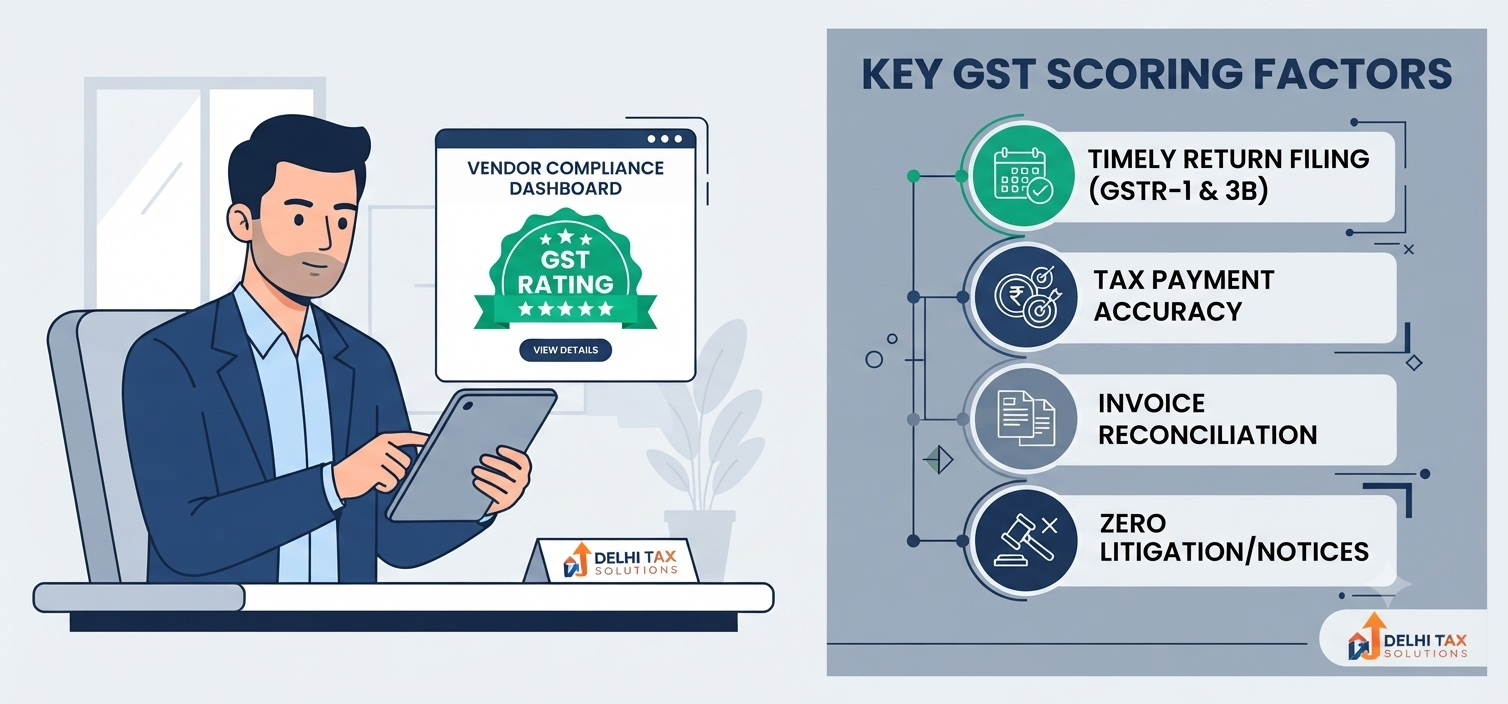
- Core Scoring Criteria: Timely filing of GSTR-1 and GSTR-3B, prompt payment of tax liabilities, reconciliation accuracy in GSTR-2B, and absence of tax notices or fraudulent claims.
- Impact on Input Tax Credit (ITC): Under Section 16(2)(aa), buyers can only claim ITC if their supplier files GSTR-1 on time. A poorly rated supplier threatens the buyer’s cash flow, leading major corporations to blacklist non-compliant vendors.
In the modern corporate ecosystem, vendor risk management is no longer limited to evaluating financial statements and product quality. Under the Goods and Services Tax regime, a vendor’s tax discipline directly impacts their clients’ bottom line.
To promote transparency and discourage default, the government enacted Section 149 of the CGST Act, establishing a formal framework for GST Compliance Ratings. This scoring mechanism acts as a credit bureau score for tax compliance, enabling businesses to separate reliable suppliers from high-risk defaults.
What is the GST Compliance Rating under Section 149?
Section 149(1) of the CGST Act states that every registered person may be assigned a GST compliance rating score based on their record of compliance with the provisions of the Act.
According to the statutory provisions:
- The compliance rating score is determined based on parameters prescribed by the GST Council.
- The score is updated at periodic intervals and communicated directly to the registered person.
- The score is placed in the public domain on the GST common portal (`gst.gov.in`), accessible to any searcher using a GSTIN.
Key Parameters Used to Calculate the GST Score
While the exact algorithmic weightings are updated periodically by the GST Network (GSTN), the score is calculated based on several core compliance parameters:
- On-Time Return Filing: Consistency in filing GSTR-1 and GSTR-3B before the due dates without incurring late fees or requiring persistent extension periods.
- Tax Payment Timeliness: Paying net cash liabilities via Electronic Cash Ledger promptly without accruing interest under Section 50.
- Reconciliation & Invoice Reporting: Reporting outward supplies accurately so that buyer invoices reflect cleanly in GSTR-2B without significant discrepancies or amendment delays.
- Response to Departmental Notices: Speed and accuracy in responding to e-way bill queries, DRC-01B/DRC-01C mismatch notices, or audit inquiries.
- Adherence to E-Invoicing Rules: Timely generation of IRNs (Invoice Reference Numbers) for B2B supplies above the mandatory turnover thresholds.
Why Vendor Scoring Matters: The Input Tax Credit (ITC) Link
Why do corporate procurement departments pay so much attention to a vendor’s GST rating? The answer lies in Section 16(2)(aa) of the CGST Act and GSTR-2B matching.
Under GST rules, a buyer cannot claim Input Tax Credit on an invoice unless:
- The supplier has uploaded the invoice details in their GSTR-1 / Invoice Furnishing Facility (IFF).
- The invoice details have been communicated to the buyer in their auto-populated GSTR-2B statement.
- The supplier has paid the underlying tax to the government via GSTR-3B.
| Vendor Compliance Status | Impact on Buyer’s Operations | Financial Consequence for Buyer |
|---|---|---|
| High Rating (Compliant) | Invoices auto-populate seamlessly in GSTR-2B every month. | 100% ITC claimed on time; zero working capital lockup. |
| Low Rating (Delayed Filing) | GSTR-1 delayed or missing; invoices fail to reflect in GSTR-2B. | ITC blocked or delayed; buyer must pay extra cash tax. |
| Defaulting / Suspended | Supplier fails to file GSTR-3B after uploading GSTR-1. | Buyer faces DRC-01A recovery notices from tax officers. |
Commercial Benefits of Maintaining a High Score
Maintaining a stellar GST rating score gives businesses a distinct competitive edge in B2B markets:
- Preferred Vendor Status: Enterprise buyers routinely filter out vendors with low ratings during tender evaluations and RFP processes to safeguard their cash flow.
- Faster Payment Processing: Many buyers link vendor payment releases to successful GSTR-2B reflection. A high rating ensures faster invoice clearances.
- Lower Departmental Audit Risk: High compliance ratings signal low tax risk, reducing the likelihood of scrutiny audits, physical verification visits, or sudden license suspensions.
- Easier Credit & Financing: Banks and NBFCs evaluate GST compliance health during working capital and business loan underwriting.
How to Maintain a Top GST Compliance Rating
To protect your company’s market reputation and maintain a clean score, establish robust internal controls:
- Automate E-Invoicing: Integrate your ERP with an e-invoicing portal to generate IRNs real-time at the moment of dispatch.
- Implement Monthly Reconciliation: Perform thorough monthly matching between sales registers, GSTR-1, and GSTR-3B before finalizing tax payments.
- Resolve Vendor Discrepancies Early: Utilize automated vendor management tools to flag non-compliant sub-tier suppliers who might disrupt your own compliance chain.
Protect Your Supply Chain & Vendor Compliance
Unchecked vendor delays can lead to unexpected ITC reversals, interest penalties under Section 50, and damage to your own corporate compliance score.
The tax advisory experts at Delhi Tax Solutions offer comprehensive vendor GST risk audits, automated GSTR-2B reconciliation systems, and complete return management to keep your business operating smoothly.
Frequently Asked Questions (FAQs)
+ Q: Where can I check my business’s or a vendor’s GST Compliance Rating?
A: You can view the compliance status and return filing history of any taxpayer publicly on the official GST Common Portal (`gst.gov.in`) under the “Search Taxpayer” tool using their 15-digit GSTIN.
+ Q: Can a newly registered business get a GST compliance rating immediately?
A: No. Compliance ratings require a track record of filing returns and tax payments over a period of time. Newly registered entities are assigned a neutral status until sufficient return filing history is accumulated.
+ Q: What happens if my GST rating drops due to a technical glitch or portal error?
A: Taxpayers can submit grievances through the GST Self-Service Helpdesk portal with proof of timely filing or payment. Once verified by the GSTN technical team, any algorithmic scoring errors will be rectified.
+ Q: Does paying late fees restore my GST rating score?
A: While paying late fees and interest fulfills your statutory obligation to clear pending defaults, the historical delay still impacts your timing metrics. Consistent, on-time filings over subsequent months are required to rebuild a high score.
About this article: Based on Section 149 and Section 16(2)(aa) of the Central Goods and Services Tax (CGST) Act, 2017. Updated for 2026.
Disclaimer: This article is strictly for educational purposes and should not be construed as official legal or professional tax advice. Please consult a qualified tax advisor or Chartered Accountant to assess your specific business compliance requirements.