
💡 Key Takeaways: GST Appellate Tribunal (GSTAT)
- 💡 Second Appellate Forum: The GSTAT is the specialized statutory tribunal constituted under Section 109 to hear second appeals against orders passed by the First Appellate Authority.
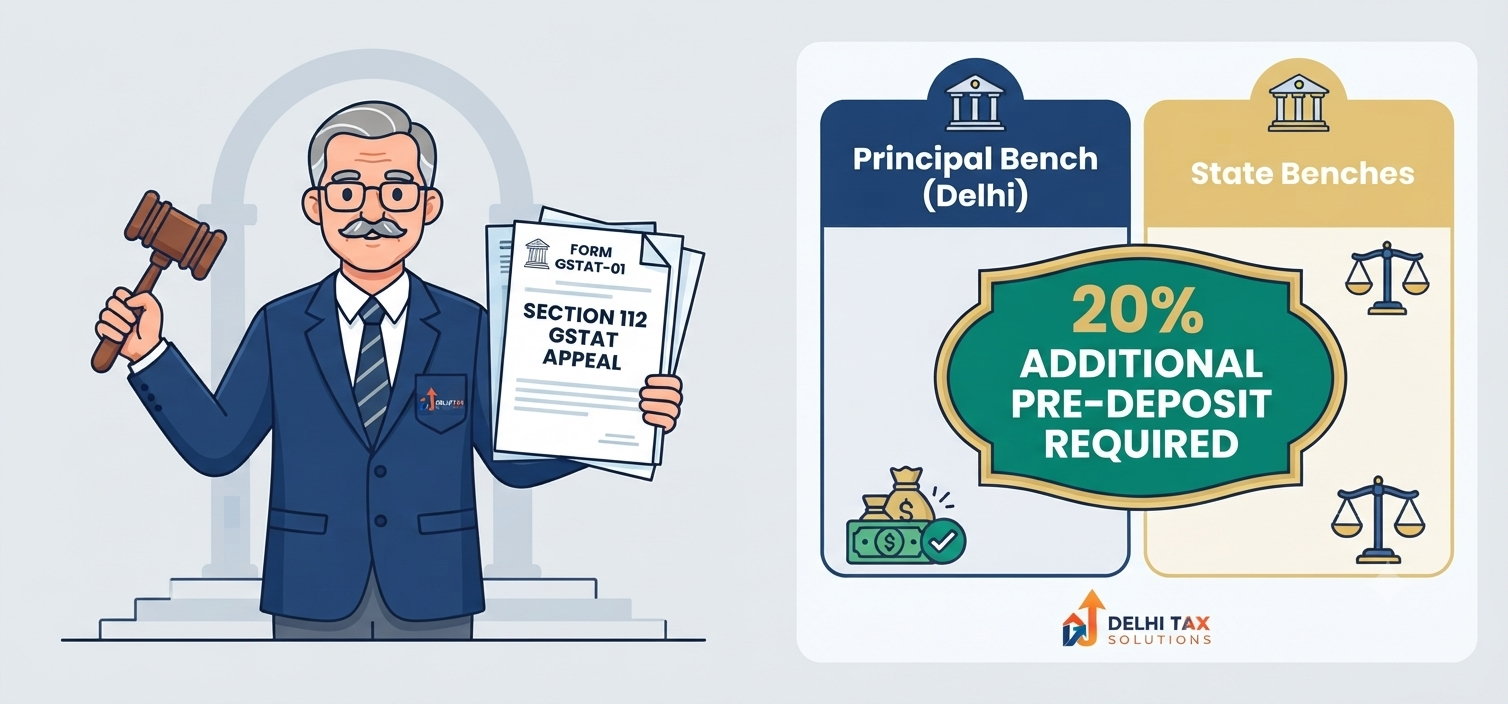
- 💡 Bench Structure: GSTAT comprises a Principal Bench in New Delhi and multiple State Benches across different states to ensure regional access.
- 💡 20% Pre-Deposit Rule: To file an appeal before GSTAT under Section 112, taxpayers must deposit an additional 20% of the disputed tax amount (in addition to the 10% paid for the first appeal).
- 💡 Fact-Finding Final Authority: GSTAT is the highest and final fact-finding authority under GST law; higher courts (High Courts and Supreme Court) only entertain substantial questions of law.
- 💡 Automatic Recovery Stay: Payment of the required pre-deposit under Section 112 automatically stays the recovery of the remaining disputed tax demand.
When a taxpayer receives an unfavorable order from the First Appellate Authority under a GST Appeal (Section 107), the fight for justice does not end there. To resolve complex tax disputes without burdening the High Courts, the CGST Act establishes a dedicated judicial forum known as the GST Appellate Tribunal (GSTAT).
Governed primarily by Section 109 (Constitution) and Section 112 (Appeals), the establishment of GSTAT marks one of the most critical structural developments in Indian indirect tax litigation. In this comprehensive guide, we unpack how GSTAT is structured, its jurisdictional powers, statutory pre-deposit requirements, and appeal procedures.
What is the GST Appellate Tribunal (GSTAT)?
The GST Appellate Tribunal is an independent statutory judicial tribunal designed specifically to hear appeals against orders passed by the First Appellate Authority (Section 107) or the Revisional Authority (Section 108). It serves as a bridge between departmental appellate proceedings and constitutional courts.
Because GSTAT is structured with both Judicial Members and Technical Members (representing both Central and State tax departments), it offers balanced expertise in interpreting administrative GST procedures as well as statutory law.
Constitution of GSTAT Under Section 109
Under Section 109 of the CGST Act, the Central Government, based on the recommendations of the GST Council, constitutes the Appellate Tribunal. The structure is divided into two main levels:
1. The Principal Bench (New Delhi)
The Principal Bench is located in New Delhi and is headed by the President of the Tribunal. It handles disputes involving international trade, cross-border transactions, and critical cases where the place of supply is in dispute across multiple states.
2. State Benches
To make dispute resolution accessible nationwide, the government has constituted State Benches across various states. State Benches hear all appeal cases that do not involve Place of Supply disputes. Each State Bench consists of Judicial and Technical Members ensuring equal representation of Central and State perspectives.
| Bench Type | Location | Primary Jurisdiction & Subject Matter |
|---|---|---|
| Principal Bench | New Delhi | Matters involving Place of Supply disputes and national policy questions. |
| State Benches | Capital cities & major commercial centers in states | All standard tax demand, ITC, classification, and penalty disputes not involving Place of Supply. |
Filing an Appeal Before GSTAT (Section 112)
Under Section 112 of the CGST Act, any person aggrieved by an order passed under Section 107 or Section 108 can file an appeal before the Appellate Tribunal within 3 months from the date on which the order is communicated.
Similarly, the tax department can also review lower appellate orders and file a departmental appeal before GSTAT within 6 months of the order date.
The 20% Pre-Deposit Requirement for GSTAT Appeals
Similar to first appeals, Section 112(8) imposes a mandatory statutory pre-deposit condition before GSTAT can entertain an appeal application.
To file a second appeal before GSTAT, the appellant must deposit:
- 100% of the Admitted Liability: Full payment of tax, interest, fine, fee, and penalty that the taxpayer agrees with.
- 20% Additional Disputed Tax: An amount equal to 20% of the remaining tax in dispute (in addition to the 10% paid during the first appeal under Section 107, making a total cumulative pre-deposit of 30%).
💡 Pro Tip: Capping Limits on Pre-Deposit
The statutory pre-deposit for GSTAT under Section 112 is capped at a maximum of ₹50 Crore CGST and ₹50 Crore SGST (or ₹100 Crore IGST). Once this pre-deposit is paid, recovery for the remaining 70% disputed demand is automatically stayed!
Powers of the Tribunal Under Section 113
After hearing both the appellant and the tax department, the GST Appellate Tribunal has wide-ranging judicial powers under Section 113 to:
- Confirm, modify, or annul the decision or order appealed against.
- Remand the case back to the First Appellate Authority or Adjudicating Officer with specific directions for fresh adjudication.
- Rectify any error apparent on the face of the record within 3 months from the date of the order.
Official circulars regarding GSTAT operational notifications and bench locations are published on the Central Board of Indirect Taxes and Customs (CBIC) portal, while administrative filings are hosted on the main GST Portal.
💡 Need Senior Legal Representation for GSTAT Litigation?
GSTAT is the final fact-finding authority in the GST legal hierarchy. Arguments, evidence, and factual submissions not properly pleaded before GSTAT cannot generally be raised later before High Courts.
Secure your legal position with Delhi Tax Solutions. Our experienced team of Advocates and Indirect Tax Specialists handle second-tier appellate drafting, legal arguments, and GSTAT tribunal representation.
Frequently Asked Questions (FAQs)
+ 💡 Q: What is the primary role of GSTAT in GST litigation?
A: GSTAT (GST Appellate Tribunal) acts as the second appellate authority under Section 109 to hear appeals against orders passed by First Appellate or Revisional Authorities. It is the final fact-finding tribunal under GST law.
+ 💡 Q: What is the pre-deposit required for filing an appeal before GSTAT?
A: Under Section 112(8), you must pay 100% of any admitted liability plus an additional 20% of the disputed tax demand (over and above the 10% pre-deposit already paid during the first appeal).
+ 💡 Q: Can I appeal directly to the High Court without going to GSTAT?
A: Generally, no. The statutory hierarchy requires approaching GSTAT first. High Courts under Section 117 only entertain appeals against GSTAT orders if the case involves a “substantial question of law” (and not mere dispute of facts).
+ 💡 Q: What is the difference between GSTAT Principal Bench and State Benches?
A: The Principal Bench (New Delhi) exclusively hears cases where one of the main issues in dispute is the “Place of Supply”. All other standard dispute appeals are handled by the respective State Benches.
About this article: Based on Section 109, Section 112, and Section 113 of the CGST Act, 2017. Updated for 2026.
Disclaimer: This article is for educational and informational purposes only and does not constitute formal legal representation or advice. Please consult a qualified tax litigator to handle GSTAT tribunal appeals.