
💡 Key Takeaways
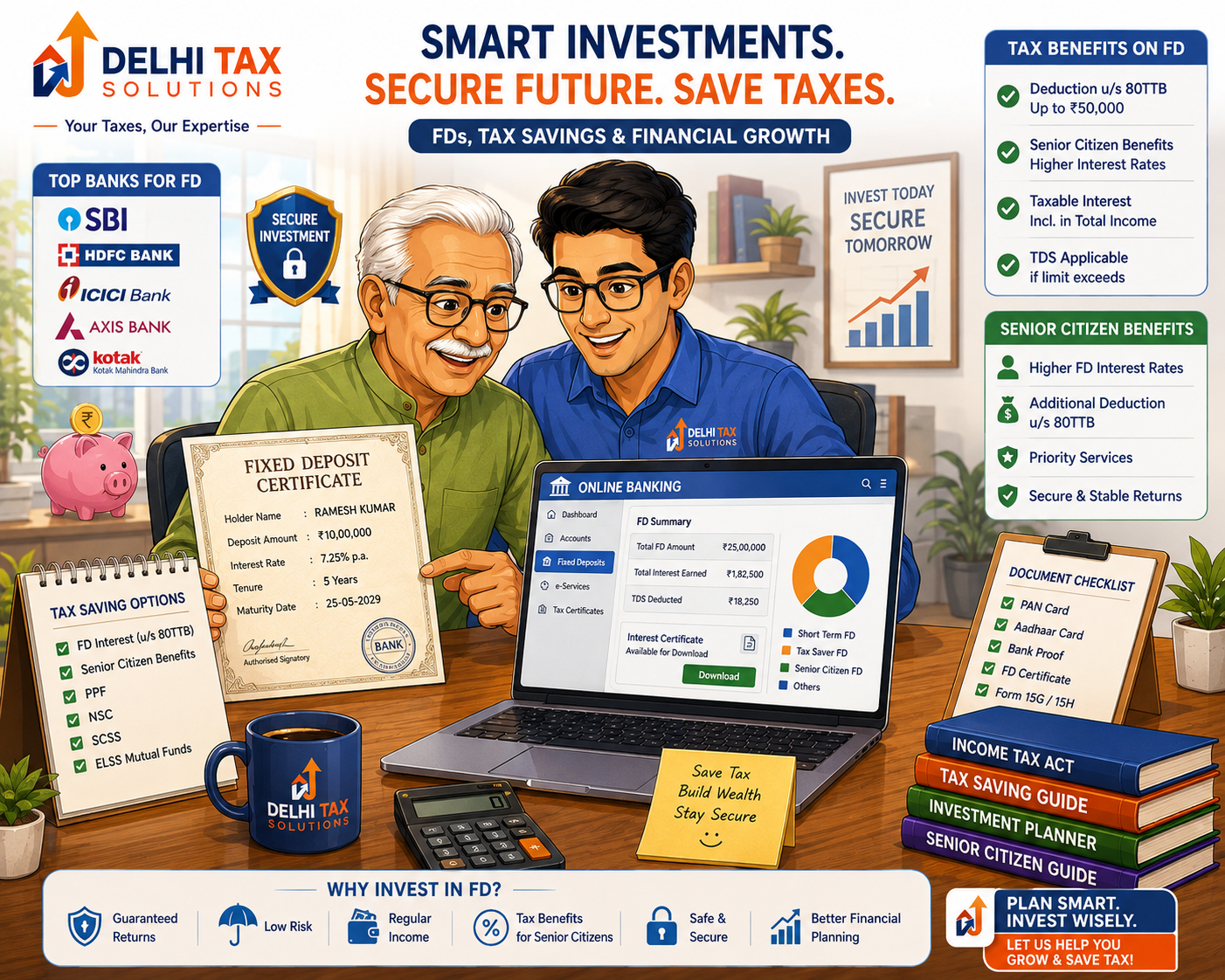
- Submit Form 15G or 15H to stop banks deducting 10% TDS on fixed deposit interest.
- Form 15G applies to individuals under 60 and HUFs with non-taxable total income.
- Form 15H is reserved exclusively for senior citizens aged 60 years or above.
- TDS thresholds under Section 194A are ₹40,000 for regular individuals and ₹50,000 for senior citizens.
- Submit declarations in April each financial year to ensure zero unwanted tax deductions.
Fixed deposits remain a favorite investment avenue across India, offering guaranteed returns and stable liquidity. However, earning significant interest income often triggers automatic tax deductions by banks at source. Submitting Form 15G 15H to avoid TDS on FD interest ensures your hard-earned interest income reaches your bank account without unnecessary tax cuts.
Under Section 194A of the Income Tax Act, banks deduct 10% Tax Deducted at Source when interest exceeds prescribed thresholds. If your overall annual income falls below the taxable slab, this deduction creates an unnecessary financial strain. You then face the hassle of filing an Annual Return to claim a tax refund from the government.
Submitting self-declarations under Section 197A prevents banks from deducting TDS upfront. This comprehensive guide walks you through the exact submission procedures, eligibility rules, and crucial tax calculations for FY 2025-26. Take control of your fixed deposit earnings today.
How to use Form 15G 15H to avoid TDS on FD interest?
To use Form 15G 15H to avoid TDS on FD interest, submit a valid self-declaration under Section 197A to your bank at the start of the financial year. Form 15G applies to individuals under 60 years whose total taxable income is zero. Form 15H applies exclusively to senior citizens aged 60 or above. Once submitted, the bank registers your zero-TDS status, preventing automatic 10% tax deductions under Section 194A on your fixed deposit earnings.
Understanding Section 194A and the FD TDS threshold
Banks are statutory bodies mandated to withhold taxes on interest payments under Section 194A. Whenever your annual interest from all fixed deposits within a single bank branch network crosses the prescribed limit, the bank deducts 10% TDS. If you fail to quote your Permanent Account Number (PAN), the deduction rate spikes to 20%.
The standard FD TDS threshold stands at ₹40,000 per financial year for individuals aged below 60 years. For senior citizens, Section 194A offers an enhanced threshold limit of ₹50,000. These thresholds apply per bank, not per individual deposit account. According to operational guidelines on the Income Tax Department portal, banks compute interest continuously throughout the year.
If your total annual income from all sources stays below the basic exemption limit, paying TDS upfront is logically unnecessary. This is precisely why the Central Board of Direct Taxes introduced self-declarations. You can manage your personal Income Tax compliances efficiently by preventing these upfront cuts right at the beginning of April.
Role of Section 80TTB for senior citizens
Senior citizens enjoy an additional tax shelter under Section 80TTB of the Income Tax Act. This provision permits a deduction of up to ₹50,000 on interest earned from savings accounts and fixed deposits. The Press Information Bureau frequently highlights this benefit as a major relief measure for retirees relying on interest payouts.
Core eligibility criteria: 15G vs 15H eligibility explained
Understanding 15G vs 15H eligibility is vital before submitting your self-declaration to a bank or financial institution. Submitting the wrong form leads to immediate rejection or legal penalties under Section 277 for submitting false declarations. Both forms serve the same purpose but apply to strictly different taxpayer demographics.
Form 15G is designed for resident individuals under the age of 60 and Hindu Undivided Families (HUFs). Non-resident Indians (NRIs) and artificial juridical entities cannot submit Form 15G. Two conditions must be met simultaneously: your total calculated tax liability for the year must be zero, and your total interest income must not exceed the basic exemption limit (₹2.5 Lakhs under the Old Tax Regime).
Form 15H is meant exclusively for resident senior citizens aged 60 years or older. Unlike Form 15G, senior citizens can submit Form 15H even if their total interest income exceeds the basic exemption limit. The primary condition for Form 15H is simply that the final net tax payable for the financial year must be zero after applying deductions like Section 80C or Section 80TTB.
Who can submit Form 15G?
Knowing who can submit Form 15G prevents costly administrative mistakes during filing. Resident individuals, HUFs, and qualifying trusts can submit Form 15G provided their taxable income remains zero. Companies, partnership firms, and NRIs are completely excluded from using Form 15G. Startup founders setting up entities via Company Registration must follow corporate tax deduction rules rather than individual self-declarations.
| Parameters | Form 15G | Form 15H |
|---|---|---|
| Eligible Age Group | Below 60 Years | 60 Years and Above |
| Target Entity | Resident Individuals & HUFs | Resident Senior Citizens Only |
| Interest Income Cap | Must NOT exceed basic exemption limit | No cap (Net tax must be zero) |
| NRIs Allowed? | No | No |
| TDS Threshold Trigger | ₹40,000 | ₹50,000 |
⚡ Quick Summary
Use Form 15G if you are under 60 and earn zero taxable income. Use Form 15H if you are a senior citizen whose net annual tax payable comes out to zero.
Step-by-step process: How to submit Form 15G and 15H online?
Preventing unwanted tax deductions requires timely submission of your forms. The most effective window is the first week of April every financial year. Banks recalculate interest schedules quarterly, so submitting declarations early prevents early-quarter deductions.
Most major Indian public and private banks offer online submission features through Internet Banking and mobile applications. You no longer need to stand in long bank queues. The Reserve Bank of India encourages digital self-declarations to enhance banking ease for citizens.
Follow these operational steps to complete your online submission in minutes:
- Log into your bank’s Internet Banking portal or mobile app.
- Navigate to the “Services” or “Tax Center” tab and select “Submit Form 15G/15H”.
- Select your active fixed deposit accounts linked to your customer ID.
- Verify your personal details, including your address, mobile number, and active PAN.
- Enter estimated total income and the total number of Form 15G/15H documents submitted to other banks.
- Authenticate the submission using a One-Time Password (OTP) sent to your registered mobile number.
- Download the acknowledgement receipt containing the Unique Identification Number (UIN) generated by the bank.
Handling offline bank submissions
If you prefer offline submission, visit your nearest bank branch with three physical copies of Form 15G or Form 15H. Fill in your personal details, estimated annual income, and fixed deposit account numbers. Hand them over to the branch manager and ensure you collect a stamped acknowledgement copy for your records.
Consequences of false declarations and late submissions
Submitting a false declaration to evade tax is a serious offense under Indian tax law. Under Section 277 of the Income Tax Act, making a false statement in Form 15G or 15H can lead to rigorous imprisonment ranging from 3 months to 7 years, along with heavy financial fines. Never submit these forms if your income genuinely falls into a taxable bracket.
If you submit your form late after the bank has already processed quarterly TDS, the bank cannot reverse the tax deduction. The bank deposits the withheld tax directly into the central government’s account under your PAN. The bank will issue a Form 16A detailing the deducted amount.
When this happens, your only recourse is filing an annual Income Tax Return (ITR). You must claim a tax refund for the deducted amount. Our CA team at Delhi Tax Solutions handles complex tax refund claims and provides guidance on TDS compliance to help taxpayers recover their money efficiently.
Impact on business entities and GST
Individual fixed deposit interest rules differ completely from corporate cash flow management. Businesses managing operational funds must track commercial taxes separately, including their GST Registration obligations. Self-declarations under Form 15G/15H apply purely to direct tax on interest income, not operational business transactions.
Filing ITR and tracking Form 15G 15H in Form 26AS
Submitting Form 15G or Form 15H stops tax deduction, but it does not exempt you from reporting the interest income in your annual return. The Income Tax Department requires every citizen to report interest earnings under “Income from Other Sources”.
Banks upload details of all accepted Form 15G and 15H declarations to the tax portal quarterly. You can verify whether your bank processed your form by reviewing your Form 26AS and Annual Information Statement (AIS). Open your tax profile, download AIS, and check the “Information from Payments” section.
Ensure the total interest reported matches your bank passbook statements. Mismatches between interest reported by banks and figures in your ITR trigger automated tax notices. Always cross-verify your statements before submitting your final return for the financial year.
Managing fixed deposit taxes requires proactive steps at the start of every financial year. Submitting Form 15G or Form 15H ensures your liquidity remains intact without unnecessary tax deductions under Section 194A. Ensure you meet the eligibility criteria, double-check your total income calculations, and keep stamped acknowledgements safe.
Need assistance with tax refund claims, ITR filing, or complex income calculations? Contact the expert team at Delhi Tax Solutions today to streamline your annual tax filings smoothly.
About this article: Researched using official government sources and Delhi Tax Solutions’ in-house tax advisory team. Last updated August 2026.
This article is for general informational purposes and is not a substitute for personalised professional tax advice.
Frequently Asked Questions (FAQs)
Q: What is the difference between Form 15G and Form 15H?
A: Form 15G is designed for resident individuals under 60 years of age and HUFs whose total taxable income is zero and whose total interest income does not exceed the basic exemption limit (₹2.5 Lakhs under the Old Tax Regime). Form 15H is reserved exclusively for resident senior citizens aged 60 years or above. Senior citizens can submit Form 15H even if their interest income exceeds the basic exemption limit, provided their final net tax liability for the financial year remains zero.
Q: Who can submit Form 15G for fixed deposit interest?
A: Resident individuals below 60 years of age, Hindu Undivided Families (HUFs), and qualifying trusts can submit Form 15G. To be eligible, your total estimated tax liability for the financial year must be nil, and your total aggregate interest income from all sources must not exceed the basic exemption threshold. Non-Resident Indians (NRIs), partnership firms, and private limited companies are strictly prohibited from submitting Form 15G to banks.
Q: What is the FD TDS threshold for senior citizens in FY 2025-26?
A: Under Section 194A of the Income Tax Act, the threshold limit for TDS on fixed deposit interest for senior citizens aged 60 or above is ₹50,000 per financial year per bank. If a senior citizen’s interest income across all branches of a single bank remains below ₹50,000, the bank will not deduct 10% TDS automatically, even if Form 15H is not submitted. For non-senior citizens, this threshold limit is ₹40,000.
Q: What happens if I miss submitting Form 15G before TDS is deducted?
A: If you miss submitting Form 15G or 15H on time and the bank deducts 10% TDS, the bank cannot refund this amount directly to your account. The bank deposits the withheld tax into the central government’s account under your PAN. To recover this money, you must file your annual Income Tax Return (ITR-1 or ITR-2) after the financial year ends and claim a formal tax refund from the Income Tax Department.
Q: Can I submit Form 15G if my total interest income exceeds the basic exemption limit?
A: No, individuals under 60 years of age cannot submit Form 15G if their total interest income for the financial year exceeds the basic exemption limit (₹2,50,000 under the Old Tax Regime), even if their final taxable income becomes zero after claiming deductions under Section 80C or 80D. This restriction applies strictly to Form 15G. Senior citizens using Form 15H do not face this restriction, provided their net tax liability remains zero.
