
💡 Key Takeaways
- NRIs can repatriate up to USD 1 Million per financial year from their Non-Resident Ordinary (NRO) accounts under the Reserve Bank of India’s Liberalised Remittance Scheme framework.
- Form 15CA is an online declaration filed by the remitter, while Form 15CB is a formal certification issued by a Chartered Accountant verifying tax clearance.
- Form 15CB is mandatory for foreign remittances exceeding ₹5 Lakhs in a financial year if the income is taxable in India.
- Repatriating funds resulting from property sales requires proof of legitimate tax payment and clear title deeds to avoid banking delays.
- Ensuring complete compliance prevents tax penalties and simplifies annual Income Tax Filing obligations for non-residents.
For Non-Resident Indians (NRIs) and Persons of Indian Origin (PIOs), moving money out of India—whether from real estate sales, mutual fund liquidations, or family inheritances—is often met with regulatory hurdles. Managing repatriation NRO account 15CA 15CB compliance requires navigating two regulatory pillars: Foreign Exchange Management Act (FEMA) guidelines and Indian Income Tax regulations. Whether you are transferring balances into a freely repatriable NRE account or remitting capital directly to an overseas bank account, strict documentation is essential. From individual capital gains to corporate equity liquidations structured alongside domestic Company Registration entities, knowing how to execute this process saves time and protects your wealth from double taxation.
Understanding NRO Fund Repatriation and Limits
NRO vs. NRE Accounts: The Core Difference
An NRO (Non-Resident Ordinary) account holds income earned within India, such as rental income, dividends, pension payouts, or asset sale proceeds. Unlike NRE (Non-Resident External) accounts, which are fully and freely repatriable without dollar caps, NRO account funds are subject to regulatory restrictions and tax withholding at source.
The USD 1 Million Annual Repatriation Limit
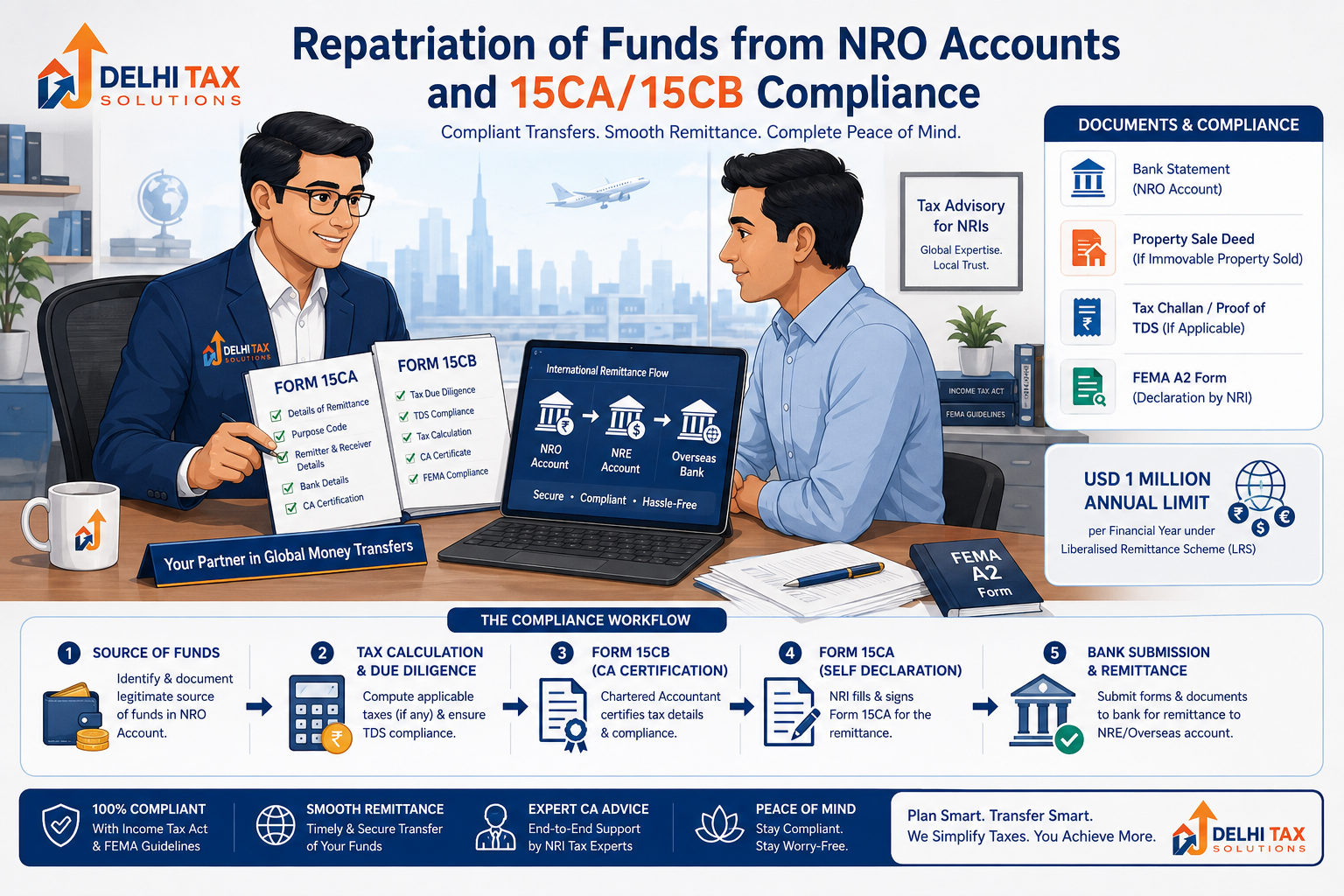
Under the Liberalised Remittance Scheme (LRS) framework set by the central bank, NRIs are permitted an NRO repatriation limit of up to USD 1 Million (or its equivalent in foreign currency) per financial year (April 1 to March 31). This cap applies collectively to foreign remittances and internal transfers from NRO to NRE accounts.
If the funds stem from an inherited property sale, the remittance must be supported by valid legal heirship certificates, probate wills, or settlement deeds. For large real estate transactions subject to municipal levies and municipal Property Tax deductions, maintaining clear financial logs is mandatory before initiating transfers.
Decoding Form 15CA and Form 15CB Compliance
What is Form 15CA?
Form 15CA is a self-declaration submitted online by the remitter on the official tax portal. It notifies the tax department that tax has been appropriately paid or withheld on funds being sent out of India. Form 15CA is divided into four distinct parts depending on the transaction value and taxability:
- Part A: Used when the remittance is taxable and does not exceed ₹5 Lakhs in total during the financial year.
- Part B: Used when the remittance exceeds ₹5 Lakhs and an order/certificate under Section 195(2), 195(3), or 197 has been obtained from the Assessing Officer.
- Part C: Used when the remittance exceeds ₹5 Lakhs AND is taxable, requiring a Chartered Accountant’s certificate in Form 15CB.
- Part D: Used when the remittance is completely non-taxable under specified exempt categories (e.g., personal gifts, family maintenance within limits).
What is Form 15CB?
Form 15CB is an independent statutory certificate issued by a practicing Chartered Accountant. The CA examines the source of funds, verifies applicable Double Taxation Avoidance Agreements (DTAA), checks exchange rates, and confirms that statutory TDS Compliance under Section 195 has been fully satisfied. Once signed by the CA, Form 15CB is uploaded directly to the e-filing portal before the taxpayer submits Form 15CA Part C.
⚡ Key Workflow Rule
Form 15CB must always be uploaded by your Chartered Accountant on the tax portal first. Once accepted by the taxpayer, the portal generates an Acknowledgement Number, which is then used to generate and file Form 15CA Part C.
Step-by-Step NRO to NRE Fund Transfer Process
Executing an NRO to NRE fund transfer tax compliant process involves a structured multi-step sequence between your tax advisor, the portal, and your authorized dealer bank:
| Stage | Action Item | Responsible Party |
|---|---|---|
| 1. Document Review | Gather proof of source of funds (e.g., property sale deed, bank statements, tax challans, inheritance documents). | Taxpayer & CA |
| 2. Tax Computation | Calculate exact capital gains or income tax liabilities, deduct applicable TDS, and pay outstanding tax dues via online challan. | Chartered Accountant |
| 3. Filing Form 15CB | The CA verifies tax payments, drafts Form 15CB, and uploads it electronically using their Digital Signature Certificate (DSC). | Chartered Accountant |
| 4. Filing Form 15CA | The taxpayer logs into the e-filing portal, approves Form 15CB, completes Form 15CA (Part C), and submits it. | Taxpayer / Authorized Representative |
| 5. Bank Submission | Submit Form 15CA, Form 15CB acknowledgement, FEMA A2 declaration, and source documents to the Authorized Dealer (AD) Bank. | Taxpayer & AD Bank |
Tax Considerations and Professional CA Advisory
Interplay with Cross-Border Regulations
Repatriation calculations must align with guidelines published by the Income Tax Department and policy circulars released by the Press Information Bureau. Furthermore, all foreign exchange movements, NRO-to-NRE account transfers, and outward currency remittances operate strictly under frameworks mandated by the Reserve Bank of India. Non-residents operating businesses in India must also ensure that domestic operations meet GST Registration thresholds and comply with corporate governance rules established by the Ministry of Corporate Affairs.
Why Professional Advisory is Essential
Submitting incorrect information in Form 15CA/15CB can result in heavy tax penalties under Section 271I (up to ₹1 Lakh per default) or lead to banking rejections that stall foreign remittances. If you are selling ancestral property, liquidating Indian assets, or transferring significant wealth overseas, expert guidance is critical. Talk to a Delhi Tax Solutions expert today. Our certified Chartered Accountants will handle the entire 15CA 15CB form filing process, verify tax credits, issue formal 15CB certificates, and ensure your funds are repatriated without delay.
Mastering the repatriation NRO account 15CA 15CB workflow protects your hard-earned assets while keeping your cross-border transactions fully compliant. Connect with Delhi Tax Solutions to streamline your international fund transfers today.
About this article: Researched using official government sources and Delhi Tax Solutions’ in-house tax advisory team. Last updated August 2026.
Frequently Asked Questions (FAQs)
Q: What is the maximum NRO repatriation limit per financial year?
A: Under current RBI guidelines, NRIs and PIOs are allowed to repatriate up to USD 1 Million (or equivalent) per financial year from their NRO accounts, subject to proper tax payment and documentation.
Q: When is Form 15CB mandatory for remitting money out of an NRO account?
A: Form 15CB is mandatory when the total taxable remittance to a foreign country or NRE account exceeds ₹5 Lakhs in a financial year and requires certification of tax payment by a Chartered Accountant.
Q: How do I transfer funds from an NRO account to an NRE account?
A: To transfer money from NRO to NRE, you must calculate and pay applicable taxes, obtain Form 15CB from a CA, file Form 15CA Part C online, and submit these along with FEMA Form A2 to your bank.
Q: Are taxes deducted when transferring money from NRO to NRE or overseas bank accounts?
A: The transfer itself is not a tax event, but the underlying income sitting in the NRO account (capital gains, rent, interest) must be fully taxed in India before the bank permits the transfer.
Q: What documents are required by banks for 15CA and 15CB verification?
A: Banks typically require signed copies of Form 15CA, the Form 15CB certificate, tax payment challans, proof of source of funds (e.g., sale deed or inheritance papers), and a completed FEMA Form A2.
