
💡 Key Takeaways
- Outbound transfers require navigating dual regulations under RBI’s FEMA framework and the Indian Income Tax Act.
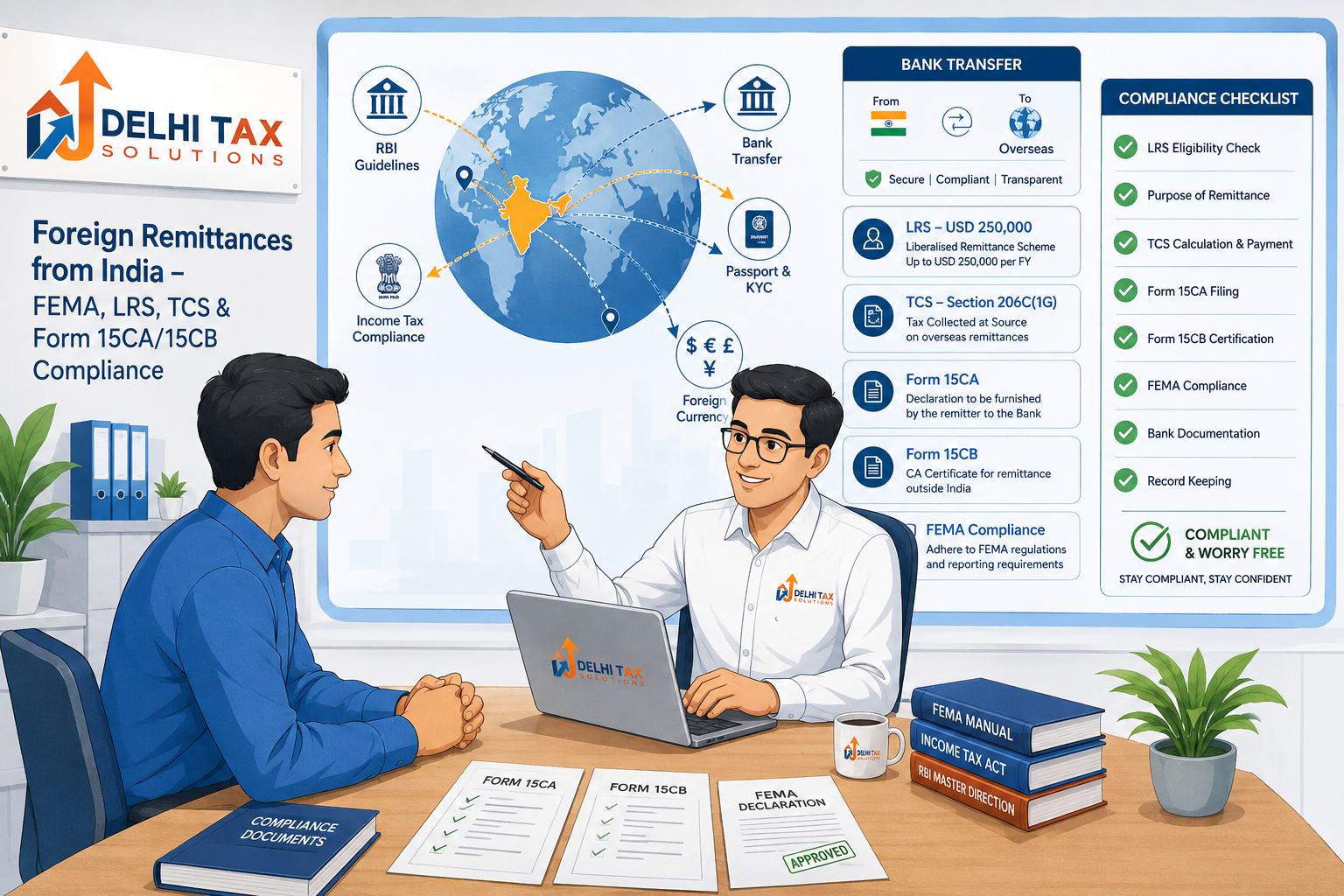
- Resident individuals can remit up to USD 250,000 per financial year under the Liberalised Remittance Scheme (LRS).
- Section 206C(1G) imposes Tax Collection at Source (TCS) ranging from 0.5% to 20% depending on remittance purpose.
- Form 15CA and Form 15CB certifications are mandatory for taxable foreign remittances exceeding ₹5 Lakhs.
- Comprehensive documentation safeguards against regulatory audits and ensures smooth cross-border wealth management.
Sending money abroad from India requires strict adherence to legal frameworks, where fema income tax foreign remittances intersect to govern every wire transfer. Whether you are funding an overseas education, investing in foreign stocks, supporting family members abroad, or structuring corporate expansions connected to domestic Company Registration entities, cross-border payments involve rigorous oversight. Understanding statutory limits, withholding requirements, and mandatory electronic filings prevents costly banking delays and regulatory penalties.
Regulatory Framework for International Wire Transfers
Outbound fund transfers from India are regulated by two distinct authorities: the Reserve Bank of India (RBI) under the Foreign Exchange Management Act (FEMA) and the Central Board of Direct Taxes (CBDT) under the Income Tax Act. Under the Liberalised Remittance Scheme (LRS), resident individuals can freely remit up to USD 250,000 per financial year for permitted current or capital account transactions without prior RBI approval. Business entities, however, must follow separate corporate remittance pathways.
Before initiating any international payment, remitters must verify whether the transaction is an eligible current account expense or a capital investment. Proper classification dictates reporting codes, documentary proofs required by Authorized Dealer (AD) banks, and applicable tax collection obligations. Ensuring meticulous record-keeping aligns your foreign financial activities with current Income Tax Filing standards and RBI transparency directives.
Decoding LRS Limits and Remittance Purpose Codes
The USD 250,000 Annual Threshold
The LRS limit applies cumulatively across all AD banks per financial year for resident individuals. This cap covers donations, gifts, maintenance of close relatives, travel, medical treatment, and studies abroad. Minors can also utilize the USD 250,000 allowance, provided guardian compliance is established.
Mandatory RBI Purpose Codes
Every outward remittance requires a designated RBI purpose code. Selecting the correct code—such as S0305 for education or S1301 for investment in equity shares—is critical. Inaccurate coding triggers compliance flags and holds funds at intermediary correspondent banks.
⚡ Compliance Tip
Always verify your aggregate financial year remittance volume across all bank accounts to prevent accidental breaches of the USD 250,000 LRS ceiling.
Tax Collection at Source (TCS) Rules under Section 206C(1G)
Tax Collection at Source applies to remittances processed through AD banks under TCS on foreign remittance Section 206C(1G) mandates. Banks collect TCS at the time of debiting your account, which can later be claimed as a credit or refund during annual tax return filings.
| Remittance Purpose Category | TCS Rate (Up to ₹7 Lakhs Threshold) | TCS Rate (Above ₹7 Lakhs Limit) |
|---|---|---|
| Education (Funded via Educational Loan) | 0% | 0.5% on amount exceeding ₹7 Lakhs |
| Education / Medical Treatment (Own Funds) | 0% | 5% on amount exceeding ₹7 Lakhs |
| Overseas Tour Packages | 5% from first rupee | 20% across all tier thresholds |
| Investments, Gifts, Maintenance & Others | 0% (Up to ₹7 Lakhs aggregate) | 20% on amount exceeding ₹7 Lakhs |
Mandatory Compliance via Form 15CA and Form 15CB
Understanding Form 15CA Parts
For taxable foreign remittances exceeding ₹5 Lakhs in a financial year, the remitter must electronically file Form 15CA and Form 15CB filing paperwork on the income tax portal. Form 15CA is a self-declaration broken into four parts depending on tax liability and remittance size, ensuring the department tracks foreign payments effectively.
The Role of Form 15CB Certificate
Form 15CB must be certified by a practicing Chartered Accountant. The CA verifies that appropriate Tax Deducted at Source (TDS) has been deducted, analyzes Double Taxation Avoidance Agreement (DTAA) benefits, and signs off on the remittance computation before bank processing.
Operational Best Practices and Regulatory Oversight
Tax Clearance and Ancillary Liabilities
Remitters must ensure that underlying funds are clean and fully taxed. If property sale proceeds or business profits are being remitted, verify that municipal Property Tax or corporate GST Registration obligations are settled. Official updates published by the Press Information Bureau, notifications from the Income Tax Department, circulars by the Reserve Bank of India, and corporate frameworks overseen by the Ministry of Corporate Affairs govern cross-border capital flows.
Why Professional Guidance Matters
Navigating LRS limits, TCS offsets, DTAA clauses, and CA certifications requires specialized expertise. Speak with a Delhi Tax Solutions expert today. Our certified Chartered Accountants will verify your purpose codes, file your Form 15CA/15CB accurately, and ensure seamless outward remittance processing without regulatory friction.
Mastering fema income tax foreign remittances ensures your international transactions remain compliant, transparent, and tax-efficient. Partner with Delhi Tax Solutions to streamline your cross-border financial operations today.
About this article: Researched using official government sources and Delhi Tax Solutions’ in-house tax advisory team. Last updated August 2026.
Frequently Asked Questions (FAQs)
Q: What is the maximum outward remittance limit under the RBI Liberalised Remittance Scheme (LRS)?
A: Under the RBI Liberalised Remittance Scheme (LRS), resident individuals can freely remit up to USD 250,000 per financial year for permitted current or capital account transactions. This limit applies cumulatively across all bank accounts held by the individual in India and covers purposes such as education, travel, medical treatment, and overseas investments.
Q: How is Tax Collection at Source (TCS) applied on foreign remittances under Section 206C(1G)?
A: Tax Collection at Source (TCS) under Section 206C(1G) is collected by Authorised Dealer banks at the time of remittance. For most purposes like investments or general maintenance, a 20% TCS applies to amounts exceeding the aggregate threshold of ₹7 Lakhs per financial year. Remittances funded via educational loans attract a lower 0.5% rate on excess amounts.
Q: When are Form 15CA and Form 15CB mandatory for international money transfers?
A: Form 15CA and Form 15CB are mandatory when executing taxable foreign remittances exceeding ₹5 Lakhs in a financial year. Form 15CA is submitted online by the remitter as a self-declaration, while Form 15CB is a certifying document issued by a practicing Chartered Accountant confirming proper tax deduction and DTAA compliance.
Q: Can resident individuals remit funds abroad for capital investments under FEMA?
A: Yes. Resident individuals can use their annual USD 250,000 LRS allowance to make capital account remittances, such as purchasing equity shares, debt instruments, or immovable property overseas, or setting up overseas joint ventures and wholly-owned subsidiaries, provided all RBI reporting guidelines are strictly followed.
Q: How do NRO account repatriation rules differ from regular LRS remittances for NRIs?
A: While LRS governs resident outward transfers up to USD 250,000, Non-Resident Indians (NRIs) repatriating funds from their Non-Resident Ordinary (NRO) accounts can transfer up to USD 1 Million per financial year. This higher limit applies to legitimate asset sale proceeds, rents, and inheritances in India, subject to valid tax clearance certificates.
