
💡 Key Takeaways
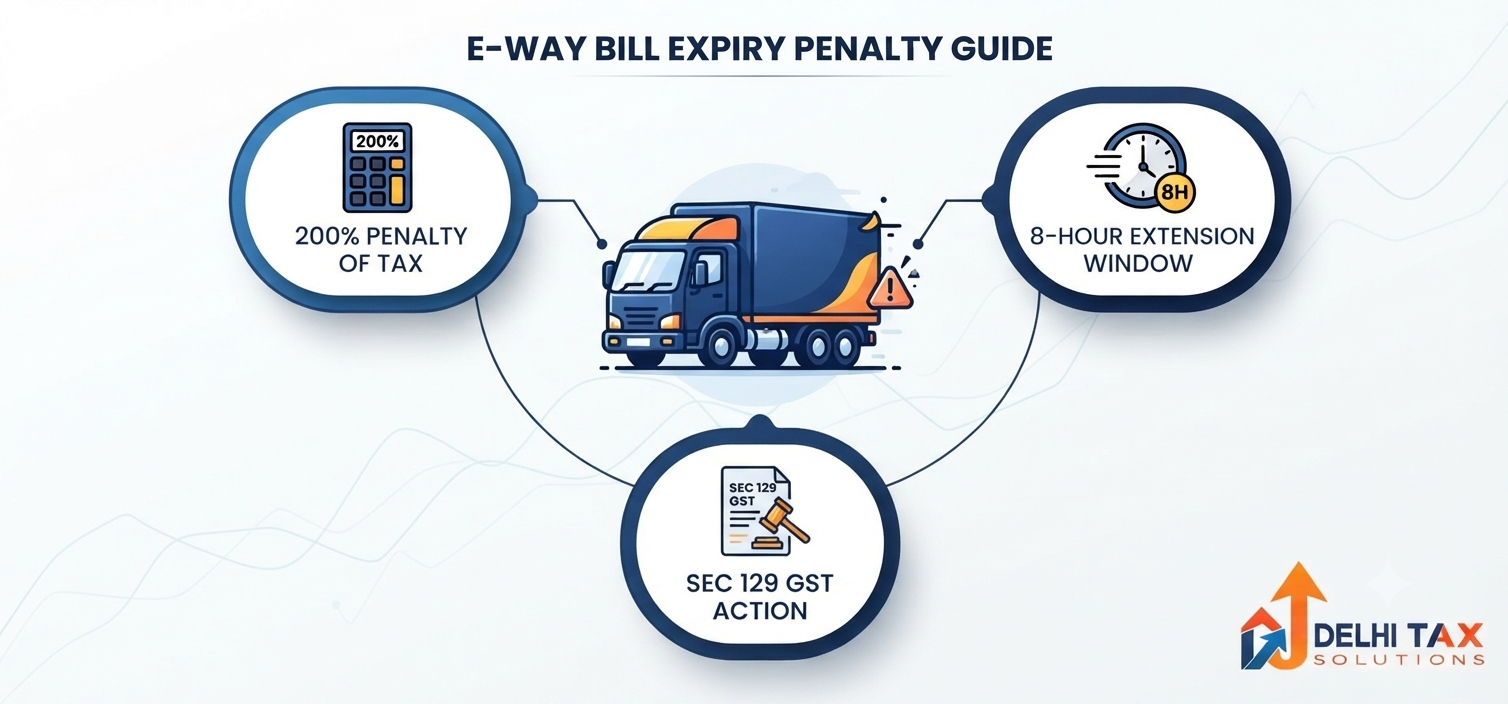
- An expired e-way bill penalty triggers a massive 200% fine on the tax payable under Section 129 GST.
- Officers can legally intercept and order vehicle detention if the e-way bill validity has crossed its limit.
- You have a strict 8-hour window before or after expiry to request an e-way bill validity extension.
- Penalty payments must be processed using Form GST DRC-03 to secure the release of goods.
- Minor clerical errors do not justify vehicle seizure; they attract a nominal ₹1,000 penalty instead.
Picture this scenario: Your transport vehicle is kilometres away from its destination. A mobile GST squad intercepts the truck, checks the documents, and discovers the e-way bill expired just one hour ago. The goods are immediately detained. This exact situation costs Indian MSMEs and transporters lakhs of rupees every week.
Navigating an expired e-way bill penalty can feel overwhelming. The GST rules treat an expired document almost identically to travelling with no document at all. This means officers will invoke Section 129 of the CGST Act, leading to heavy fines, disrupted supply chains, and complicated paperwork.
Based on cases handled by our CA team, the biggest mistake taxpayers make is ignoring the timeline. You must understand your legal rights and obligations immediately. We will break down exactly how the penalty is calculated, which legal forms you will encounter, and the fastest way to get your consignment released.
What is the Expired E-Way Bill Penalty?
The expired e-way bill penalty is a strict financial fine imposed when goods in transit are caught with an e-way bill that has crossed its validity period. Under section 129 gst, the penalty is generally 200% of the tax payable on the goods if the owner comes forward to pay. Until this massive penalty is paid, the GST department has the legal right to detain both the goods and the transport vehicle.
Understanding the Legal Ground: Section 129 GST Act
When goods move across India without proper documentation, the government views it as potential tax evasion. Section 129 of the CGST Act grants tax authorities the power to detain and seize goods in transit. If your e-way bill expires, the document becomes legally invalid.
There is a critical legal distinction you must know. Section 129 deals solely with detention and seizure. It forces you to pay a penalty to release the goods. This is entirely different from Section 130, which deals with complete confiscation. If you fail to resolve a Section 129 detention within 15 days, the case escalates to confiscation under Section 130.
Detention vs. Seizure
Detention means the GST officers deny access to your goods pending an investigation. Seizure happens when authorities formally take possession of the goods. In both cases, the transporter loses control of the vehicle.
⚡ Quick Summary
Driving with an expired e-way bill is treated as driving without one. The vehicle will be detained under Section 129, and goods will only be released after paying a heavy penalty or providing an equivalent bank guarantee.
How Much is the E-Way Bill Penalty Calculation?
The gst section 129 amendment introduced by the Finance Act radically changed penalty structures. Previously, the penalty was 100% of the tax amount. Today, it is much harsher. The exact penalty depends entirely on who comes forward to claim the goods and pay the fine.
When the Owner Comes Forward
If the rightful owner of the goods accepts liability and steps forward, the penalty is exactly 200% of the tax payable. No separate tax amount is collected during this stage; you only pay the penalty to release the vehicle.
When the Owner Does Not Come Forward
If the owner refuses to claim the goods (or cannot be found), the transporter usually has to resolve the issue. In this scenario, the penalty skyrockets. It becomes the higher of either 50% of the value of the goods or 200% of the tax payable.
| Scenario | Taxable Goods Penalty | Exempted Goods Penalty |
|---|---|---|
| Owner claims the goods | 200% of the tax payable | 2% of goods value or ₹25,000 (whichever is lower) |
| Owner does NOT claim | Higher of 50% of goods value OR 200% of tax | 5% of goods value or ₹25,000 (whichever is lower) |
If you need help ensuring your transport documents align with your broader compliance, review our guide on GST Registration. Proper initial setup prevents severe compliance headaches down the line.
The Detention Procedure: What Happens at the Checkpoint?
When a vehicle is intercepted with an expired eway bill, the GST officers must follow strict cbic guidelines. They cannot simply demand cash on the spot. The process involves a highly specific sequence of GST MOV forms.
Step 1: Interception and Statement
The officer intercepts the vehicle and requests documents. If the e-way bill has expired, they will record the driver’s statement and issue Form GST MOV-01. They then issue an order for physical verification in Form GST MOV-02.
Step 2: Physical Verification
The authorities must inspect the goods. The officer will prepare a detailed physical verification report within 24 hours of the inspection, officially documented in Form GST MOV-04.
Step 3: Official Detention Order
This is the critical moment. The officer issues form gst mov 06, which legally detains the vehicle and goods. Immediately following this, they will serve a notice under Form GST MOV-07, explicitly stating the tax and penalty calculated. You are given an opportunity to be heard before the final order is passed in Form GST MOV-09.
Always verify your forms against the official CBIC GST Portal to ensure the officers are following statutory protocol.
How to Extend E-Way Bill Validity to Avoid Penalties
The best way to handle an expired e-way bill penalty is to prevent it from happening. Under the CGST Rules, an eway bill validity lasts for a specific timeframe depending on the distance travelled (normally 200 km per day for standard cargo).
If a vehicle breaks down, faces extreme weather, or encounters a strike, you can legally extend the e-way bill. However, you only have an 8-hour window. You must apply for the extension within 8 hours before expiry, or within 8 hours after expiry.
To extend it, the transporter must log into the portal, enter the current e-way bill number, and select the reason for extension. Once this 8-hour grace period passes, the system locks you out. At that point, if the goods are still in transit, they are vulnerable to vehicle seizure.
How to Appeal or Release Detained Goods
If you receive form gst mov 06 and your vehicle is parked at the checkpoint, you need to act quickly. You essentially have two choices to secure the release of your goods.
Payment of Penalty
The fastest route is to accept the penalty. You must pay the 200% penalty amount through the GST portal using Form GST DRC-03. Once the payment reflects, the proper officer will issue a release order in Form GST MOV-05, and the truck is free to go.
Furnishing a Bank Guarantee
If you believe the detention was unfair and you want to fight it, you do not have to pay cash immediately. You can furnish a bank guarantee equal to the penalty amount. The goods will be released, and you can proceed to file an appeal. If you need dedicated help with this process, [LINK GAP — no live page found: suggested topic: Section 129 Appeals] our team can guide you through the litigation.
Remember, an appeal against a section 129 gst order must be filed within three months using Form GST APL-01.
Moving Forward Safely
Getting hit with an expired e-way bill penalty disrupts cash flow and ruins delivery timelines. Remember your three critical takeaways: track your expiry times religiously, use the 8-hour extension window immediately during delays, and ensure you have the funds or a bank guarantee ready if detained. Proactive GST Services and compliance training for your transport staff are your best defence. Stay vigilant on the road.
Frequently Asked Questions (FAQs)
+ Q: What is the penalty for an expired e-way bill in 2026?
A: Under the amended Section 129 of the CGST Act, the penalty for moving goods with an expired e-way bill is strictly 200% of the tax payable on those goods, provided the owner comes forward. If the owner does not claim the goods, the penalty rises to the higher of 50% of the goods’ value or 200% of the tax.
+ Q: Can I extend an e-way bill after it has expired?
A: Yes, but only within a very tight timeframe. The GST rules allow a transporter to extend the validity of an e-way bill within 8 hours before its expiry or up to 8 hours after its expiry. Once this 8-hour grace period passes, the portal will block any extension requests, leaving the goods vulnerable to detention.
+ Q: What is the difference between detention and confiscation under GST?
A: Detention, covered under Section 129, is a temporary hold on your goods and vehicle until a penalty is paid. Ownership remains with you. Confiscation, covered under Section 130, is the permanent seizure of goods by the government. A Section 129 detention automatically becomes a Section 130 confiscation if the penalty is not paid within 15 days.
+ Q: How do I pay the penalty under Section 129?
A: To pay a Section 129 penalty, you must log into the GST portal and navigate to the ‘User Services’ section. From there, you will file Form GST DRC-03 under the ‘voluntary payment’ category. You must mention the exact notice number (Form GST MOV-07) and pay the 200% penalty through your electronic cash ledger.
+ Q: Can the GST department detain goods for minor clerical mistakes?
A: No. According to the CBIC guidelines, minor clerical errors in the e-way bill—such as a spelling mistake in the name, a slight error in the PIN code (if the state is correct), or a minor typo in the vehicle number—do not warrant vehicle detention under Section 129. They attract a minor penalty of just ₹1,000 under Section 125.
About this article: Researched using official government sources, real-time competitor and search-trend analysis, and Delhi Tax Solutions’ in-house tax advisory team. Last updated September 2026.
This article is for general informational purposes and is not a substitute for personalised professional tax advice.