
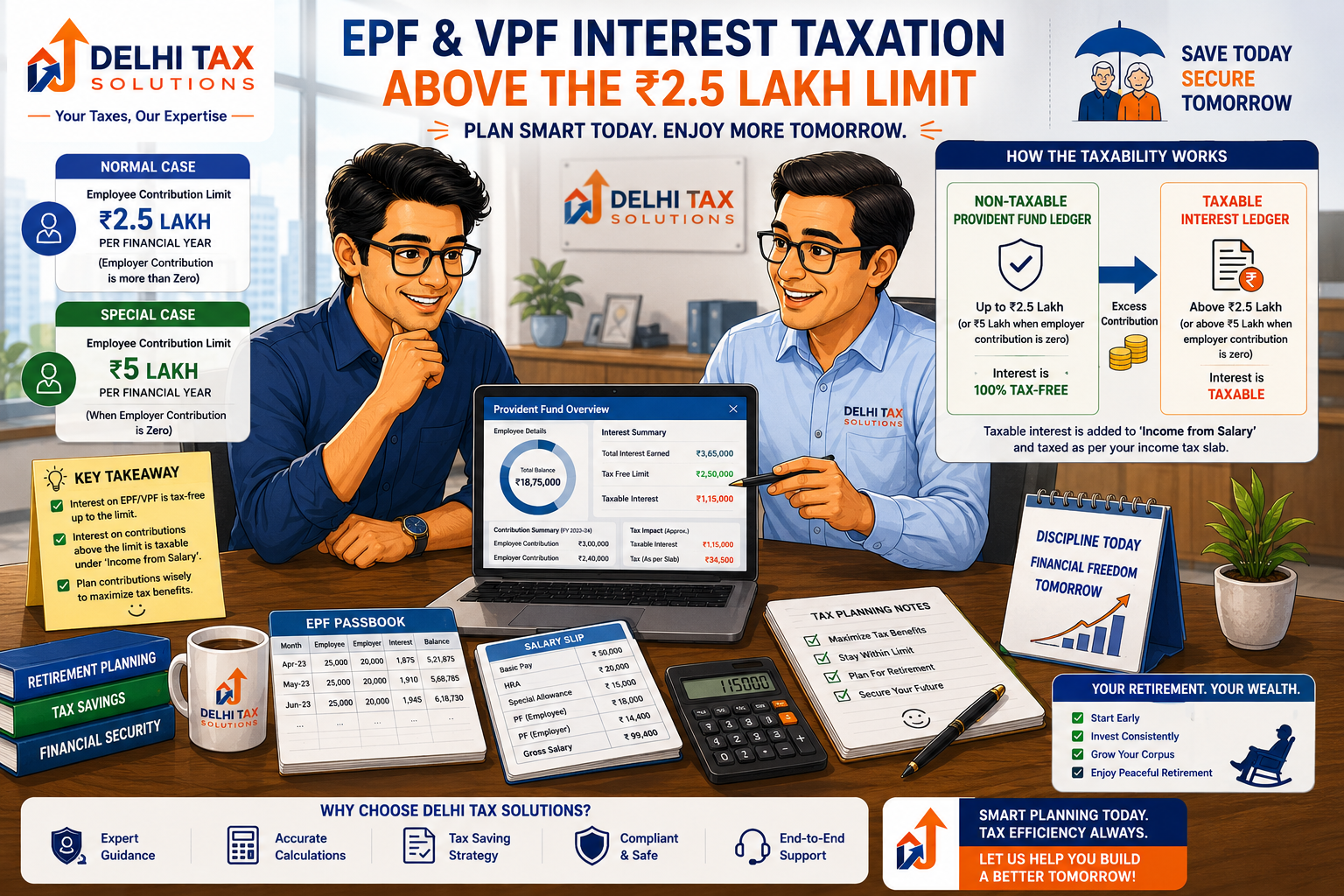
💡 Key Takeaways
- EPF and VPF interest on employee contributions exceeding ₹2.5 lakh annually is taxable.
- If the employer makes zero contribution, the non-taxable employee threshold rises to ₹5 lakh.
- Taxable interest is credited to a separate ledger within the provident fund account.
- Employers report this taxable component directly in annual Form 16 salary certificates.
- Consulting professional tax CAs ensures high earners avoid calculation errors during filing.
Building a robust retirement corpus through the Employee Provident Fund is a cornerstone of personal finance for Indian salaried workers. However, understanding EPF VPF interest taxation above limit rules is vital for high-earning professionals who park surplus funds in voluntary provident schemes to avoid unexpected tax liabilities.
Tax regulations introduced strict boundaries to prevent high-net-worth individuals from leveraging tax-free sovereign interest rates on massive contributions. Whether you are a senior IT consultant in Delhi NCR or a corporate director reviewing your annual savings, knowing these thresholds protects your net yield.
This comprehensive guide breaks down statutory contribution caps, separate ledger rules, calculation methods, and compliance frameworks for FY 2025-26. Plan your retirement investments correctly to maximize returns.
What is EPF VPF interest taxation above limit?
EPF VPF interest taxation above limit refers to the statutory income tax rule where interest earned on annual employee provident fund and voluntary provident fund contributions exceeding ₹2.5 lakh is treated as taxable income under the head “Income from Other Sources.” This provision ensures that high-earning salaried individuals pay applicable slab-rate taxes on interest generated from surplus contributions beyond the government-mandated ceiling.
What are the rules for PF contribution above limit tax?
Navigating PF contribution above limit tax requires understanding the exact statutory thresholds established by the tax authorities. According to notifications issued by the Income Tax Department, employee contributions to Recognized Provident Funds (RPF) are divided into taxable and non-taxable accounts starting from April 1, 2021.
For standard employees where the employer also contributes, annual employee contributions up to ₹2.5 lakh generate tax-free interest. If the employer makes zero contribution to the fund—such as in certain independent establishments—the employee threshold doubles to ₹5 lakh per financial year.
Corporate executives managing personal investments alongside corporate compliance structures like Company Registration must track these figures carefully. Managing related withholdings through structured TDS mechanisms prevents compliance discrepancies.
The ₹2.5 lakh statutory threshold
The ₹2.5 lakh ceiling applies exclusively to the employee’s own contribution through mandatory EPF deductions and voluntary VPF additions combined within a single financial year.
Special ₹5 lakh limit exceptions
Where employers make no contribution to the provident fund account, the statutory ceiling for tax-free employee interest is expanded to ₹5 lakh per annum.
How does VPF taxable interest rule impact savers?
Analyzing the VPF taxable interest rule is essential for savers who utilize Voluntary Provident Fund contributions to lock in sovereign-backed yields. Official reviews published by the Press Information Bureau highlight that these measures target high-income earners while safeguarding modest savers.
When an employee’s combined EPF and VPF contribution surpasses ₹2.5 lakh in a financial year, the EPFO maintains two separate sub-accounts: a non-taxable contribution account and a taxable contribution account. Interest accrued on the taxable sub-account is computed annually and subjected to tax deduction at source or reported for direct return filing.
Taxpayers evaluating their overall financial portfolios must also reconcile annual earnings with statutory Income Tax filing obligations.
Dual ledger maintenance by EPFO
The Employees’ Provident Fund Organisation automatically segregates deposits into taxable and non-taxable ledgers to simplify annual interest calculation and reporting for members.
Taxability under Income from Other Sources
Unlike regular salary income, the taxable portion of provident fund interest is reported under “Income from Other Sources” and taxed according to the individual’s applicable personal income tax slab rate.
| Contribution Scenario | Maximum Tax-Free Limit | Tax Treatment for Excess Amount |
|---|---|---|
| Employer contributes to EPF | ₹2,50,000 per financial year | Interest on excess is taxable at slab rates |
| Employer makes zero contribution | ₹5,00,000 per financial year | Interest on excess is taxable at slab rates |
| Employer contribution to EPF | Not counted toward employee cap | Employer contributions remain tax-free up to 12% of salary |
| Voluntary Provident Fund (VPF) | Combined with EPF under ₹2.5L cap | Excess VPF contributions generate taxable interest |
⚡ Quick Summary
EPF and VPF interest earned on employee contributions exceeding ₹2.5 lakh per year (or ₹5 lakh if no employer contribution exists) is fully taxable at personal income tax slab rates.
How is EPF interest tax calculation performed?
Executing an accurate EPF interest tax calculation involves determining the precise closing balance of the taxable contribution ledger at the end of each financial year. Financial analyses published by the Reserve Bank of India emphasize that transparency in provident fund accounting protects retail savers from miscalculations.
The EPFO calculates interest monthly on running balances, but the interest attributable to the taxable contribution ledger is isolated and reported to the Income Tax Department. For example, if a high earner contributes ₹4 lakh total in a year, the ₹1.5 lakh excess generates interest that must be declared in their annual Income Tax Return (ITR).
Corporate human resources departments and payroll providers regulated by the Ministry of Corporate Affairs integrate these calculations directly into annual tax statements.
Monthly running balance computation
Interest accrues monthly based on opening and closing balances, requiring precise arithmetic segregation between the taxable and non-taxable sub-ledgers throughout the year.
Avoiding compliance and reporting errors
Failing to report taxable provident fund interest can trigger automated scrutiny notices from the tax portal. Reconciling passbooks with Form 16 statements eliminates these risks.
What are compliance obligations for high-earning salaried workers?
High-earning salaried professionals must adopt structured compliance habits to manage their provident fund portfolios. Employers are required to deduct TDS on taxable interest where applicable, and taxpayers must ensure their chartered accountants incorporate these figures into their advance tax computations.
Business owners managing multiple commercial ventures must also ensure that related entity compliances, such as GST Registration, remain up to date alongside personal filings.
Advance tax and TDS reconciliation
Because taxable interest is credited annually, advance tax installments must account for this additional income stream to prevent statutory penal interest under Sections 234B and 234C.
Professional CA advisory support
Navigating complex multi-stream income requires expert guidance. Protect your retirement earnings and file your returns accurately with professional assistance.
Talk to a Delhi Tax Solutions expert to get your ITR filed and provident fund tax computations optimized professionally. Secure your financial future and ensure complete compliance today.
About this article: Researched using official government sources and Delhi Tax Solutions’ in-house tax advisory team. Last updated August 2026.
This article is for general informational purposes and is not a substitute for personalised professional tax advice.
Frequently Asked Questions (FAQs)
Q: What is the annual contribution limit before EPF interest becomes taxable?
A: The statutory annual contribution limit before employee provident fund and voluntary provident fund interest becomes taxable is ₹2.5 lakh per financial year. However, if your employer makes zero contribution to your provident fund account, this tax-free employee contribution threshold is increased to ₹5 lakh per annum.
Q: How is tax calculated on EPF and VPF interest exceeding ₹2.5 lakh?
A: The EPFO maintains a separate taxable ledger for contributions exceeding the ₹2.5 lakh threshold. Interest accrued on this specific taxable balance at the end of each financial year is computed and categorized under “Income from Other Sources,” which is then added to the taxpayer’s total income and taxed according to their applicable personal income tax slab rate.
Q: Are employer and employee contributions clubbed together for the tax limit?
A: No, employer and employee contributions are not clubbed together. The ₹2.5 lakh (or ₹5 lakh) tax-free limit applies strictly to the employee’s own aggregate contributions made through mandatory EPF deductions and voluntary VPF additions. Employer contributions remain tax-free up to 12% of salary independently under separate statutory rules.
Q: How do employers report taxable EPF interest in Form 16?
A: Employers calculate the taxable interest on excess provident fund contributions using data provided by the EPFO and report this exact monetary value in Part B of Form 16. Salaried employees must ensure this reported figure matches their annual passbook records when filing their Income Tax Returns to prevent automated tax scrutiny.
Q: Does the ₹2.5 lakh tax limit apply separately if the employer makes no contribution?
A: Yes, the threshold is adjusted if the employer makes zero contribution. For funds where the employer does not contribute anything, the statutory limit for tax-free employee contributions is doubled from ₹2.5 lakh to ₹5 lakh per financial year, providing additional headroom for eligible members before interest taxation begins.
