💡 Key Takeaways
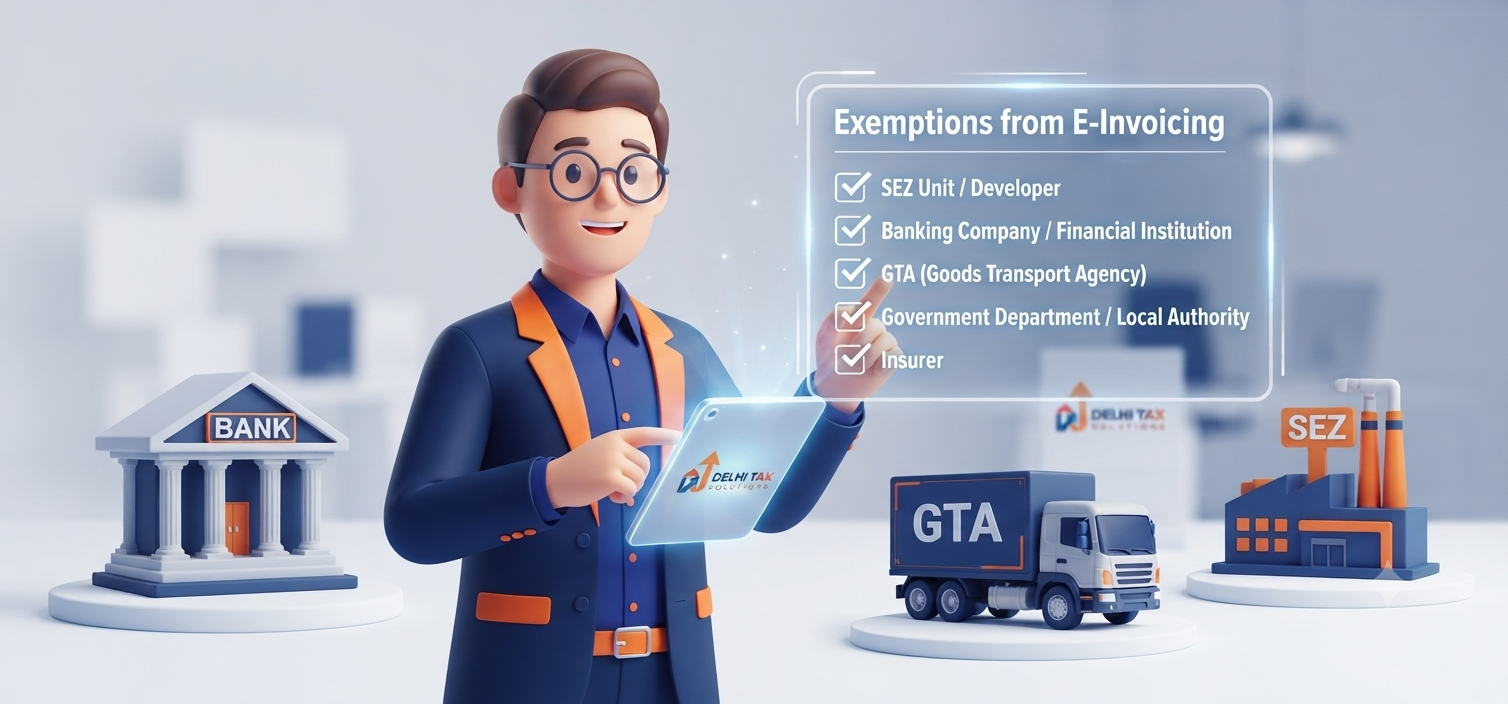
- Certain business entities are globally exempt from generating e-invoices, regardless of their Annual Aggregate Turnover (AATO).
- SEZ Units are completely exempt, but SEZ Developers must generate e-invoices if they cross the turnover threshold.
- Goods Transport Agencies (GTAs) are exempt from generating e-invoices for their transportation services.
- Exempt entities must print a specific mandatory declaration on their standard tax invoices stating they are exempt from generating an IRN.
- B2C (Business to Consumer) transactions are inherently exempt from the e-invoicing mandate for all businesses.
The implementation of mandatory electronic invoicing under GST revolutionized how B2B transactions are reported to the Invoice Registration Portal (IRP). While the government steadily lowered the turnover threshold to encompass more businesses, it deliberately kept certain sectors outside the purview of Rule 48(4) of the CGST Rules. Understanding the complete list of exemptions from e-invoicing is critical to prevent compliance errors, especially for businesses dealing with multiple registration types.
These exemptions are primarily granted to sectors that already operate under stringent regulatory frameworks (like banking) or handle massive volumes of direct consumer ticketing (like multiplexes and transport). This guide details every official e-invoice exemption for 2026, dissects the specific rules for sezs and gta e-invoice compliance, and outlines the mandatory invoice declarations required for exempt businesses.
The Complete List of Entities Exempt from E-Invoicing
As per CBIC notifications, the following classes of registered persons are exempt from generating an Invoice Reference Number (IRN), even if their Annual Aggregate Turnover exceeds the mandated threshold:
| Exempt Entity Type | Regulatory Rule / Notification | Specific Details |
|---|---|---|
| Banks, FIs, and NBFCs | Rule 54(2) of CGST Rules | Includes insurers, banking companies, and Non-Banking Financial Companies. |
| Goods Transport Agency (GTA) | Rule 54(3) of CGST Rules | Exempt specifically for the service of goods transportation by road in a goods carriage. |
| Passenger Transport Services | Rule 54(4) of CGST Rules | Includes airlines, railways, and road passenger transport businesses. |
| Multiplexes & Cinema Screens | Rule 54(4A) of CGST Rules | Exempt for supplying services by way of admission to exhibition of cinematograph films. |
| SEZ Units | Notification 61/2020-Central Tax | Only SEZ Units are exempt. SEZ Developers do not enjoy this exemption. |
| Government Departments | Notification 23/2021-Central Tax | Government departments and Local Authorities are entirely excluded from the mandate. |
Understanding the SEZ Exemption: Units vs. Developers
One of the most frequent points of confusion regarding e-invoice exemptions surrounds Special Economic Zones (sezs). The GST law draws a very sharp distinction between a unit operating inside an SEZ and the developer who built the SEZ.
- SEZ Units: A business entity registered as an SEZ Unit is completely exempt from generating e-invoices. They can continue issuing standard tax invoices for their supplies.
- SEZ Developers: An entity registered as an SEZ Developer is NOT exempt. If their aggregate turnover exceeds the notified threshold, they must generate an IRN for all B2B supplies.
- DTA to SEZ Supplies: If a regular business located in a Domestic Tariff Area (DTA) makes a supply to an SEZ Unit, the DTA supplier must generate an e-invoice (treating it as an export/zero-rated supply).
GTA E-Invoice Rules: How Do They Work?
Goods Transport Agencies provide critical logistics infrastructure. The CBIC specifically excluded GTAs from the e-invoicing mandate because their primary operational document is a consignment note, and billing mechanisms often fall under the Reverse Charge Mechanism (RCM).
For gta e-invoice compliance, the rule is straightforward: GTAs issuing consignment notes and invoices for the transportation of goods by road are exempt from generating an IRN. However, there is a catch. If a business that happens to be registered as a GTA also provides other unrelated taxable supplies (for example, leasing out commercial real estate or selling vehicle spare parts), they must generate e-invoices for those non-transportation B2B supplies, provided their overall turnover exceeds the threshold.
The Mandatory Invoice Declaration for Exempt Entities
Simply being exempt does not mean you can ignore e-invoicing entirely on your paperwork. To prevent confusion among buyers who might expect an IRN and QR code to claim Input Tax Credit (ITC), the government introduced a mandatory declaration rule for exempt entities.
If your turnover exceeds the e-invoicing threshold but you fall into an exempt category (like a Bank, SEZ Unit, or GTA), you must explicitly print a declaration on all your B2B tax invoices. The standard format mandated by the CBIC is:
“I/We hereby declare that though our aggregate turnover in any preceding financial year from 2017-18 onwards is more than the aggregate turnover notified under sub-rule (4) of rule 48, we are not required to prepare an invoice in terms of the provisions of the said sub-rule.”
Common Exemptions Not Tied to Entity Type
Aside from specific industries, certain types of transactions are naturally exempt from the e-invoicing framework across the board:
- B2C Transactions: Business-to-Consumer sales do not require an e-invoice. (However, dynamic QR codes may be required for B2C invoices if turnover exceeds ₹500 Crores).
- Exempt Supplies (Bill of Supply): If a business sells wholly tax-exempt goods or services, they issue a ‘Bill of Supply’ instead of a Tax Invoice. E-invoicing only applies to Tax Invoices, Credit Notes, and Debit Notes.
- Imports: Bills of Entry used for import of goods are not subject to e-invoicing.
Frequently Asked Questions (FAQs)
+ Q: Is e-invoicing mandatory for hospitals and healthcare services?
A: Hospitals are not explicitly granted a blanket exemption. However, healthcare services are generally exempt from GST, meaning they issue a Bill of Supply rather than a Tax Invoice. If a hospital makes taxable B2B supplies (like renting space to a pharmacy) and their turnover exceeds the limit, they must generate an e-invoice for those specific taxable supplies.
+ Q: Are SEZ Developers exempt from e-invoicing?
A: No. Only SEZ Units are exempt. SEZ Developers must comply with e-invoicing provisions and generate IRNs for their B2B outward supplies if they cross the turnover threshold.
+ Q: What happens if an exempt GTA doesn’t put the required declaration on their invoice?
A: Failure to include the mandatory declaration can lead to the invoice being considered invalid under GST rules, potentially resulting in compliance penalties and causing friction with buyers who may face difficulties claiming Input Tax Credit.
+ Q: Do export businesses get an e-invoice exemption?
A: No. Exports (both with and without payment of IGST) are considered zero-rated supplies and are fully subject to e-invoicing rules. Exporters must generate an IRN.
+ Q: Do I need an e-invoice for Nil-rated or purely non-GST supplies?
A: No. Nil-rated, wholly exempt, and non-GST supplies are documented via a Bill of Supply, which does not require an e-invoice.
Navigate Complex GST Rules with Delhi Tax Solutions
Are you unsure if your specific business operations qualify for an e-invoice exemption? Misinterpreting SEZ or GTA rules can result in invalid invoices and severe ITC penalties for your clients.
Our expert team provides precise, industry-specific GST Compliance Services to ensure your invoicing practices align perfectly with CBIC notifications. Contact Delhi Tax Solutions today for a comprehensive compliance review.
About this article: Compiled using official CBIC notifications, CGST Rule 48(4), and insights from the senior tax advisory panel at Delhi Tax Solutions. Last updated September 2026.
Disclaimer: This guide is intended for informational and educational purposes only and does not replace formal legal or tax consultation.