💡 Key Takeaways
- E-Invoicing under GST is mandatory for registered businesses with an aggregate annual turnover exceeding ₹5 Crore in any preceding financial year from 2017-18 onwards.
- The threshold was lowered in phases by CBIC, moving from ₹500 Crore in October 2020 down to the current ₹5 Crore limit effective August 1, 2023.
- E-Invoicing applies primarily to B2B supplies, export transactions, and SEZ supplies, while strictly excluding B2C transactions and exempt goods.
- Statutory exemptions cover BFSI institutions, NBFCs, Goods Transport Agencies (GTA), passenger transport services, multiplex admissions, and government bodies.
- Issuing invoices without a valid IRN renders them legally invalid under Rule 48(5), inviting penalties under Section 122 and blocking buyer Input Tax Credit (ITC).
Digital transformation in Indian indirect taxation reached a pivotal milestone with the rollout of the GST e-invoicing framework under Rule 48(4) of the CGST Rules. Designed to streamline tax reporting, eliminate invoice tampering, and automate Input Tax Credit (ITC) reconciliation, e-invoicing has reshaped how commercial enterprises document sales. While large conglomerates were the first to adopt mandatory digital workflows, successive Central Board of Indirect Taxes and Customs (CBIC) notifications continuously lowered the eligibility turnover limit, bringing millions of Micro, Small, and Medium Enterprises (MSMEs) under its compliance umbrella.
Navigating **GST E-Invoicing Applicability** requires a clear understanding of your business’s aggregate annual turnover across all financial years since GST’s launch in FY 2017-18. A common misconception among business owners is that turnover is evaluated solely on current-year performance; however, crossing the statutory threshold in even a single preceding financial year triggers permanent compliance obligations. Based on cases handled by our CA team at Delhi Tax Solutions, businesses that miscalculate turnover limits or fail to generate valid Invoice Reference Numbers (IRNs) face severe dispatch delays, invoice invalidation, and recipient credit disputes. This comprehensive guide outlines the complete turnover threshold journey, B2B vs B2C rules, statutory exemptions, IRP generation steps, and crucial compliance precautions.
What Is GST E-Invoicing Applicability and Its Current Limit?
**GST E-Invoicing Applicability** mandates that registered taxpayers whose aggregate annual turnover exceeds ₹5 Crore in any preceding financial year from 2017-18 onwards must electronically upload their B2B tax invoices, credit notes, and debit notes to an authorized Invoice Registration Portal (IRP). Mandated under Rule 48(4) of the CGST Rules, the IRP validates invoice data, issues a unique 64-character Invoice Reference Number (IRN), and generates a digitally signed QR code containing key transactional details.
The Phase-Wise Journey of E-Invoicing Threshold Limits
The implementation of mandatory electronic invoicing under Indian GST followed a phased, structured approach. Rather than imposing immediate digital infrastructure demands on smaller enterprises, the Ministry of Finance progressively lowered aggregate turnover thresholds over three years. Understanding this historical progression helps tax managers verify whether historical compliance triggers apply to their active GSTINs.
Historical Timeline of Threshold Reductions
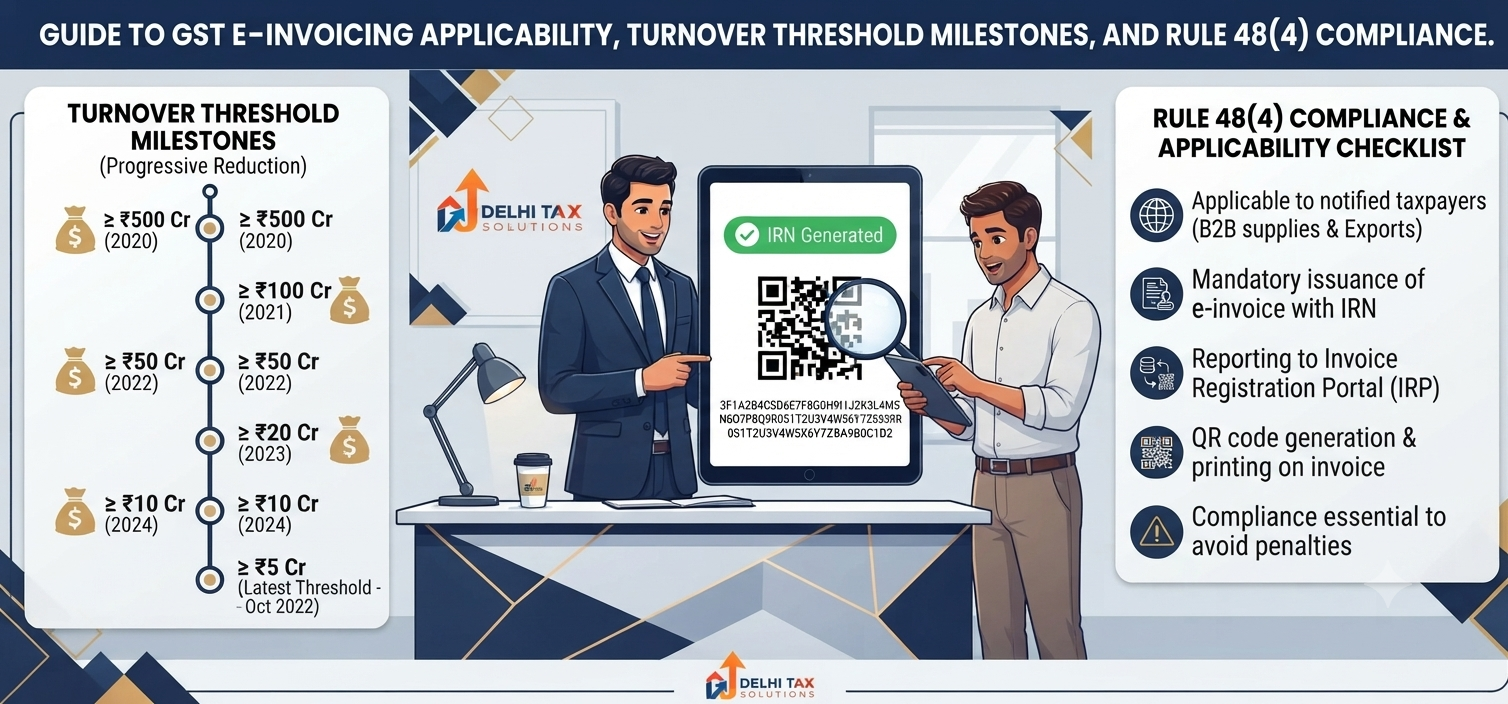
- Phase 1 (October 1, 2020): CBIC introduced e-invoicing via Notification No. 13/2020–Central Tax for large enterprises with an aggregate turnover exceeding ₹500 Crore in any preceding financial year from 2017-18.
- Phase 2 (January 1, 2021): The threshold was lowered to ₹100 Crore under Notification No. 88/2020–Central Tax, expanding coverage to mid-sized corporate entities.
- Phase 3 (April 1, 2021): Notification No. 13/2021–Central Tax reduced the limit to ₹50 Crore, bringing broader commercial suppliers under digital reporting rules.
- Phase 4 (April 1, 2022): The threshold was further reduced to ₹20 Crore under Notification No. 01/2022–Central Tax, bringing growing manufacturing and trading firms into the system.
- Phase 5 (October 1, 2022): Notification No. 17/2022–Central Tax brought down the threshold to ₹10 Crore.
- Phase 6 (August 1, 2023 – Present): Under Notification No. 10/2023–Central Tax, CBIC established the current threshold of ₹5 Crore aggregate annual turnover.
How to Calculate Aggregate Turnover for E-Invoicing
Under Section 2(6) of the CGST Act, aggregate turnover is calculated on an all-India basis for a single PAN across all registered units. It includes taxable outward supplies, exempt supplies, exports, and interstate branch transfers between distinct persons. It explicitly excludes Central tax (CGST), State tax (SGST), Integrated tax (IGST), Union Territory tax (UTGST), and GST Compensation Cess. If the sum of all sales across all branches in India exceeded ₹5 Crore in FY 2017-18, 2018-19, 2019-20, 2020-21, 2021-22, 2022-23, 2023-24, 2024-25, or 2025-26, e-invoicing becomes mandatory for all future B2B billing.
Which Transactions Are Covered Under GST E-Invoicing?
Not all transactions generated by an eligible enterprise require an IRN. GST rules establish precise boundaries between transactions subject to e-invoicing and those governed by standard billing or alternative reporting channels.
Transactions Covered Under Rule 48(4)
E-Invoicing applies mandatorily to the following commercial document categories:
- B2B Tax Invoices: Outward taxable supplies of goods or services made to registered buyers (including distinct entities sharing the same PAN).
- Export Transactions: Direct exports of goods or services (with or without IGST payment) and Deemed Exports.
- Supplies to SEZ Units & Developers: Outward taxable supplies made to Special Economic Zone units or developers.
- Credit Notes & Debit Notes: All credit notes and debit notes issued by an eligible taxpayer relating to B2B supplies, exports, or SEZ transactions.
Transactions Strictly Excluded from E-Invoicing
The following transactions do not require IRN generation on the IRP portal:
- B2C (Business-to-Consumer) Invoices: Supplies made to unregistered persons or final consumers are excluded from Rule 48(4).
- Exempt and Non-GST Supplies: Invoices covering exclusively exempt goods or non-GST items (such as petroleum crude, diesel, aviation turbine fuel, and alcoholic liquor) require a Bill of Supply rather than an e-invoice.
- Inward Reverse Charge Mechanism (RCM) Supplies: Self-invoices generated by a recipient under Section 9(4) RCM do not require IRP registration. However, if a registered supplier issues a B2B invoice under Section 9(3) RCM, e-invoicing remains mandatory for the supplier.
⚡ Quick Summary
GST e-invoicing is mandatory for all registered businesses with an aggregate annual turnover exceeding ₹5 Crore in any financial year from 2017-18 onward. It applies to B2B invoices, exports, and SEZ supplies. Non-compliance renders invoices legally invalid under Rule 48(5), exposes suppliers to penalties under Section 122, and blocks recipient Input Tax Credit under Section 16(2).
Statutory Exemptions: Who Is Not Required to Generate E-Invoices?
Certain business sectors are granted statutory exemption from e-invoicing mandates, regardless of their annual aggregate turnover. CBIC exempted these specific categories due to specialized operational workflows or pre-existing digital ticketing standards.
Entities Exempt from E-Invoicing under Rule 48(4)
- Insurers, Banking Companies, and Financial Institutions: Includes non-banking financial companies (NBFCs) and microfinance institutions governed by the RBI.
- Goods Transport Agencies (GTA): GTA service providers supplying road transportation of goods are exempt from generating e-invoices.
- Passenger Transport Service Providers: Entities providing passenger transport services (such as railways, state transport buses, and airlines) issuing passenger tickets.
- Multiplex Cinema Admissions: Entities providing admission to exhibition of cinematograph films in multiplex screens issuing electronic tickets.
- Government Departments and Local Authorities: Public administrative bodies, local municipal corporations, and statutory authorities (exempted via Notification No. 14/2021–Central Tax).
- SEZ Units: Special Economic Zone manufacturing or service units are explicitly exempt under Notification No. 13/2020–Central Tax. Note: SEZ Developers are NOT exempt and must generate e-invoices.
- OIDAR Service Providers: Overseas entities supplying Online Information Database Access and Retrieval services to unregistered non-taxable persons in India.
Step-by-Step E-Invoice Generation Workflow on the IRP
Generating a valid e-invoice involves transmitting structured invoice JSON payloads from your ERP or accounting software to an official Invoice Registration Portal (IRP) such as Official Invoice Registration Portal (IRP).
Step 1: Invoice Creation in ERP / Accounting Software
Create a standard tax invoice in your ERP containing all mandatory fields prescribed under GST Form INV-01, including buyer GSTIN, line-item HSN codes, taxable value, tax rates (CGST, SGST, IGST), and place of supply.
Step 2: JSON Payload Generation and Submission
Convert invoice data into the standard schema (eINV-01) JSON format. Upload the JSON file to an authorized IRP portal via direct API integration, GSP integration, or offline bulk generation utilities.
Step 3: IRN Generation and Digital QR Signing
The IRP validates invoice details, checks for duplicate invoice numbers across the tax year, and generates a unique 64-character hash known as the Invoice Reference Number (IRN). The portal digitally signs the payload and generates a QR code containing key invoice parameters.
Step 4: Auto-Population into GSTR-1 and E-Way Bill System
The IRP automatically transmits verified invoice data to the main GST Portal, auto-populating Table 4 of Form GSTR-1. If consignment movement details (Part-B) are included in the payload, the portal simultaneously generates an E-Way Bill, streamlining dual compliance.
| Comparison Parameter | B2B E-Invoicing | B2C Invoicing |
|---|---|---|
| Recipient Type | Registered Taxpayer (GSTIN holder) | Unregistered End Consumer |
| IRN Generation Mandatory? | Yes (64-character hash required via IRP) | No (IRN not generated on IRP) |
| QR Code Requirements | Signed QR code generated by IRP | Dynamic QR Code (only for turnover > ₹500 Cr) |
| Portal Auto-Population | Auto-populates GSTR-1 & recipient GSTR-2B | Manual / Aggregated reporting in Form GSTR-1 |
| Statutory Provision | Rule 48(4) of CGST Rules | Rule 46 / Notification No. 14/2020–CT |
| Impact of Non-Compliance | Invoice invalid; buyer loses ITC under Sec 16(2) | Penalty for missing dynamic QR code if applicable |
Consequences of Non-Compliance & Penalties Under GST
Failing to adhere to e-invoicing requirements carries severe administrative and financial consequences for both suppliers and recipient buyers.
Legal Invalidation of Tax Invoices
Under Rule 48(5) of the CGST Rules, any invoice issued by an eligible taxpayer without an IRN is deemed legally invalid. It is treated as if no invoice was ever issued, exposing the supplier to penalties under Section 122 of the CGST Act (100% of tax due or ₹10,000, whichever is higher, for each non-compliant invoice).
Recipient Input Tax Credit (ITC) Disallowance
Under Section 16(2)(a) of the CGST Act, a registered buyer can claim Input Tax Credit only if they possess a valid tax invoice. Since a non-e-invoice is invalid under Rule 48(5), tax authorities disallow ITC claims made by buyers, leading to commercial disputes, interest payments, and strained vendor relationships.
Transit Interception and E-Way Bill Risks
Transporting goods without a valid e-invoice and matching E-Way Bill exposes consignments to interception by mobile tax squads under Section 68. Intercepted goods face detention and penalties under Section 129 equal to 200% of the tax payable. Businesses seeking comprehensive regulatory support can explore our specialized GST Compliance Services to ensure 100% billing accuracy.
Frequently Asked Questions (FAQs)
+ Q: How do I know if my business falls under the ₹5 Crore GST e-invoicing limit?
A: Calculate your total aggregate annual turnover across all branches in India for every financial year from FY 2017-18 to present. If your aggregate turnover exceeded ₹5 Crore in any single financial year during this period, e-invoicing applies to your GSTIN for all B2B transactions, exports, and SEZ supplies.
+ Q: What happens if an eligible supplier issues a standard tax invoice without an IRN?
A: Under Rule 48(5) of the CGST Rules, any invoice issued by an eligible taxpayer without an IRN is not treated as a valid tax invoice under law. The supplier faces penalties under Section 122 (₹10,000 or 100% of tax amount), and the buyer cannot claim Input Tax Credit (ITC) under Section 16(2)(a).
+ Q: Are SEZ units and SEZ developers both exempt from e-invoicing?
A: No. SEZ Units are explicitly exempt from generating e-invoices under Notification No. 13/2020–Central Tax. However, SEZ Developers are NOT exempt. SEZ developers with aggregate turnover exceeding ₹5 Crore must generate IRNs for their B2B supplies. Additionally, regular units supplying to SEZ units must generate e-invoices.
+ Q: Can e-invoices be modified or cancelled on the IRP portal after generation?
A: E-Invoices cannot be edited or amended directly on the IRP. An IRN can be cancelled on the IRP within 24 hours of generation, provided no active E-Way Bill is attached. After 24 hours, cancellation is prohibited on the IRP; any amendments or cancellations must be made manually in Form GSTR-1 on the main GST portal.
+ Q: Is e-invoicing mandatory for B2C transactions for businesses above ₹5 Crore turnover?
A: No, B2C (Business-to-Consumer) transactions made to unregistered buyers are strictly excluded from Rule 48(4) e-invoicing. Businesses do not generate IRNs for B2C sales. However, taxpayers with aggregate turnover exceeding ₹500 Crore must display a Dynamic QR Code on B2C invoices for digital payment enablement.
Streamline Your GST E-Invoicing Compliance Today
E-invoicing errors can halt dispatches, invalidate customer tax invoices, and disallow Input Tax Credit. Ensuring 100% compliance requires expert aggregate turnover auditing, ERP integration, and timely IRP setup.
Our CA-led team at Delhi Tax Solutions assists enterprises with seamless e-invoicing onboarding, portal error resolution, and complete GST compliance management. Contact our tax experts today to safeguard your invoicing workflow.
About this article: Researched using official CBIC notifications, real-time competitor and search-trend analysis, and Delhi Tax Solutions’ in-house tax advisory team. Last updated September 2026.
Disclaimer: This article is for general informational purposes and is not a substitute for personalised professional tax advice.