💡 Key Takeaways
- Printing a Dynamic QR Code on B2C invoices is mandatory for GST-registered taxpayers whose Annual Aggregate Turnover (AATO) exceeds ₹500 Crore in any FY from 2017-18 onwards.
- Unlike B2B e-invoicing, B2C invoices are NOT uploaded to the Invoice Registration Portal (IRP) and do not generate an IRN.
- The B2C Dynamic QR Code is generated locally by the merchant’s POS/billing software to enable instant digital payment (UPI, cards, wallets) by the retail buyer.
- If the customer pays before invoice generation (e.g., online payment or cash), printing the QR code is waived provided the payment reference details are recorded on the invoice.
- Failure to comply with the Dynamic QR Code mandate results in penalties under Section 125 of the CGST Act (up to ₹25,000 per violation).
To promote digital payments and streamline tax compliance across retail environments, the Central Board of Indirect Taxes and Customs (CBIC) mandated the implementation of a dynamic qr code gst requirement on all Business-to-Consumer (B2C) tax invoices. While B2B e-invoicing has progressively expanded to lower turnover thresholds, the B2C Dynamic QR Code rule targets large enterprise businesses interacting directly with end consumers.
Many taxpayers and accountants confuse the B2C QR code with the B2B e-invoicing QR code generated via the Invoice Registration Portal (IRP). However, the legal framework, purpose, and generation method for a **b2c e-invoice** QR code are entirely distinct. This article provides a complete breakdown of applicability thresholds, mandatory embedded information, exceptions, and practical compliance workflows for enterprise taxpayers.
Who Must Print a Dynamic QR Code on B2C Invoices?
Under Notification No. 14/2020 – Central Tax (as amended), the mandate applies to all GST-registered taxpayers whose Annual Aggregate Turnover (AATO) exceeds ₹500 Crore in any preceding financial year from 2017-18 onwards.
If your aggregate turnover crossed ₹500 Crore in 2018-19, for example, your business remains permanently obligated to generate and display Dynamic QR Codes on all B2C invoices issued in subsequent financial years, even if your turnover drops below ₹500 Crore in later years.
B2B E-Invoicing vs. B2C Dynamic QR Code: Key Differences
Understanding the distinction between B2B e-invoicing and B2C Dynamic QR Code generation is critical for avoiding ERP configuration errors. Below is a detailed statutory comparison:
| Feature / Aspect | B2B E-Invoicing (IRN) | B2C Dynamic QR Code |
|---|---|---|
| Applicable Turnover Threshold | Exceeding ₹5 Crore AATO. | Exceeding ₹500 Crore AATO. |
| Recipient Category | Registered Persons (B2B) & Exports. | Unregistered End Consumers (B2C). |
| Generation Portal | Invoice Registration Portal (IRP). | Self-generated by Merchant Billing System / POS. |
| IRN Requirement | Mandatory 64-digit IRN generated. | No IRN is generated or required. |
| Primary Purpose | Tax reporting, ITC verification, fraud prevention. | Facilitating instant digital payments (UPI/Net Banking). |
Mandatory Data Parameters Inside the Dynamic QR Code
A static payment QR code (such as a laminated Paytm or PhonePe sticker at a billing counter) does not comply with the GST law. The QR code must be dynamic—meaning it changes dynamically with each transaction to encode the exact invoice particulars.
As per CBIC Circular No. 146/02/2021-GST, the Dynamic QR Code generated by your Point of Sale (POS) software must encode the following mandatory parameters:
- Supplier GSTIN: The 15-digit GST identification number of the seller.
- Supplier UPI ID / Bank Account Details: The payment recipient handle for direct settlement.
- Invoice Number & Invoice Date: Unique document reference assigned by the supplier’s ERP.
- Total Invoice Value: Total bill amount including taxes.
- GST Tax Breakdown: Itemized tax amounts (CGST, SGST, IGST, and Cess).
Key Exceptions and Compliance Scenarios
CBIC issued Circular No. 156/12/2021-GST to address practical billing challenges encountered by large retailers and e-commerce platforms. The following rules govern specific transaction scenarios:
1. Pre-Paid B2C Transactions (Online / Card / Cash)
If the customer makes payment before the invoice is generated (e.g., paying via credit card, UPI, cash, or net banking at a retail counter or online checkout), printing a dynamic payment QR code on the invoice is not required. However, the printed tax invoice must explicitly state the payment cross-reference details (such as Transaction ID, Payment Date, UPI Ref No., or Cash Receipt Number).
2. E-Commerce Operators (Sec. 52 TCS)
When supplies are made through an E-Commerce Operator (ECO) who collects payment from the buyer, the responsibility to display the Dynamic QR Code rests with the supplier issuing the invoice. If the ECO provides a payment link or dynamic QR code on their platform, and the invoice cross-references the ECO transaction details, it is deemed fully compliant.
3. Displaying QR Code on Digital Displays / POS Screens
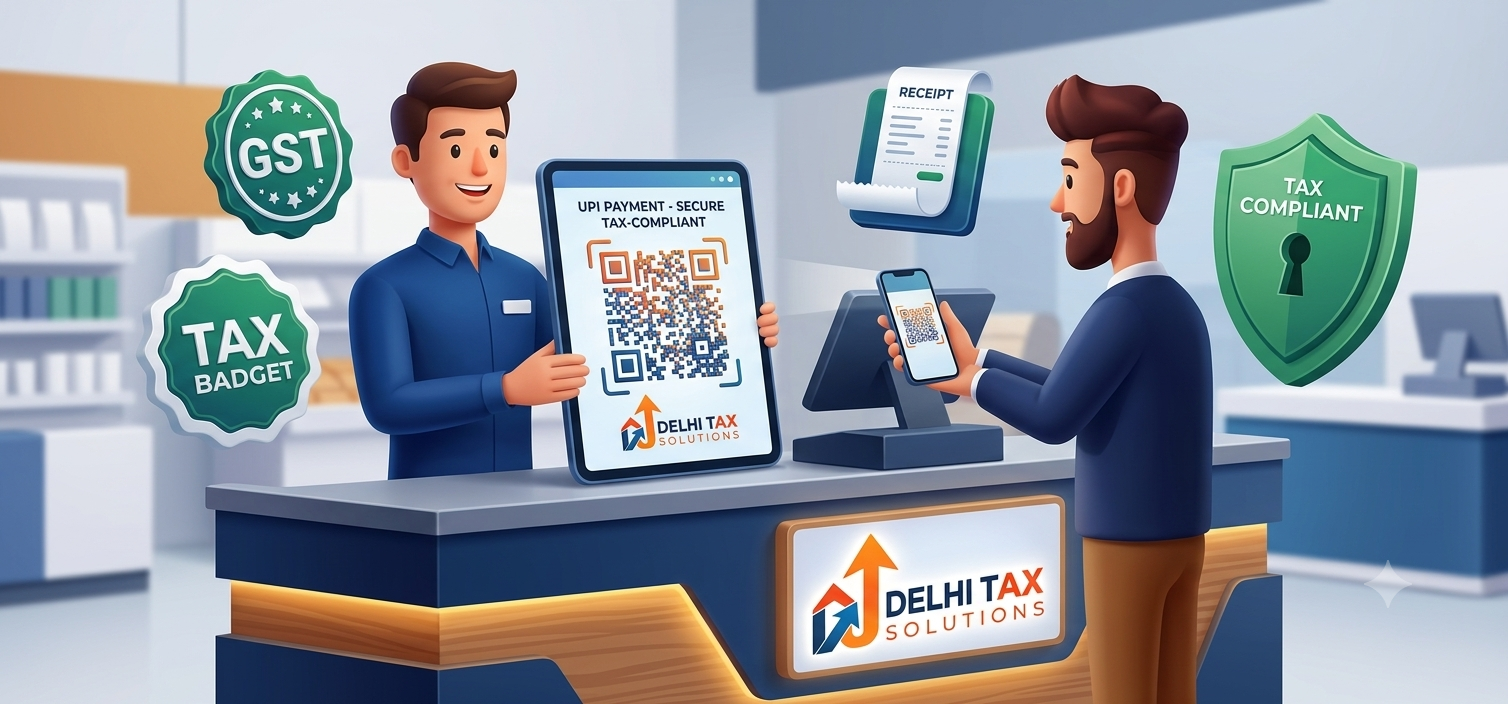
In physical retail stores, if the POS terminal displays the Dynamic QR Code on a digital screen for the customer to scan and pay, and the invoice is printed after payment completion containing the payment reference, the merchant is fully compliant under GST rules.
⚡ Penalties for Non-Compliance
Issuing a B2C tax invoice without a compliant Dynamic QR Code (when applicable) is considered issuing an improper tax document. Penalties are levied under Section 125 of the CGST Act (General Penalty), which can extend up to ₹25,000 per non-compliant invoice (₹25,000 CGST + ₹25,000 SGST).
Exempt Entities from B2C Dynamic QR Code Rules
Even if their aggregate turnover exceeds ₹500 Crore, the following specified entities are completely exempt from printing Dynamic QR Codes on B2C invoices:
- Insurers, Banking Companies, Financial Institutions, and NBFCs.
- Goods Transport Agencies (GTA) providing road transport services.
- Passenger Transportation Service providers (air, rail, road).
- Multiplex Cinema Exhibitors issuing movie entry tickets.
- Non-Resident OIDAR Service Providers supplying digital services to unregistered Indian consumers.
Frequently Asked Questions (FAQs)
+ Q: Is a static UPI QR code printed on paper compliant for B2C invoices?
A: No. A static QR code does not contain the unique invoice number, exact bill value, and tax breakdown. The GST law strictly requires a dynamic QR code generated specifically for that individual bill.
+ Q: Does a business with ₹10 Crore turnover need to print B2C Dynamic QR Codes?
A: No. The Dynamic QR Code requirement for B2C invoices is only applicable to taxpayers whose turnover exceeds ₹500 Crore in any preceding financial year from 2017-18 onwards.
+ Q: Are export invoices required to have a B2C Dynamic QR Code?
A: No. Export transactions are treated as B2B supplies under GST law. They require standard B2B e-invoicing (IRN generation) if the supplier crosses the applicable e-invoicing threshold, rather than a B2C Dynamic QR Code.
+ Q: What if a customer pays in cash at the counter?
A: If the customer pays cash prior to or at the time of invoice printing, the printed tax invoice does not need to show an active QR code, provided it mentions that payment was received in cash along with the payment date/receipt number.
+ Q: Do B2C invoices with Dynamic QR Codes need to be reported in GSTR-1?
A: Yes. B2C sales must be reported in consolidated form in Table 5 or Table 7 of Form GSTR-1 on the GST Common Portal as per standard return filing procedures.
Optimize Your Enterprise GST Compliance with Delhi Tax Solutions
Configuring ERP systems, POS machines, and payment gateways for GST-compliant Dynamic QR Codes requires technical precision and statutory mapping.
At Delhi Tax Solutions, our experienced team of Chartered Accountants provides tailored GST Compliance Services, ERP integration support, and audit readiness for enterprise businesses. Reach out to us today to streamline your retail tax operations.
About this article: Prepared using official CBIC circulars (Circular No. 146/02/2021-GST & Circular No. 156/12/2021-GST), GSTN technical guides, and senior advisory insights from Delhi Tax Solutions. Last updated September 2026.
Disclaimer: This publication provides operational guidance on GST compliance and does not constitute formal legal or professional advice.