💡 Key Takeaways: Deemed Exports under GST
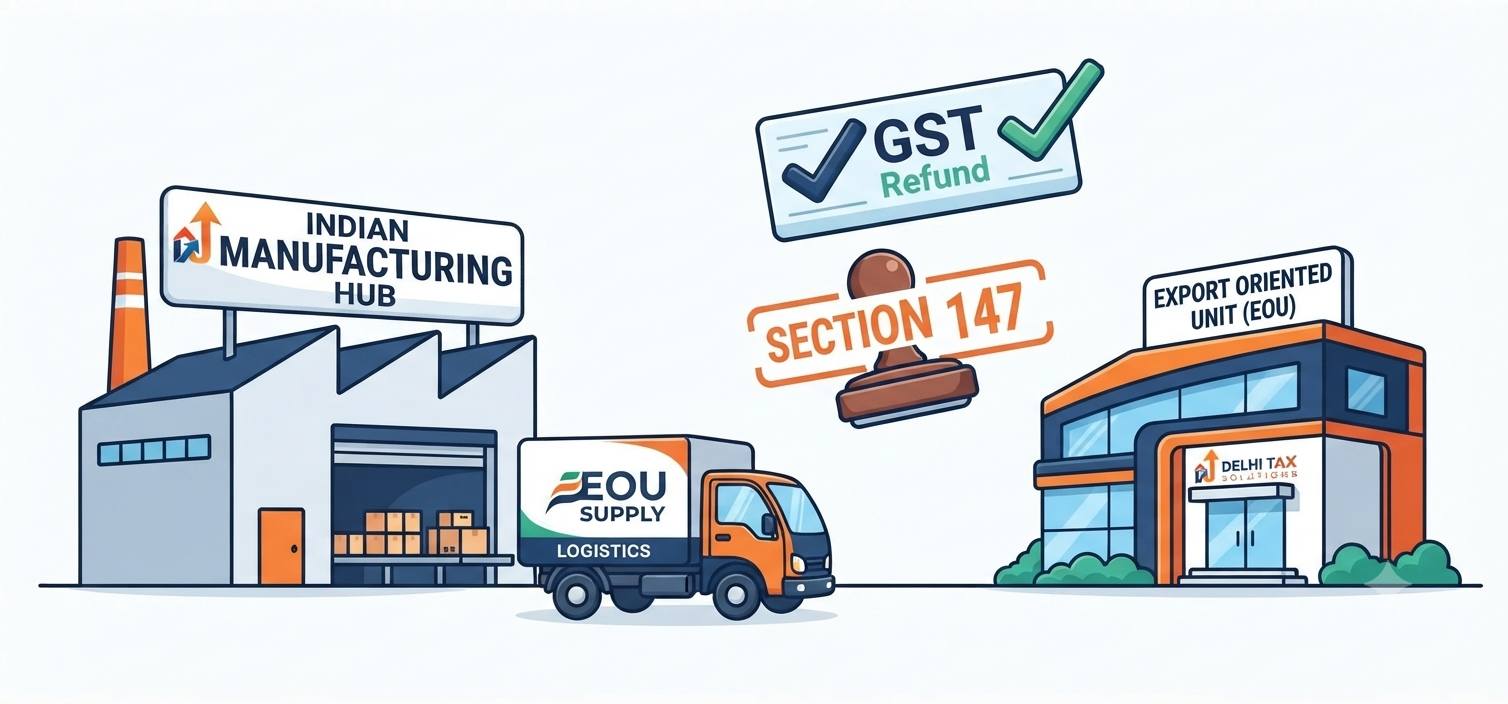
- Deemed exports are domestic transactions where goods do not leave India but are treated similarly to exports for tax benefits under Section 147.
- This classification applies only to the supply of goods; services do not qualify.
- Taxes must be paid upfront by the supplier. You cannot supply goods under a Letter of Undertaking (LUT) for deemed exports.
- Common deemed export transactions include supplies to Export Oriented Units (EOUs) or holders of Advance Auth and EPCG licenses.
- A GST refund can be claimed by either the supplier or the recipient, provided input tax credit (ITC) hasn’t been claimed twice.
When we hear the word “exports,” we usually think of goods crossing international borders to reach another country. However, under the Goods and Services Tax (GST) framework in India, there is a special category known as deemed exports.
According to Section 147 of the CGST Act, 2017, the government can notify certain domestic supplies of goods as “deemed exports.” These are transactions where the goods do not actually leave India, and the payment is received either in Indian Rupees (INR) or in convertible foreign exchange. Because these goods are supplied to specific units (like EOUs) or under specific authorizations that promote the country’s export industry, they are granted special benefits—primarily the ability to claim a tax refund.
Key Conditions for Deemed Exports
To qualify as a deemed export under GST, a transaction must meet the following criteria:
- Goods Only: The concept of deemed exports applies exclusively to the supply of goods. Services do not qualify.
- Manufactured in India: The goods must be manufactured or produced within India.
- No International Border Crossing: The goods must not leave the physical boundaries of India.
- Notified Category: The supply must fall under the specific categories notified by the Central Government (e.g., Notification No. 48/2017-Central Tax).
- Tax Payment Required: The supplier must pay GST (IGST or CGST/SGST) at the time of supply. They cannot supply these goods under a Letter of Undertaking (LUT) or bond.
The 4 Categories of Deemed Exports (Notification 48/2017)
The government has explicitly defined four types of transactions that qualify as deemed exports:
1. Supplies against Advance Authorisation (AA)
Advance Auth is a scheme that allows the duty-free import or domestic procurement of inputs that are physically incorporated into a product slated for export. When a domestic supplier provides raw materials to a manufacturer holding an Advance Authorisation, this transaction is a deemed export.
2. Supplies to an Export Oriented Unit (EOU)
An EOU, STP (Software Technology Park), EHTP (Electronic Hardware Technology Park), or BTP (Bio-Technology Park) is set up with the primary goal of exporting its entire production. Any goods supplied to an EOU by a domestic vendor are classified as deemed exports.
3. Supplies against Export Promotion Capital Goods (EPCG)
The EPCG scheme allows an exporter to import or procure capital goods (machinery, equipment) at a zero customs duty rate, provided they fulfill specific export obligations. Domestic supplies of capital goods to a recipient holding an EPCG Authorisation fall under deemed exports.
4. Supply of Gold by Specified Banks or PSUs
When authorized banks or Public Sector Undertakings (PSUs) supply gold to an exporter holding an Advance Authorisation, it is considered a deemed export.
⚠️ Pro Tip: Documentation is Key
To successfully claim a refund, suppliers must collect an acknowledgment from the jurisdictional Tax Officer of the EOU/AA holder confirming the receipt of the goods. Keep these acknowledgments safely filed!
How the Refund Mechanism Works
Because deemed exports are not zero-rated, the supplier must issue a standard tax invoice and charge the applicable GST. After the tax is paid to the government, a refund can be claimed.
Who Can Claim the Refund?
The GST law provides flexibility for claiming the refund to prevent working capital blockages:
- Option 1: The Supplier: The domestic supplier can claim a refund of the GST paid on the deemed export, provided the recipient (the EOU or AA holder) has not claimed Input Tax Credit (ITC) on that invoice and gives an undertaking that they will not claim a refund.
- Option 2: The Recipient: The recipient (the EOU or AA holder) can claim the refund of the GST paid to the supplier as a refund of unutilized ITC.
Note: Only one party can claim the refund to avoid double benefits.
Deemed Exports vs. Zero-Rated Supplies
Many businesses confuse deemed exports with zero-rated supplies (physical exports or supplies to SEZs). Here is the core difference:
| Feature | Regular Exports (Zero-Rated) | Deemed Exports |
|---|---|---|
| Location of Goods | Leave India (or go to an SEZ) | Remain in India |
| Applicability | Goods and Services | Goods Only |
| Tax Payment | Can be exported without tax under LUT | Tax must be paid; LUT cannot be used |
| Refund Type | Refund of unutilized ITC or IGST paid | Refund of tax paid on the specific transaction |
Get Your Deemed Export Refunds Faster with Delhi Tax Solutions
Struggling with blocked working capital due to pending GST refunds for your supplies to EOUs or Advance Auth holders? Refund applications require precise documentation and timely filing to avoid rejections.
Our GST experts can streamline your refund process, whether you are the supplier or the recipient. Contact Delhi Tax Solutions today to optimize your export tax strategy.
Frequently Asked Questions (FAQs)
+ Q: Can services be considered deemed exports?
A: No, the deemed export classification under GST applies exclusively to the supply of goods. Services provided to an EOU or Advance Auth holder are treated as normal taxable supplies.
+ Q: Can I use an LUT (Letter of Undertaking) for deemed exports?
A: No, deemed exports cannot be made under an LUT without the payment of tax. The supplier must charge and pay GST, and the refund is claimed subsequently.
+ Q: Is a supply to an SEZ (Special Economic Zone) a deemed export?
A: No, supplies to an SEZ developer or SEZ unit are classified as “Zero-Rated Supplies” under Section 16 of the IGST Act, not as deemed exports. They have different tax treatments.
+ Q: What happens if the recipient claims ITC on the deemed export invoice?
A: If the recipient (e.g., the EOU) claims Input Tax Credit (ITC) on the invoice, the supplier cannot claim the refund. In this scenario, the recipient must apply for the refund of unutilized ITC to avoid dual benefit.
+ Q: What is the time limit to file a refund claim for deemed exports?
A: The refund application (Form GST RFD-01) must be filed within two years from the date on which the return relating to such deemed export supplies is to be furnished.
About this article: Authored using statutory provisions of Section 147 of the CGST Act, 2017 and Notification No. 48/2017-Central Tax. Last updated September 2026.
Disclaimer: This blog post is for educational purposes and does not constitute formal legal or tax advisory opinion.