
💡 Key Takeaways:
- Only the supplier can issue legal GST debit and credit notes.
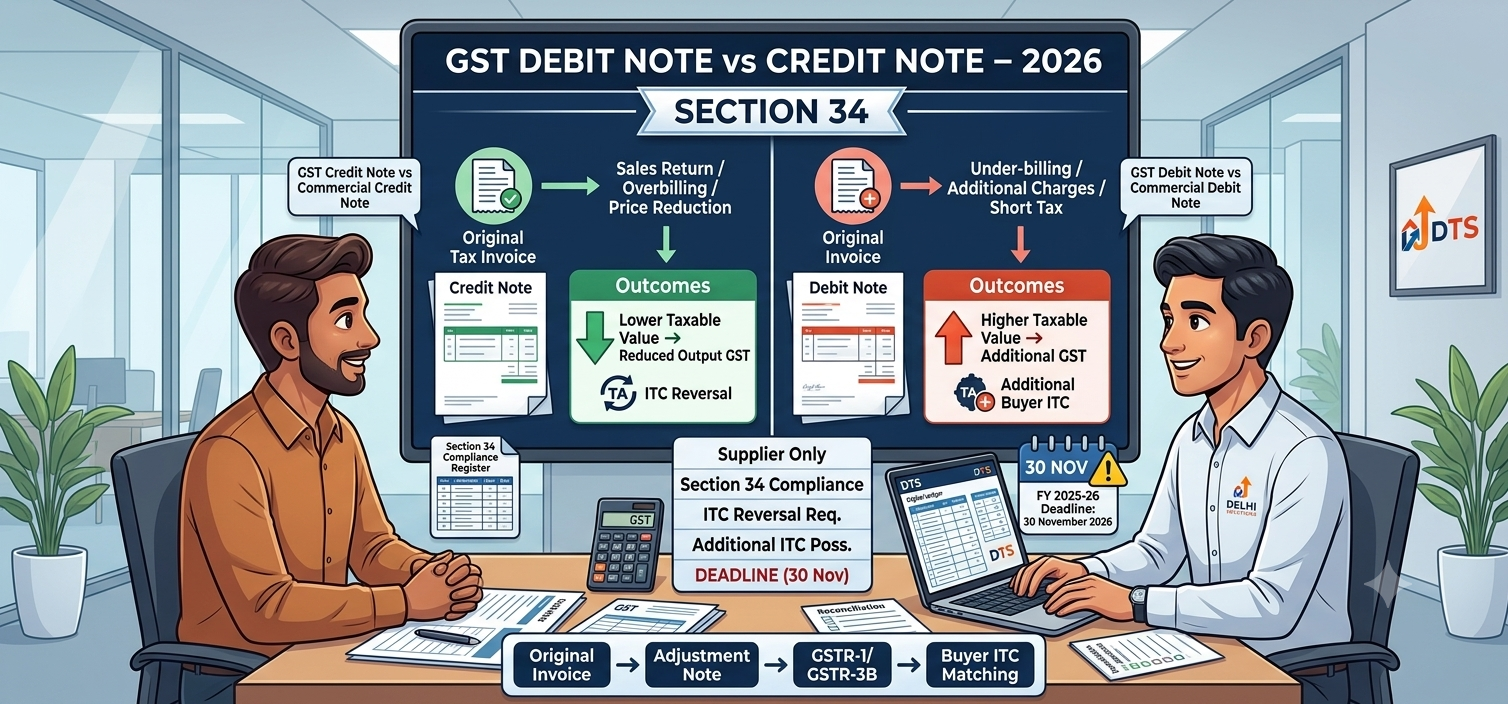
- A credit note GST document reduces tax liability; a debit note increases it.
- The deadline to report adjustments is November 30 of the following financial year.
- Buyers must reverse ITC for a supplier’s tax reduction to be valid.
- Section 34 dictates all rules for these adjustments.
Every business deals with returned goods, accidental billing errors, or post-sale discounts. When an error happens, you cannot simply tear up a tax invoice that has already been filed with the government. You need a strict legal mechanism to adjust your tax liability. That is exactly what debit and credit notes under Section 34 are built to handle.
Many business owners in India struggle to distinguish between the two. Issue the wrong document, and you either pay excess tax out of pocket or face a notice for claiming an invalid Input Tax Credit (ITC). With the tax portal now tightly matching supplier and buyer records, accuracy matters more than ever.
In this guide, we break down how to legally adjust your tax liability using a credit note GST adjustment or a debit note. We cover the exact statutory differences, the crucial November 30 deadlines for 2026, and practical tips directly from our advisory desk to keep your business fully compliant.
What Are Debit and Credit Notes Under GST?
A credit note GST document is issued by a registered supplier to decrease the taxable value or tax charged on an original invoice, usually due to returned goods or downward price revisions. Conversely, a debit note GST document is issued to increase the taxable value when the original invoice was undercharged. Governed entirely by Section 34 of the CGST Act, these notes ensure tax adjustments are legally tracked without deleting past invoices.
Credit Note Under Section 34(1): When to Issue
Section 34(1) of the CGST Act clearly defines the exact scenarios where a registered supplier must issue a credit note. Think of this document as your legal tool to bring your tax liability down when you have overcharged a client or received damaged inventory back.
There are four primary triggers for issuing a credit note. First, if the original tax invoice shows a higher taxable value than what was actually agreed upon. Second, if you mistakenly applied an 18% tax rate instead of the correct 12%. Third, when a buyer returns the goods. Finally, if the services provided were found to be deficient and a partial refund is negotiated.
Remember, this document must always link back to the original supply. Once issued, it reduces your output tax liability in your returns. However, the buyer must reverse their corresponding ITC for your tax reduction to be fully validated by the GST Portal. If the buyer does not act, you do not get your tax relief.
It is also critical to ensure that your business is properly registered to issue these documents. If you have not yet completed your GST registration online India setup, you cannot legally issue a tax-adjustable note.
Debit Note Under Section 34(3): When to Issue
On the flip side, Section 34(3) governs the issuance of debit notes. You use a debit note when you need to collect more tax or increase the total taxable value of a completed transaction. It functions exactly like a supplementary invoice.
You must issue a debit note in two specific situations. First, if the taxable value charged in the initial invoice is lower than what was actually payable. For example, you billed a client for ₹50,000, but the actual contract value was ₹60,000. Second, if the tax charged was lower than required—like accidentally billing a product at 5% instead of the mandatory 18%.
When you issue a debit note, your output tax liability increases immediately. You are required to pay the difference to the government. At the same time, the buyer can claim additional ITC based on this debit note, provided they have a clean compliance record. Managing these adjustments requires robust GST compliance practices so nothing falls through the cracks.
Debit Note vs Credit Note: Quick Comparison
Understanding the difference between a debit and credit note is essential for accurate accounting. Here is a clear breakdown of how they compare.
| Feature | Credit Note under GST | Debit Note under GST |
|---|---|---|
| Core Purpose | Decreases taxable value / tax liability | Increases taxable value / tax liability |
| Issued By | Supplier only | Supplier only |
| Common Triggers | Sales returns, over-billing, post-sale discounts | Under-billing, extra charges incurred |
| Impact on Supplier | Reduces Output Tax liability | Increases Output Tax liability |
| Impact on Buyer | Must reverse ITC | Can claim additional ITC |
This strict boundary prevents manipulation. A buyer cannot simply issue a note to force a tax reduction on the supplier. The supplier remains in full control of the tax invoice ecosystem.
Quick Summary
Only suppliers can issue tax-adjustable notes. Use a credit note to lower your tax when goods are returned. Use a debit note to collect extra tax when you underbilled.
Time Limits and GST Return Filing for 2026
The government does not grant unlimited time to fix historical billing errors. Section 34(2) specifies rigid statutory deadlines to ensure tax finality for each financial year.
For any credit note GST adjustment pertaining to a specific financial year, you must declare it in your returns no later than November 30 of the following financial year, or the date of filing the annual return, whichever is earlier. For instance, if you issue a credit note for an invoice generated in January 2026, it must be reported by November 30, 2026.
If you miss this strict deadline, the document becomes purely financial. It will no longer reduce your tax liability, meaning your business must absorb the tax loss completely. You are required to report these adjustments accurately in Table 9 of your GSTR-1 and GSTR-3B filing.
According to the latest Section 34 of the CGST Act updates, failure to report within this window leaves no room for appeal. The portal will automatically reject late attempts to claim ITC reversals.
What Our CA Team Sees in Practice
Navigating these rules is rarely straightforward on the ground. Based on cases handled by our CA team, we frequently spot three costly errors among Indian MSMEs.
First, we see buyers issuing “financial credit notes” to suppliers for defective goods and expecting a tax refund. Under the law, only the supplier can issue a valid GST-compliant note. If the buyer issues it, no tax adjustment can be legally claimed.
Second, businesses often ignore the matching concept. If you issue a credit note but your buyer fails to reverse their ITC, the government portal will flag the discrepancy. Your tax reduction will be blocked until the buyer complies. You must actively follow up with your clients.
Third, companies routinely miss the November 30 deadline. We have seen businesses lose lakhs in valid tax refunds simply because they delayed their reconciliation process. Keeping a clean Section 34 register is just as vital as managing your annual Income Tax rules compliance.
Maintaining a Clean Section 34 Register
To avoid penalties and lost working capital, your accounting team must maintain a strict closed-loop reference system. Every single note must reference the original invoice number and date.
You cannot issue a bulk credit note for random yearly discounts unless you can trace them back to specific tax invoices. The GST Council made it easier by allowing one credit note against multiple invoices, but the linkage must remain clear. Set calendar alerts 30 days before the November cut-off.
By automating your reconciliation against the recipient’s GSTR-2B, you ensure that every note issued results in a successful ITC reversal. This protects you during department audits.
Conclusion
Mistakes happen in business billing, but your tax filings do not have to suffer. Debit and credit notes under Section 34 provide a clean, legal mechanism to fix invoice errors, handle inventory returns, and pass on negotiated discounts. Remember the three core rules: only suppliers issue them, they must directly link to the original invoice, and you must report them before the strict November 30 deadline.
Talk to a Delhi Tax Solutions expert today to get your tax filings reconciled accurately and on time. Do not let minor billing errors turn into massive working capital leaks. Keep your records flawless, stay ahead of deadlines, and keep your business moving forward safely.
Frequently Asked Questions (FAQs)
Q: What is the time limit to issue a credit note under GST for FY 2025-26?
A: For any invoice generated in the Financial Year 2025-26, the strict statutory deadline to issue and declare a credit note is November 30, 2026, or the actual date of filing your GST Annual Return (GSTR-9), whichever happens earlier. If you miss this exact date, you cannot legally claim any tax reduction from the government.
Q: Can a buyer issue a debit note or credit note under GST?
A: No. Under Section 34 of the CGST Act, only the registered supplier of the goods or services is legally permitted to issue a GST-compliant debit or credit note. If a buyer wants to return goods, they must ask the supplier to officially issue the credit note to adjust the tax liability.
Q: Do we need to issue a separate credit note for every invoice?
A: No. Thanks to recent amendments in the CGST Act, suppliers can now issue a single, consolidated credit note against multiple original tax invoices. You no longer need to match one credit note to one specific invoice, provided all the original invoice details and tax amounts are correctly tracked in your system.
Q: What is the difference between a financial credit note and a GST credit note?
A: A GST credit note explicitly adjusts the tax liability and must be uploaded to the GST portal with specific tax amounts clearly stated. A financial or commercial credit note does not include any GST component at all; it simply adjusts the payable accounting balance between the buyer and seller without affecting tax filings.
Q: What happens if the buyer does not reverse their Input Tax Credit (ITC)?
A: If a supplier issues a GST credit note to reduce their output tax, the buyer is legally required to reverse the corresponding ITC in their returns. If the buyer fails to reverse this ITC, the tax portal’s matching system will flag it, and the supplier’s tax reduction will be strictly denied by the government.
This article is for general informational purposes and is not a substitute for personalised professional tax advice. About this article: Researched using official government sources, real-time competitor and search-trend analysis, and Delhi Tax Solutions’ in-house tax advisory team. Last updated September 2026.
