
💡 Key Takeaways:
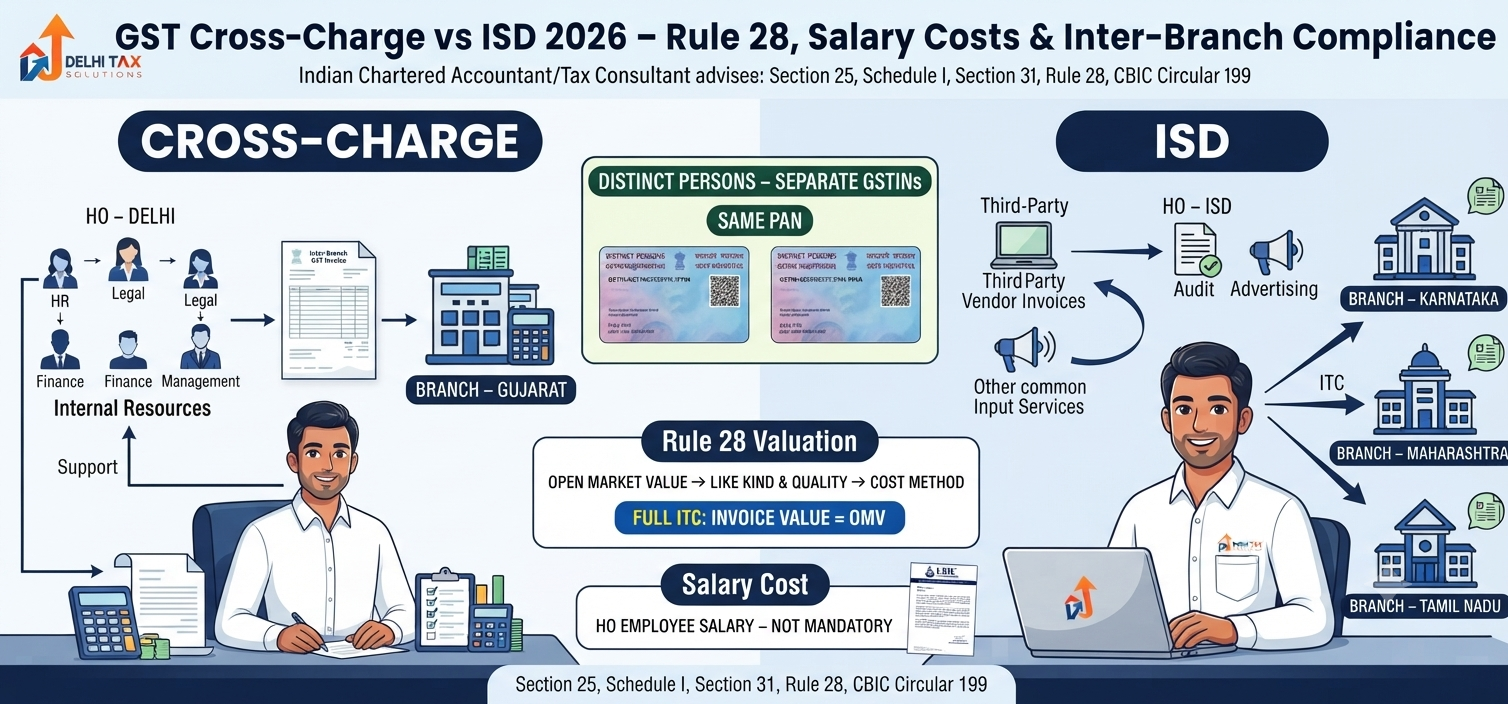
- Distinct persons under separate GSTINs must account for inter-branch supplies.
- CBIC Circular clarifications state that HO salary costs need not be mandatorily included.
- Rule 28 governs valuation, deeming invoice value as open market value if full ITC applies.
- ISD handles third-party common credits, while cross-charge covers internally generated services.
Operating a business across multiple Indian states means dealing with complex branch compliance. Under Section 25 of the Central Goods and Services Tax (CGST) Act, distinct registrations under the same PAN are treated as separate legal entities. This triggers intricate tax obligations whenever resources, administrative backing, or management services move between locations. Company founders and finance teams frequently stumble over how to value these internal transfers and whether employee payroll expenses must form part of the bill. Getting this wrong leads to disputed tax demands, trapped working capital, and audit penalties.
Decoding Cross-Charge GST and Distinct Persons
Cross-charge refers to the mechanism used to bill services supplied internally between distinct business verticals or state branches. When your Delhi head office coordinates legal, human resources, or financial management for a manufacturing unit in Gujarat, GST law views it as a taxable supply. Even though money does not change hands between external parties, Schedule I mandates tax accounting for supplies between related persons.
Every branch operating with a separate GSTIN must maintain strict accounting symmetry. Failing to record these operational interactions invites scrutiny from tax authorities during annual audits. Comprehensive GST registration management ensures your inter-branch invoicing framework remains airtight and fully compliant with current regulations.
Our CA practice frequently observes businesses panicking over internal billing structures. Establishing clear inter-branch documentation prevents unexpected compliance friction down the line.
Cross-Charge Versus Input Service Distributor (ISD)
A major confusion point for corporate finance teams is choosing between a cross-charge invoice and an Input Service Distributor (ISD) mechanism. They serve completely different operational functions within an enterprise.
Operational Differences in Credit Flow
ISD is strictly used to distribute tax credits on common third-party services—such as centralized software licenses, audit fees, or advertising bills—procured by a central office on behalf of multiple units. Conversely, cross-charge applies to internally generated services where the head office uses its own internal infrastructure and workforce to support branch locations.
Understanding this distinction protects organizations from double taxation and incorrect credit distribution. Businesses scaling up their operations often integrate these compliance steps early through structured company registration advisory to avoid structural mismatches.
Valuation Rules Under Rule 28 of CGST Rules
Valuing inter-branch transfers requires strict adherence to Rule 28 of the CGST Rules. The valuation hierarchy begins with the open market value of such services. If that is unavailable, it moves to the value of services of like kind and quality, or a cost-plus method.
A vital safeguard exists under the second proviso to Rule 28. Where the recipient branch is eligible for full input tax credit, the value declared on the invoice is legally deemed to be the open market value. This means that even a nominal or zero-markup invoice satisfies statutory requirements because the tax paid flows back seamlessly as credit.
Proper application of these valuation tiers keeps corporate tax liabilities predictable and shields businesses from arbitrary departmental re-assessments.
Inclusion of Salary Costs in Branch Billing
One of the most contentious debates in corporate taxation centered on whether head office staff salaries should be factored into cross-charge valuations. Earlier judicial precedents created widespread anxiety by suggesting that management staff time spent on branch operations warranted proportional salary cost allocations.
To resolve this ambiguity, the Central Board of Indirect Taxes and Customs issued guiding principles via official clarifications. As per established circular norms, the cost of salaries of head office employees involved in providing internal support services is not mandatorily required to be included when computing taxable cross-charge values, even when the recipient branch cannot claim full input tax credit.
This provides immense relief to multi-state enterprises, eliminating the need to track minute timesheet allocations for internal personnel.
Comparative Framework: Cross-Charge vs ISD
To visualize how these mechanisms differ in daily execution, review the comparative matrix below:
| Feature | Cross-Charge | Input Service Distributor (ISD) |
|---|---|---|
| Nature of Supply | Internally generated services and resources | Distribution of third-party vendor credits |
| Document Issued | Standard tax invoice under Section 31 | ISD invoice or distribution document |
| Salary Inclusion | Employee salaries not mandatorily required | Not applicable (deals with external invoices) |
| Primary Purpose | Account for inter-unit distinct person supplies | Proportionate credit dissemination |
Structuring Compliant Inter-Branch Workflows
Implementing a robust compliance framework requires setting up clear internal agreements and accurate record-keeping. Businesses must periodically review their operational setups to ensure all branch interactions are accounted for without inviting aggressive tax scrutiny. Ensuring your enterprise holds all necessary business licenses and registrations creates a solid foundation for cross-state operations.
Founders expanding their footprints across Delhi and neighboring states can streamline their corporate setup by reviewing structured guides on how to start your business effectively. Proactive planning avoids last-minute reconciliation scrambles during tax audits.
Tax compliance is an evolving landscape where precision dictates profitability. Maintaining transparent records across all distinct registrations safeguards your cash flow and builds long-term institutional stability.
In a Nutshell
Cross-charge handles internal head office support services under Rule 28 valuation, while ISD distributes third-party common vendor credits across distinct GSTINs.
Conclusion
Mastering cross-charge and valuation rules under GST ensures your multi-state operations run smoothly without unexpected tax roadblocks. By understanding the boundaries between internal support services and third-party credit distribution, finance teams can optimize their working capital. Clear documentation and adherence to Rule 28 provisions protect your business from compliance disputes.
Talk to a Delhi Tax Solutions expert to get your inter-branch valuation and GST compliance audited within 3 days. Proper structuring today prevents costly legal battles tomorrow.
You can explore additional financial insights across our tax and finance blogs. Staying informed protects your business against unexpected tax liabilities.
About this article: Researched using official government sources, real-time competitor and search-trend analysis, and Delhi Tax Solutions’ in-house tax advisory team. Last updated September 2026.
Disclaimer: This article is for general informational purposes and is not a substitute for personalised professional tax advice.
Frequently Asked Questions (FAQs)
Q: Is cross-charging mandatory between two branch offices operating under the same PAN in different states?
A: Yes, under Section 25 of the CGST Act, separate registrations obtained by the same legal entity in different states are treated as distinct persons. Any transfer of services or support between them is deemed a taxable supply under Schedule I, making proper cross-charge invoicing mandatory to maintain legal compliance and support valid input tax credit claims across state borders.
Q: Are staff salaries and employee costs required to be included when calculating the cross-charge value?
A: According to clarifying circular guidelines issued by the CBIC, the cost of salaries of head office employees involved in providing internal support services is not mandatorily required to be included when computing the taxable value of cross-charge supplies, even if the recipient branch is not eligible for full input tax credit.
Q: What is the key operational difference between an Input Service Distributor (ISD) registration and a cross-charge invoice?
A: An Input Service Distributor mechanism is strictly utilized to distribute input tax credit on common third-party vendor services received centrally on behalf of multiple units. In contrast, a cross-charge applies to internally generated services and administrative support supplied by one registered unit to another using its own internal resources and staff.
Q: How does Rule 28 of the CGST Rules apply when the recipient branch is eligible for full Input Tax Credit?
A: Under the second proviso to Rule 28 of the CGST Rules, where the recipient branch is entitled to full input tax credit, the value declared on the inter-branch tax invoice is deemed to be the open market value. This provision significantly streamlines compliance and eliminates valuation disputes for fully credit-eligible business units.
Q: What are the legal penalties for failing to issue tax invoices on inter-branch services?
A: Failing to issue mandatory tax invoices for taxable inter-branch supplies can result in the recovery of unpaid taxes along with applicable interest under Section 50 of the CGST Act. Furthermore, it can lead to the denial or reversal of input tax credit at the recipient branch, triggering heavy penalty assessments during departmental GST audits.
