💡 Key Takeaways: Consumer Welfare Fund (Section 57)
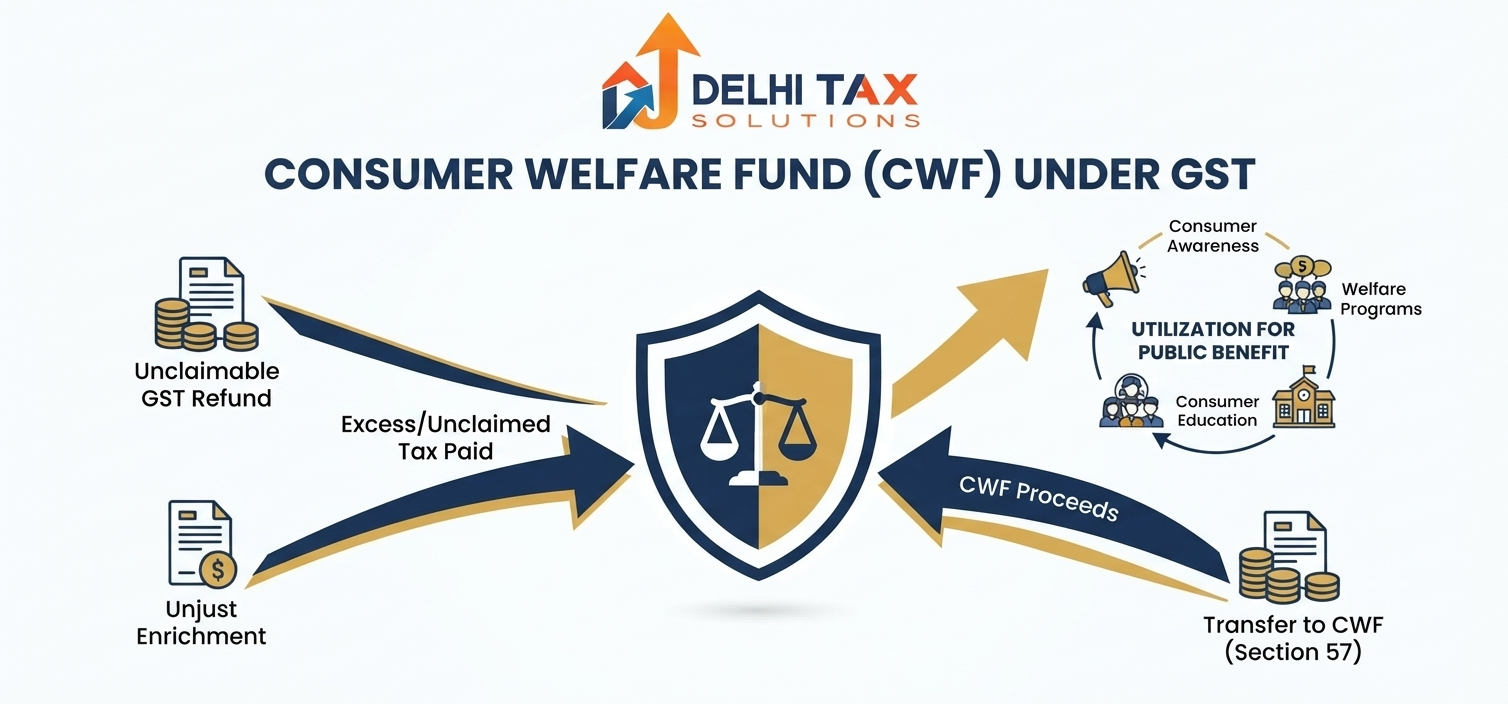
- What it is: The Consumer Welfare Fund (CWF) is a specialized reserve pool established under Section 57 of the CGST Act, 2017, to promote and protect consumer welfare.
- Where the Money Comes From: It receives unclaimable GST refunds—specifically, amounts that cannot be paid back to the business due to the rule of “unjust enrichment.”
- The Concept of Unjust Enrichment: If a business already passed the tax burden onto consumers via invoices, refunding that money back to the business would result in an unfair double-benefit.
- Utilization: The pool is utilized for consumer awareness programs, legal aid, research, and protecting consumer rights across India.
When businesses apply for a GST refund, they naturally expect the money to be credited back to their bank accounts or electronic ledgers. However, the GST framework is built on rigorous checks and balances designed to protect public finance. One such vital check is the rule of “unjust enrichment,” which leads directly to the creation and funding of the Consumer Welfare Fund (CWF) under Section 57 of the CGST Act, 2017.
If you have ever wondered where unclaimed or non-refundable tax amounts go, this article breaks down how Section 57 operates and what unjust enrichment means for taxpayers.
What is the Doctrine of “Unjust Enrichment”?
To understand the Consumer Welfare Fund, you must first understand why certain refunds are blocked from returning to businesses:
- Passing the Burden: Indirect taxes like GST are designed to be borne by the ultimate consumer. When a business sells goods or services, it collects tax and includes it in the invoice price paid by the customer.
- The Refund Dilemma: If a business later claims a refund for that tax from the government, but has already collected that exact tax amount from its customers, granting that refund directly to the business would mean they pocket the money twice—once from the consumer, and once from the government.
- Preventing Unjust Enrichment: To prevent this unfair windfall (unjust enrichment), the law mandates that unless the taxpayer can prove they haven’t passed the tax burden to anyone else, the cash cannot be refunded to them.
Where Does the Money Go? Enter Section 57
If a refund is sanctioned on merit, but fails the test of unjust enrichment because the tax burden was passed on to consumers, the money cannot remain with the government as general revenue, nor can it be pocketed by the business.
Instead, pursuant to Section 57 of the CGST Act, such amounts are credited directly to the Consumer Welfare Fund (CWF).
💼 Other Sources Credited to CWF
Apart from unclaimable refunds, the Consumer Welfare Fund also receives income from investments made out of the fund, and any other amounts specified by the government from time to time.
How is the Consumer Welfare Fund Utilized?
The money accumulated in the CWF does not sit idle. It is managed by a dedicated committee and is utilized strictly for public benefit initiatives aimed at safeguarding consumer rights. Common applications include:
- Funding nationwide consumer awareness campaigns and educational programs.
- Providing financial assistance to consumer organizations for filing public interest litigation or consumer disputes.
- Supporting research and training projects related to consumer welfare and product safety.
- Establishing testing laboratories for quality control and consumer protection.
How Taxpayers Can Avoid CWF Transfer (Overcoming Unjust Enrichment)
If you are applying for a GST refund and want to ensure the money comes to your business instead of being diverted to the Consumer Welfare Fund, you must furnish documentary evidence to satisfy the unjust enrichment test.
Depending on the refund amount, you may need to submit:
- A self-declaration if the claim amount is less than ₹2 Lakhs.
- A certificate from a Chartered Accountant (CA) or Cost Accountant (CMA) certifying that the incidence of tax has not been passed on to any other person, for claims exceeding ₹2 Lakhs.
Navigating Complex GST Refund & Unjust Enrichment Rules?
Proving that tax incidence hasn’t been passed on can be challenging during GST refund audits. Don’t risk your rightful refunds being diverted to the Consumer Welfare Fund due to documentation gaps.
Consult the taxation experts at Delhi Tax Solutions to manage your refund claims and compliance seamlessly.
Frequently Asked Questions (FAQs)
+ Q: What is the Consumer Welfare Fund under GST?
A: The Consumer Welfare Fund is a pool created under Section 57 of the CGST Act, 2017, where unclaimable GST refunds (due to unjust enrichment) are deposited and subsequently used for consumer welfare programs.
+ Q: What does “unjust enrichment” mean in GST refunds?
A: Unjust enrichment occurs when a business tries to claim a tax refund from the government after already collecting that tax amount from its customers. Giving the refund to the business would result in an unfair double profit.
+ Q: Are all GST refunds subject to the unjust enrichment test?
A: No. Certain refunds are exempt from the principle of unjust enrichment, such as refunds of accumulated ITC on zero-rated supplies (exports) or inverted duty structures, and tax paid on supplies that were not provided.
+ Q: How can a taxpayer prove there is no unjust enrichment?
A: Taxpayers can prove this by providing financial records, invoices, and a certificate from a Chartered Accountant (CA) or Cost Accountant confirming that the economic burden of the tax was borne by the business itself and not passed on to buyers.
About this article: Based on Section 57 and Section 54 of the CGST Act, 2017. Updated for 2026.
Disclaimer: This article is for informational and educational purposes only and should not be considered legal or financial advice.