💡 Key Takeaways: Confiscation Under Section 130
- Intent to Evade is Mandatory: Section 130 is invoked only when there is a clear, proven intent to evade the payment of tax by the taxpayer or transporter.
- Title Transfer to Government: Once goods or conveyances are formally confiscated, their legal ownership transfers entirely to the Central or State Government.
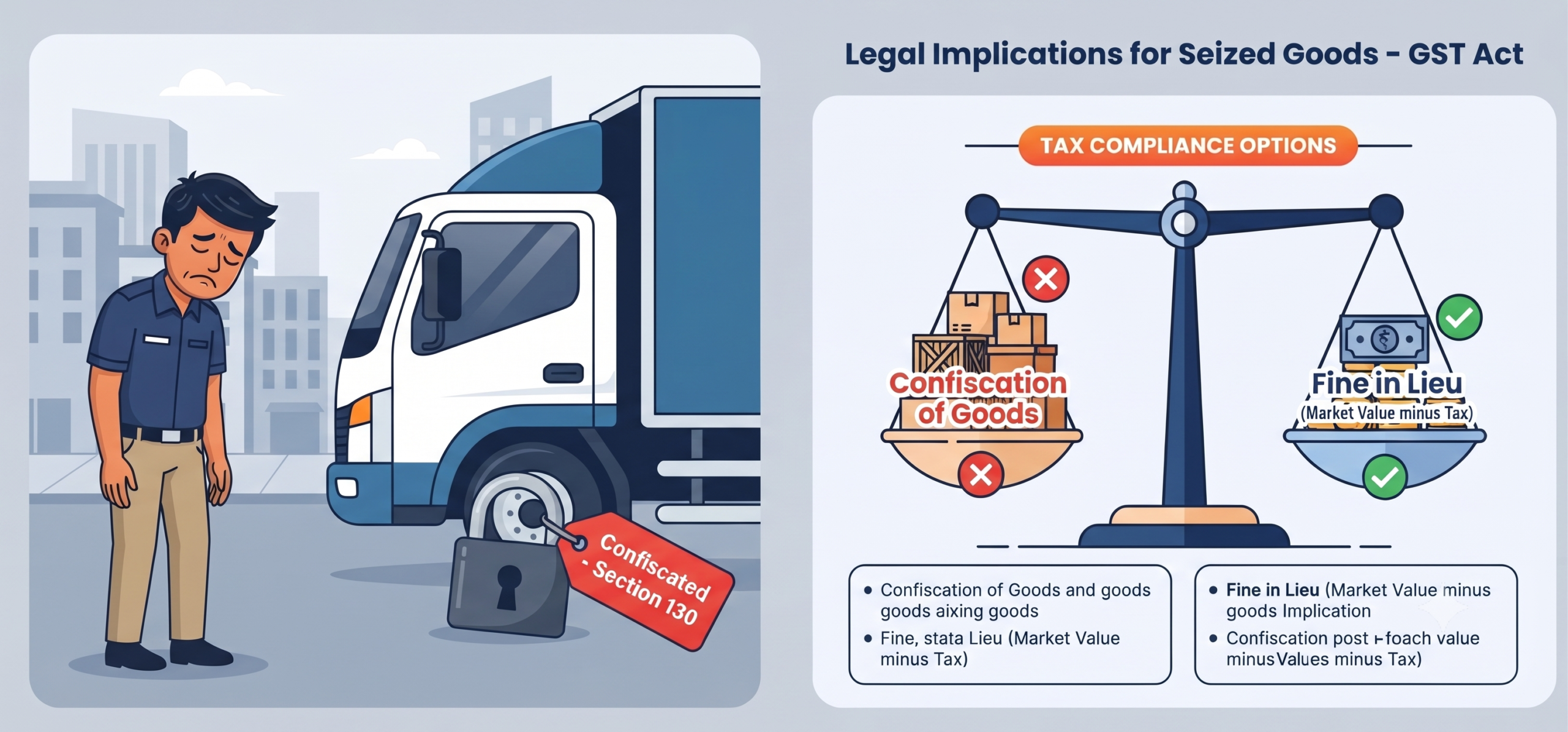
- Fine in Lieu of Confiscation: Taxpayers are given a chance to pay a redemption fine to get their goods back. The maximum fine cannot exceed the market value of the goods minus the tax chargeable.
- Vehicle Confiscation: Conveyances (trucks, ships) used in smuggling can also be confiscated unless the owner proves it was used without their knowledge.
- Time Limit for Payment: If the fine in lieu of confiscation is not paid within 3 months of the order, the authorities can auction or dispose of the goods.
The Goods and Services Tax (GST) framework is armed with stringent anti-evasion measures. While standard procedural lapses attract regular penalties, severe cases involving deliberate tax evasion trigger the ultimate penal provision: Confiscation of Goods and Conveyances.
Governed by Section 130 of the CGST Act, 2017, confiscation goes a step further than mere detention. It permanently strips the taxpayer of their ownership rights over the goods unless a heavy statutory fine is paid. In this technical guide, we will explore the specific triggers for confiscation, how redemption fines are calculated, and the legal procedures leading to the auction of confiscated items.
The 5 Triggers for Confiscation (Section 130(1))
Not every discrepancy during transit or at the business premises leads to confiscation. The law explicitly requires the presence of mens rea (the intent to evade tax). According to Section 130(1), goods and/or conveyances shall be liable to confiscation if any person commits one of the following five offenses with the intent to evade payment of tax:
- Supplying or receiving any goods in contravention of the provisions of the GST Act or Rules.
- Failing to account for the goods on which tax is liable to be paid (e.g., hidden inventory in undeclared godowns).
- Supplying goods liable to tax under GST without actually applying for GST registration.
- Contravening any statutory provision with the explicit intent to evade tax.
- Using any conveyance (truck, van, vessel) as a means of transport for carrying illicit goods in violation of the Act.
Detention (Section 129) vs. Confiscation (Section 130)
A common point of confusion for businesses and transporters is the difference between Section 129 and Section 130. It is crucial to understand that these are two distinct legal actions:
| Parameter | Section 129 (Detention / Seizure) | Section 130 (Confiscation) |
|---|---|---|
| Primary Purpose | Temporary detention to secure the payment of tax and penalty during transit checks. | Permanent deprivation of property ownership due to deliberate and proven tax evasion. |
| Intent to Evade | Can be invoked even for procedural/clerical errors in E-way bills without proven intent to evade. | Cannot be invoked without establishing a clear “intent to evade payment of tax.” |
| Ownership of Goods | Ownership remains with the taxpayer. Goods are merely held as collateral. | Legal ownership transfers entirely to the Government upon passing of the order. |
If you have received a notice purely for E-way bill mismatches during transport without fraud allegations, you should refer to our detailed guide on Section 129 E-way Bill Detentions instead.
Understanding “Fine in Lieu of Confiscation”
Even when an officer passes an order for confiscation, the law allows the taxpayer an opportunity to save their goods. Under Section 130(2), the adjudicating officer must offer the owner an option to pay a “fine in lieu of confiscation” (often called a redemption fine).
Calculating the Maximum and Minimum Fine
- Maximum Fine (For Goods): The redemption fine cannot exceed the Market Value of the goods minus the Tax Chargeable on those goods.
- Minimum Fine (For Goods): The fine cannot be less than the penalty leviable under Section 129(1) (which is typically 200% of the tax payable).
- Fine for Conveyance (Vehicle): For the transporter to release their confiscated truck, the fine in lieu of confiscation is set equal to the tax payable on the goods being transported in that vehicle.
Note: The fine in lieu of confiscation is in addition to the actual tax, interest, and standard penalties (such as those under Section 122) payable by the offender.
The Legal Procedure of Confiscation
Tax officers cannot confiscate goods arbitrarily. They are bound by strict principles of natural justice and statutory timelines:
- Issuance of Notice: Before any confiscation, the officer must issue a Show Cause Notice (SCN) stating the grounds for confiscation and the quantum of tax, penalty, and fine proposed.
- Opportunity of Being Heard: The owner must be given a reasonable opportunity to present their defense (personal hearing) and prove that there was no intent to evade tax.
- Passing of Order: If the officer is satisfied that evasion was intended, a formal Confiscation Order is passed detailing the redemption fine.
- Auction / Disposal (3-Month Rule): If the taxpayer fails to pay the fine in lieu of confiscation within 3 months from the date of the order, the proper officer has the legal authority to sell or auction the goods/conveyance and deposit the proceeds into the government treasury.
For additional details regarding auction guidelines and portal notifications, taxpayers can consult the official Central Board of Indirect Taxes and Customs (CBIC) and GST Portal.
Facing a Confiscation Notice Under Section 130?
Confiscation proceedings can result in the complete loss of your commercial inventory and transport vehicles. Defending against Section 130 requires legally proving the absence of “mens rea” (intent to evade tax).
Do not let authorities illegally auction your goods. Get immediate legal intervention with Delhi Tax Solutions. Our tax litigation experts will file aggressive replies to Show Cause Notices, challenge the valuation of redemption fines, and secure the release of your property.
Frequently Asked Questions (FAQs)
+ Q: Can goods be confiscated for a minor clerical error in an E-way bill?
A: No. High Courts have repeatedly ruled that Section 130 can only be invoked when there is a deliberate, proven intent to evade tax. Minor clerical errors in E-way bills fall under Section 129 or Section 125, not Section 130.
+ Q: What happens if I pay the fine in lieu of confiscation?
A: Upon paying the prescribed redemption fine along with the applicable tax and penalty, the confiscated goods and conveyances will be legally released back to you, and the title transfers back to you from the Government.
+ Q: How can a transporter get their confiscated truck released?
A: The transporter can secure the release of their confiscated conveyance by paying a fine equal to the tax payable on the illicit goods being transported. Alternatively, they can prove that the vehicle was used without their knowledge or connivance.
+ Q: How long does the department wait before auctioning confiscated goods?
A: The law grants the owner a period of 3 months from the date of the confiscation order to pay the fine. If payment is not made within this timeframe, the officer can proceed with the auction or disposal. Hazardous or perishable goods may be disposed of sooner.
About this article: Based on Section 130 of the CGST Act, 2017. Updated for 2026.
Disclaimer: This article is for educational and informational purposes only and does not constitute formal legal representation. Please consult a qualified GST litigator to contest confiscation orders.