💡 Key Takeaways
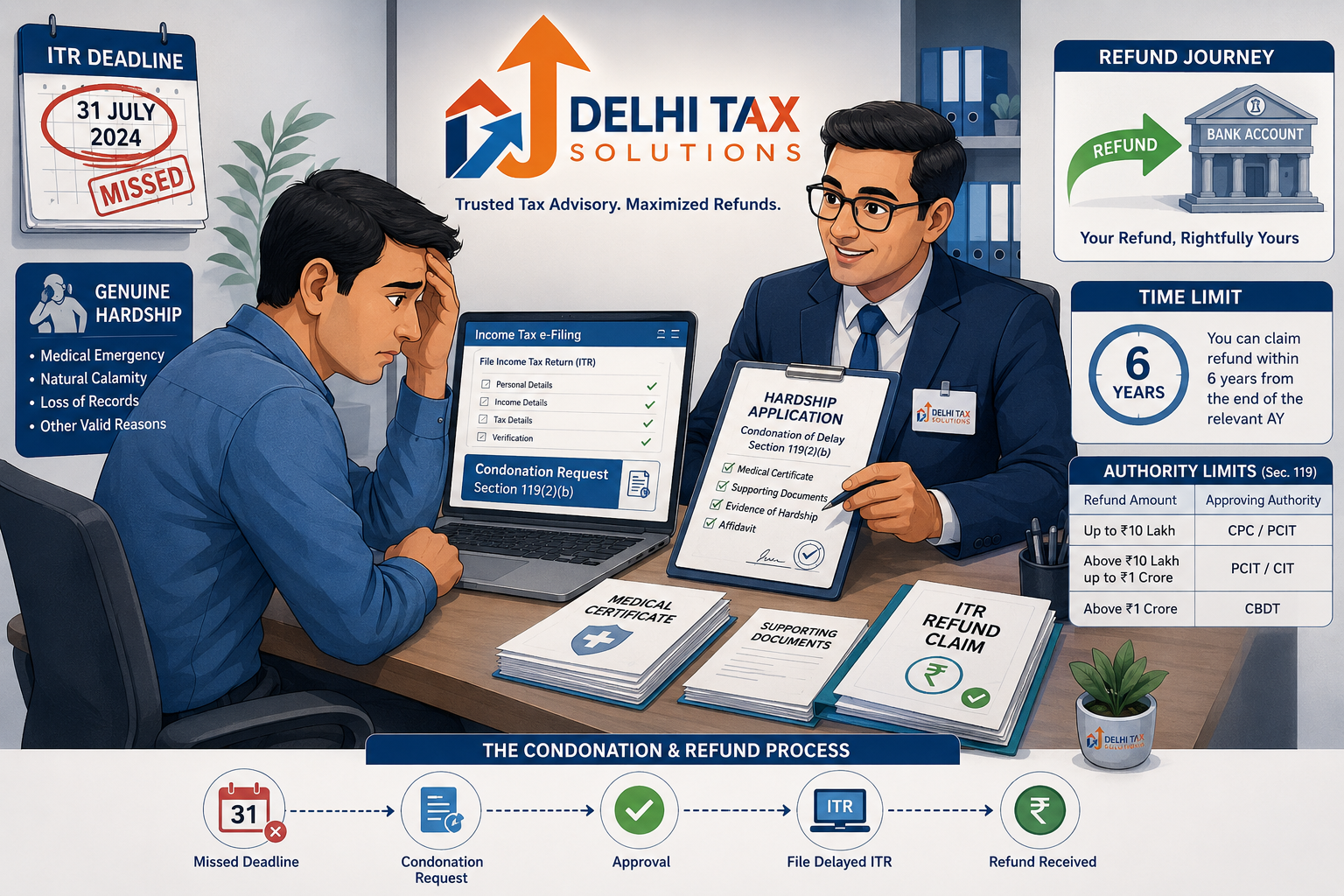
- Condonation of delay allows you to file an ITR and claim a refund even after the belated deadline (31st December) has passed.
- You must prove “genuine hardship” that prevented you from filing the return within the statutory timeframe.
- The application must be filed within six years from the end of the relevant assessment year.
- The approving tax authority depends on the monetary value of your refund claim.
- No interest is paid by the government on a refund that is issued through the condonation route.
Missing a tax deadline is a stressful experience, especially when you are owed a substantial refund from the government due to excess tax deductions. The standard timeline for filing a tax return generally expires on the 31st of December of the assessment year. Once that belated deadline lapses, the income tax portal actively blocks you from submitting standard returns. However, the law provides a final, discretionary lifeline. The condonation of delay in filing ITR mechanism allows taxpayers facing extraordinary circumstances to appeal directly to senior tax authorities for permission to file out of time. Securing this permission requires precise legal drafting and strict adherence to CBDT guidelines. Mastering this process is an advanced component of Income Tax Filing that frequently saves taxpayers lakhs of rupees in trapped funds. Let us walk through the exact statutory provisions necessary to recover your delayed refund.
Understanding the Statutory Lifeline
What is Section 119(2)(b)?
The entire condonation process hinges on Section 119(2)(b) of the Income Tax Act. This specific section empowers the Central Board of Direct Taxes (CBDT) to authorize junior tax authorities to admit an application or claim for any exemption, deduction, or refund after the expiry of the legal time limit. Effectively, if you secure approval under this section, the tax department pretends your delay never happened, allowing you to file your return manually or digitally and process your locked TDS Compliance refunds legitimately.
The Current CBDT Condonation Circular
Because this power is highly discretionary, the government issues strict administrative guidelines. The latest CBDT condonation circular lays down the exact parameters under which officers can accept your plea. The circular unequivocally states that officers must only approve claims if they are thoroughly satisfied that the taxpayer faced a “genuine hardship.” Furthermore, the income for the delayed assessment year must not be assessable in the hands of any other person, and the refund claim must be entirely legitimate and properly documented.
Establishing Genuine Hardship and Time Limits
Defining Genuine Hardship
A condonation of delay refund claim is not a right; it is a request for administrative mercy. You cannot simply claim that you “forgot” or were “too busy at work.” The Income Tax Department looks for verifiable, catastrophic events. Acceptable examples of genuine hardship typically include severe, prolonged medical emergencies (like hospitalization or terminal illness), natural disasters destroying financial records, or a sudden, unexpected death in the immediate family that paralyzed the taxpayer’s ability to manage legal affairs. Documentary proof (medical certificates, police FIRs) is absolutely mandatory.
The Six-Year Maximum Time Limit
Even with extreme hardship, the law does not leave the window open forever. The application for condonation of delay in filing ITR must be made within six years from the end of the assessment year for which the refund or loss is claimed. For example, if you are claiming a refund for the Financial Year 2019-20 (Assessment Year 2020-21), the six-year window closes on March 31, 2027. If you apply after six years, the authorities possess no statutory power to condone the delay under any circumstances.
⚡ In a Nutshell
You cannot apply for condonation simply because you were negligent. You must prove an extraordinary event prevented you from filing, and you must apply before six years have elapsed from the end of that specific assessment year.
Knowing Your Approving Authority
Monetary Jurisdiction Limits
Your application must be directed to the correct jurisdictional officer. The CBDT dictates that the authority tasked with approving your plea depends entirely on the monetary size of your condonation of delay refund claim. Filing to the wrong officer will result in your application being rejected on jurisdictional grounds, wasting valuable time.
| Amount of Refund/Loss Claimed | Approving Tax Authority |
|---|---|
| Up to ₹50 Lakhs | Principal Commissioner of Income Tax (Pr. CIT) / CIT |
| Between ₹50 Lakhs and ₹2 Crores | Chief Commissioner of Income Tax (CCIT) |
| Between ₹2 Crores and ₹3 Crores | Principal Chief Commissioner of Income Tax (Pr. CCIT) |
| Above ₹3 Crores | Central Board of Direct Taxes (CBDT) directly |
How to Apply Condonation of Delay
The Digital Application Process
Learning how to apply condonation of delay has become drastically simpler with the digitization of the tax grid. You no longer need to submit physical paperwork initially. Log into your e-filing portal dashboard, navigate to the ‘Services’ tab, and select ‘Condonation Request’. You will need to select the specific assessment year, specify the category of your request (Delay in submission of ITR), upload a comprehensive PDF detailing your genuine hardship, and attach all supporting evidentiary documents.
The Scrutiny and Approval Phase
Once submitted, the jurisdictional officer will evaluate your claim. They will check the Reserve Bank of India banking trails if massive, unexplained funds are involved, ensuring there are no money-laundering risks associated with the late filing. The officer may summon you or your authorized representative for a hearing to cross-examine your hardship claim. If satisfied, they will issue an order under Section 119(2)(b) authorizing the e-filing portal to accept your specific, delayed tax return.
Post-Approval Compliance and CA Consultation
Filing the Return and Forfeiting Interest
Getting the approval is only half the battle. Once the order is uploaded to your portal, a special window opens allowing you to file the delayed return. It is crucial to note that under the CBDT condonation circular, the government will strictly not pay any interest under Section 244A on the refund amount generated through a condoned return. You get your principal money back, but you forfeit the interest penalty the government usually pays for holding your funds.
Why Professional Drafting is Non-Negotiable
Drafting a successful hardship plea requires citing relevant legal precedents and framing the facts precisely. This is not a standard corporate filing like a GST Registration; it is a quasi-judicial appeal. Furthermore, if the refund involves corporate assets or real estate transactions, intertwining your Property Tax records to prove your financial standing during the crisis adds immense weight to your application. High-profile condonation cases involving significant corporate capital often require coordination with regulations from the Ministry of Corporate Affairs. The Press Information Bureau routinely publishes notifications emphasizing the government’s commitment to refunding legitimate taxpayer money, provided the procedural frameworks are strictly respected.
Securing a condonation of delay in filing ITR requires patience, flawless documentation, and expert legal navigation. Because this process relies heavily on the subjective satisfaction of a senior tax officer, leaving the application to chance or poorly drafted explanations almost guarantees rejection. If you have substantial funds locked away due to an unavoidable filing delay, do not forfeit your hard-earned money. Talk to a Delhi Tax Solutions expert today. Our seasoned Chartered Accountants will meticulously draft your hardship petition, liaise with the jurisdictional authorities, and ensure your trapped refund is successfully credited to your bank account.
About this article: Researched using official government sources and Delhi Tax Solutions’ in-house tax advisory team. Last updated August 2026.
Frequently Asked Questions (FAQs)
Q: What is condonation of delay in filing ITR?
A: Condonation of delay in filing ITR is a special legal provision under Section 119(2)(b) that allows a taxpayer to file their income tax return and claim a refund even after the standard and belated deadlines have expired, provided they can prove genuine hardship caused the delay.
Q: What qualifies as genuine hardship under the CBDT condonation circular?
A: The CBDT condonation circular requires taxpayers to prove circumstances entirely beyond their control. Genuine hardship typically includes severe and prolonged medical emergencies, hospitalization, natural disasters destroying records, or a sudden death in the immediate family. Negligence or forgetfulness is never accepted as genuine hardship.
Q: How to apply condonation of delay online?
A: You can apply online by logging into the Income Tax e-filing portal. Navigate to the ‘Services’ menu, select ‘Condonation Request’, choose ‘Delay in submission of ITR’, select the relevant assessment year, and upload a detailed letter explaining your hardship along with all supporting documentary evidence.
Q: What is the maximum time limit for a condonation of delay refund claim?
A: The absolute maximum time limit for a condonation of delay refund claim is six years from the end of the assessment year for which the refund or loss is being claimed. Applications submitted after this six-year window will be automatically rejected as they exceed statutory limits.
Q: Who has the authority to approve a condonation request?
A: The approving authority depends on the refund amount. Claims up to ₹50 Lakhs are handled by the Principal Commissioner of Income Tax (Pr. CIT). Claims between ₹50 Lakhs and ₹2 Crores go to the Chief Commissioner (CCIT). Claims over ₹3 Crores are processed directly by the CBDT.
