💡 Key Takeaways:
- Composition dealers can now sell goods through e-commerce operators (ECOs).
- Sales through ECOs are strictly restricted to intra-state (within the same state) supplies.
- Inter-state online sales immediately disqualify you from the composition scheme.
- E-commerce operators collect TCS (Tax Collected at Source) on these transactions.
- Service providers under the composition scheme still cannot supply services via ECOs.
For years, small business owners in India faced a frustrating roadblock: if you opted for the simplified 1% tax rate, you were banned from selling online. That restriction completely isolated millions of small traders from the digital boom. Today, the landscape looks very different.
Following critical amendments to the GST Act, the government finally opened the digital doors. Small traders can now leverage platforms like Amazon, Flipkart, and Meesho without giving up their simplified tax status. However, this massive opportunity comes with a very strict boundary that, if crossed, triggers immediate penalties.
In this guide, we break down exactly how composition e-commerce rules work in 2026. We will cover the specific Section 10 changes, the current turnover limits, and the crucial distinction between intra-state and inter-state online sales.
Can a Composition Dealer Sell Through E-Commerce?
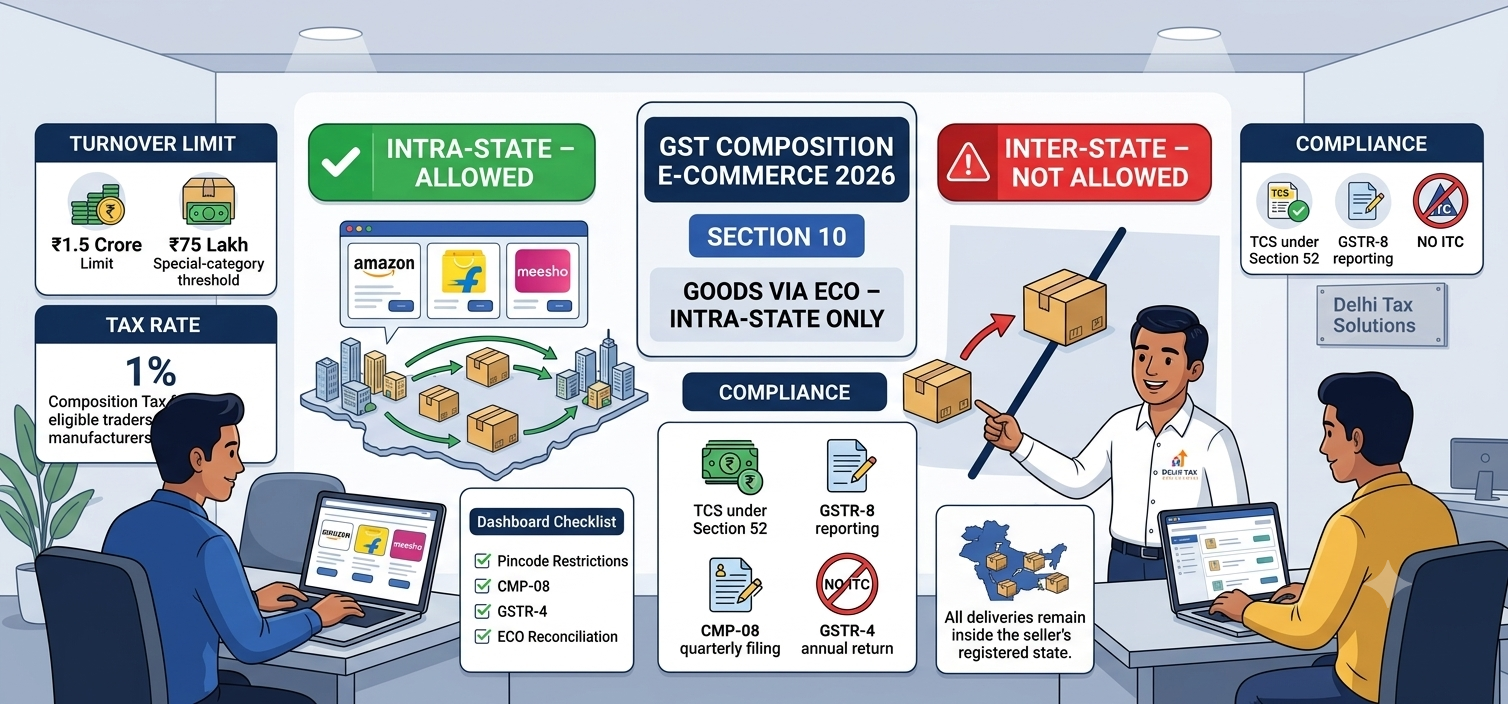
Yes, under the current GST composition scheme ecommerce rules, a composition dealer can sell goods through an e-commerce operator. Following the Section 10 changes introduced via Notification No. 36/2023, registered composition taxpayers are legally permitted to supply goods online. However, these sales must be strictly intra-state. Inter-state supply of goods and the supply of services through an e-commerce platform remain prohibited for composition dealers.
Understanding the Section 10 Changes
To grasp how we got here, you have to look at the historical text of the GST law. Originally, Section 10(2)(d) of the Central Goods and Services Tax (CGST) Act strictly barred composition taxpayers from supplying goods or services through an Electronic Commerce Operator (ECO) who is required to collect tax at source.
The Breakthrough Amendment
The Finance Act fundamentally altered this framework. By amending Section 10, the government removed the blanket ban. This composition scheme amendment was officially enacted to bring parity for small brick-and-mortar stores that wanted to digitise.
Effective Date and Application
These relaxed rules took effect on October 1, 2023, and remain fully applicable for the FY 2025-26 and beyond. If you run a local boutique in Delhi, you can now list your inventory online and ship to customers across Noida or Gurugram—provided the delivery address remains within your registered state’s borders.
Intra-State vs. Inter-State E-Commerce Rules
The single biggest trap for small online sellers is misunderstanding the geographical limits. The allowance for composition e-commerce is highly conditional.
The Intra-State Allowance
Intra state ecommerce composition simply means the supplier and the place of supply are in the same state. If your business is registered in Maharashtra, you can sell to buyers in Mumbai, Pune, or Nagpur via an e-commerce platform. The ECO will facilitate the sale and report it accordingly.
The Inter-State Prohibition
You cannot sell to a buyer outside your registered state. If that same Maharashtra-based seller receives an online order from Gujarat, fulfilling that order violates the scheme’s conditions. Doing so automatically renders the seller ineligible for the composition levy from the day the transaction occurs.
| Feature / Transaction Type | Composition Scheme Rules (2026) |
|---|---|
| Supply of Goods via E-Commerce (Intra-State) | Allowed (Taxed at 1% for traders/manufacturers) |
| Supply of Goods via E-Commerce (Inter-State) | Prohibited (Triggers immediate cancellation of scheme) |
| Supply of Services via E-Commerce | Prohibited |
| Input Tax Credit (ITC) | Not available |
Turnover Limits and TCS Implications
Before jumping into the digital marketplace, you must evaluate how online sales affect your overall threshold and cash flow.
Current Turnover Thresholds
The composition scheme turnover limit 2026 remains set at ₹1.5 crore for most states. For special category states, the limit is ₹75 lakh. Every rupee you earn through an online platform counts toward this aggregate turnover. If your combined offline and online sales breach ₹1.5 crore, you must transition to a regular GST Registration framework.
Tax Collected at Source (TCS)
When you sell through an ECO, the platform is mandated to collect tax under Section 52 of the GST Act. For regular taxpayers, ECOs deduct 1% TCS. However, under the special procedures outlined by the CBIC Official guidelines, the operator will electronically report your supplies via FORM GSTR-8 but manages TCS differently to align with your flat composition rate.
What Our CA Team Sees in Practice
Theory is one thing; practical compliance is another. Based on cases handled by our CA team at Delhi Tax Solutions, the transition to online sales frequently trips up new entrepreneurs.
The Pincode Problem
Many clients successfully register for the scheme but fail to set up geographical blockers on their seller dashboards. If you are selling on a custom Shopify site or a massive aggregator, you must configure your backend to reject out-of-state pincodes. A single ₹500 inter-state order can invalidate your composition status for the entire financial year.
Service Providers Stay Sidelined
We often get questions from freelancers wanting to offer consulting via aggregator platforms. Currently, the relief only applies to goods. If you provide services, you still cannot use an ECO under Section 10. If you are looking to formalise a service business, exploring standard Start a Business structures is your safest route.
How to Comply and File Returns
If you are ready to sell online, your compliance calendar remains relatively light compared to standard GST taxpayers, but accuracy is paramount.
Filing Form CMP-08
Instead of filing monthly GSTR-1 and GSTR-3B returns, you will file a quarterly statement called CMP-08. You will declare both your offline brick-and-mortar sales and your intra-state e-commerce sales here. You pay the flat 1% tax out of pocket, as you cannot issue a tax invoice or collect GST directly from the consumer.
Annual Return Obligations
At the end of the financial year, you must file GSTR-4. All data regarding your e-commerce supplies must reconcile perfectly with the data reported by the e-commerce operator on the GST Portal. Any mismatch can trigger an automatic notice from the tax department.
If you need help setting up an entity that scales easily across states, checking out Company Registration options might be a smarter long-term play than staying capped under the composition limits.
Conclusion: The ability to engage in composition e-commerce is a massive win for Indian small businesses. It allows you to tap into the digital economy without drowning in complex monthly filings. Just remember the three golden rules: stick to the ₹1.5 crore limit, never ship goods across state borders, and ensure your quarterly CMP-08 filings perfectly match your ECO’s reports. Talk to a Delhi Tax Solutions expert to get your GST registration filed within 3 days and secure your online seller journey today. The future of Indian retail is hybrid, and this scheme finally lets you play in both arenas.
Frequently Asked Questions (FAQ)
Q: Can a composition dealer sell goods on Amazon or Flipkart?
A: Yes, a composition dealer can sell goods on platforms like Amazon or Flipkart, provided the sales are strictly intra-state. According to the October 2023 amendment to the GST Act, you can use e-commerce operators to sell your products, but you must configure your seller account to ensure deliveries do not cross your registered state’s borders.
Q: What are the Section 10 changes for e-commerce under GST?
A: The major Section 10 changes, enacted via Notification No. 36/2023, removed the blanket ban that prevented composition taxpayers from supplying goods through an Electronic Commerce Operator (ECO). Previously prohibited entirely, small traders can now list goods online for intra-state supply while maintaining their 1% flat tax rate, reducing their compliance burden significantly.
Q: Is inter-state sale allowed for composition dealers through an e-commerce platform?
A: No, inter-state sale is absolutely not allowed for composition dealers, whether conducted offline or through an e-commerce platform. If you sell goods to a customer located in a different state, you immediately violate the scheme’s core conditions, and your composition status will be revoked, subjecting you to regular GST rates and penalties.
Q: How do e-commerce operators deduct TCS for composition sellers?
A: Under Section 52 of the GST Act, e-commerce operators are required to collect Tax Collected at Source (TCS) on the net value of taxable supplies made through their platform. For composition sellers, the ECO will deduct this tax and report it electronically in FORM GSTR-8, which then reflects in the seller’s GST portal to ensure transparent tracking.
Q: What is the composition scheme turnover limit for 2026?
A: For the financial year 2025-26 and heading into 2026, the composition scheme turnover limit is ₹1.5 crore for suppliers of goods in most Indian states. For specific special category states (like states in North-Eastern India), the threshold is lower, at ₹75 lakh. If your total offline and online sales exceed this, you must switch to regular GST.
About this article: Researched using official government sources, real-time competitor and search-trend analysis, and Delhi Tax Solutions’ in-house tax advisory team. Last updated September 2026. This article is for general informational purposes and is not a substitute for personalised professional tax advice.