
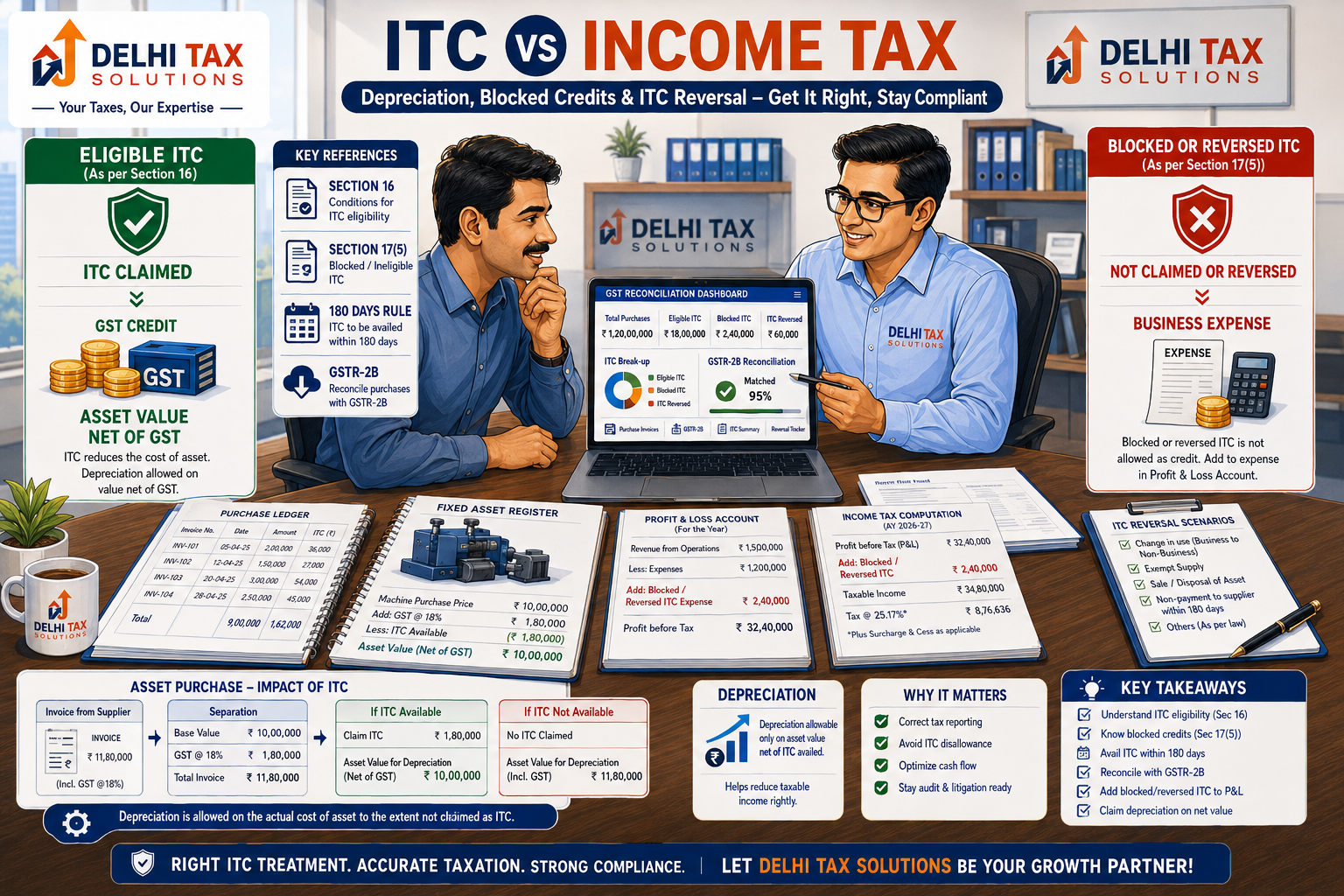
? Key Takeaways
- Avoid claiming both depreciation and Input Tax Credit (ITC) on the tax component of fixed assets.
- If you claim ITC, capitalize the asset at its cost net of GST for Income Tax purposes.
- Blocked credits (e.g., under Section 17(5) of the GST Act) are deductible as business expenses.
- ITC reversals due to non-payment to suppliers can be claimed as business expenses under Income Tax.
- Strict reconciliation of GSTR-2B with your purchase ledger is essential for annual audit compliance.
Maintaining balance between GST filings and Income Tax reporting is a foundational challenge for Indian business owners. Misinterpreting how claiming ITC without income tax conflicts occurs often leads to double-claims or audit penalties during scrutiny. Many founders assume that Input Tax Credit (ITC)—the tax paid on business inputs that you can offset against output tax liability—operates in a silo separate from your profit and loss statements. This perception is incorrect.
Your financial books must reflect the correct accounting treatment for GST credits. Failing to differentiate between the tax credit and the expense can lead to inflated asset values or incorrect profit deductions. Operating profitable companies requires precise management of your Income Tax filings while maintaining strict compliance with GST Registration mandates. This advisory guide ensures your team avoids common pitfalls encountered during yearly tax computations.
What is the core conflict between ITC and Income Tax rules?
The conflict arises when businesses attempt to claim dual benefits. If you claim Input Tax Credit on a capital asset, you effectively treat the tax component as a credit to be offset against output tax. Therefore, you cannot also claim depreciation on that same tax component under the Income Tax Act. To resolve this, you must capitalize your asset at the cost net of GST if ITC is claimed. If ITC is not claimed, you may capitalize the total cost including GST and claim depreciation on the higher value. This distinction ensures compliance with Section 16 of the GST Act and Section 43 of the Income Tax Act.
How do you manage ITC vs income tax expense treatment?
Deciding between ITC vs income tax expense treatment requires clear accounting policies. When you make a business purchase, the GST component is either a credit (ITC) or an added cost (expense). You must choose the correct path during the initial booking of the entry.
Capitalized assets and tax credits
When purchasing machinery or equipment, determine if you are eligible to claim ITC under GST Portal rules. If you claim the credit, ensure your accounting software tags the tax portion as an asset recoverable rather than an expense.
Reconciling ledger entries
Our CA team recommends monthly reconciliation between your GSTR-2B statement and your purchase ledger. This practice identifies mismatches early, preventing the miscalculation of expenses versus recoverable credits.
Are GST ITC blocked credits deductible as business expenses?
Yes, GST ITC blocked credits under Section 17(5) of the GST Act—such as credits on food, beverages, or certain personal benefits—can generally be claimed as deductible business expenses under the Income Tax Act. Because you cannot use these taxes as a credit, they form part of your cost of doing business. Ensure these expenditures are clearly labeled in your ledgers for auditor verification.
Handling ineligible input claims
When you encounter blocked inputs, these taxes are not “credits” and should not be routed through your GST credit account. Treat them as regular office or operational expenditures during financial reporting.
Documenting business usage
Maintain proper invoices for all blocked expenditures to prove they were incurred for business purposes. This documentation protects you during scrutiny by the Income Tax Department.
| Scenario | GST Treatment | Income Tax Treatment |
|---|---|---|
| Eligible ITC (Business Purchase) | Claim as Credit | Capitalize/Expense net of GST |
| Blocked Credit (Section 17(5)) | No Credit Allowed | Deduct as Business Expense |
| ITC Reversal (Non-payment > 180 days) | Reverse in GST Filings | Deduct as Business Expense |
| Depreciation on Fixed Asset | N/A | Claim on Value net of GST |
? Quick Summary
If you claim GST as a credit, you cannot deduct it as an expense. If GST is blocked or reversed, it is generally deductible as an expense under Income Tax provisions.
Does ITC reversal have an income tax impact?
Yes, ITC reversal income tax impact is significant for operational cash flow. If you fail to pay a supplier within 180 days, you must reverse the claimed ITC as per the Press Information Bureau notifications. This reversed credit essentially becomes an unrecoverable tax cost. Under the Income Tax Act, you may treat this reversed tax amount as a business expense, provided the payment is eventually made to the supplier in a subsequent financial year.
Timing considerations
Reversals often occur months after the purchase. Ensure your accounting team tracks these adjustments to maintain parity with your profit and loss projections.
Reporting on ITR
Ensure that the reversed amount is reflected in your audited financial statements. Misalignment here is a common trigger for tax notices.
What are the best practices for reconciling ITC with P&L?
Effectively reconciling ITC with P&L requires a systematic approach. Many small businesses use software that automates the link between GST filings and accounting ledgers, but manual oversight is still necessary for complex entries. As per our Company Registration advisory team, businesses must ensure that the “ITC available” column matches the “GST Input” asset account on the balance sheet.
Audit readiness
Keep a “GST-to-Tax Reconciliation File” ready for your annual audit. This file should show the GST input accounts, ITC claimed, blocked credits, and reversal entries.
Standardized accounting policies
Formalize your accounting policy. Define clearly when the GST component is charged to the asset versus when it is credited. This consistency builds trust with your tax auditors.
Why is compliance with Section 16 of the GST Act critical?
Compliance with Section 16 GST Act compliance is the foundation of tax health. This section outlines eligibility conditions for ITC, including the requirement of a valid tax invoice and the actual receipt of goods. Non-compliance here can lead to heavy penalties from the Ministry of Corporate Affairs and GST authorities.
Talk to a Delhi Tax Solutions expert to get your GST filings and income tax audit managed seamlessly today.
About this article: Researched using official government sources and Delhi Tax Solutions’ in-house tax advisory team. Last updated August 2026.
This article is for general informational purposes and is not a substitute for personalised professional tax advice.
Frequently Asked Questions (FAQs)
Q: Can I claim ITC and depreciation on the same asset?
A: No, you cannot claim double tax benefits on the same tax component. If you claim Input Tax Credit (ITC) on the GST portion of an asset purchase, you must exclude that tax component from the asset’s capitalized value for depreciation purposes under the Income Tax Act. You calculate depreciation only on the cost of the asset net of GST to avoid tax conflicts.
Q: Is ITC reversal considered an expense under Income Tax?
A: Yes, if you are required to reverse an ITC claim because of non-payment to your supplier within 180 days as mandated by GST law, that reversed tax amount effectively becomes a cost to your business. You can generally treat this amount as a deductible business expense in your Income Tax computation for the financial year in which the reversal occurs, adjusting your profit.
Q: What happens if I capitalize ITC in my books?
A: If you capitalize ITC by including the GST amount in the asset’s value, you are essentially treating the GST as part of the asset’s cost rather than a recoverable credit. This means you will claim depreciation on the higher value (including GST) instead of claiming the tax credit against your output GST liability. This approach is valid, but you must consistently apply it to avoid any audit scrutiny.
Q: How to reconcile GSTR-2B with P&L expenses?
A: Reconciling GSTR-2B with your Profit and Loss (P&L) statement is essential for audit preparation. You should perform a monthly comparison where your total purchases recorded in your ledger are mapped against the tax invoices uploaded in GSTR-2B. Differences may arise due to timing, blocked credits, or non-GST expenses. Documenting these variances in a reconciliation file provides auditors with a clear trail of why certain purchases were expensed and others claimed as credit.
Q: Are blocked GST credits deductible as business expenses?
A: Yes, GST credits that are blocked under Section 17(5) of the GST Act—such as those for food, beverages, club memberships, or rent-a-cab services—cannot be claimed as tax credits. Consequently, since this GST paid is a non-recoverable cost, it constitutes an expenditure incurred for business purposes. You are entitled to debit this GST amount to your Profit and Loss account as a business expense, which helps reduce your net taxable income.
