💡 Key Takeaways: Best Judgement Assessment (Section 62)
- Triggered by Non-Filing: Section 62 is invoked when a registered taxpayer fails to file their monthly or annual GST returns even after receiving a formal warning notice (GSTR-3A).
- Estimation of Tax: The assessing officer calculates your tax liability based on their “best judgement” using available data (like GSTR-1, E-way bills, and GSTR-2A/2B).
- Form ASMT-13: The official assessment order is issued in Form GST ASMT-13, detailing the tax, interest, and late fees demanded.
- New 60-Day Withdrawal Rule: As per the Finance Act 2023, if you file the pending valid return within 60 days of receiving the ASMT-13 order, the assessment order is automatically deemed withdrawn.
The Goods and Services Tax (GST) framework in India heavily relies on voluntary compliance and self-assessment. Every registered business is expected to calculate its own tax liability and report it by filing periodic returns. However, what happens when a taxpayer completely ignores this responsibility and stops filing returns?
To tackle non-compliance and prevent revenue leakage, the CGST Act empowers tax authorities to step in and assess the tax liability on behalf of the defaulting taxpayer. This process is legally known as the Best Judgement Assessment under Section 62 of the CGST Act. Let us dive deep into how this mechanism works, what triggers it, and the crucial steps you must take if you receive an assessment order.
What is Best Judgement Assessment (Section 62)?
Under Section 62 of the CGST Act, if a registered person fails to furnish their returns (such as GSTR-3B, GSTR-4, or the Annual Return GSTR-9), the proper officer has the authority to assess the tax liability to the best of their judgement. Since the taxpayer hasn’t provided any data, the officer relies on alternative sources of information gathered by the department.
The officer typically uses the following data points to estimate your sales and tax liability:
- Details of outward supplies declared by you in Form GSTR-1 (if filed).
- Inward supply details auto-populated in your GSTR-2A or GSTR-2B based on your suppliers’ filings.
- E-way bills generated on the portal linked to your GSTIN.
- Information gathered through inspections, audits, or any other intelligence available to the department.
The Step-by-Step Assessment Process for Non-Filers
The tax department cannot arbitrarily pass a Best Judgement Assessment order overnight. The law mandates a strict chronological procedure that officers must follow, giving the taxpayer ample opportunity to correct their default.
1. Issuance of Notice (Form GSTR-3A)
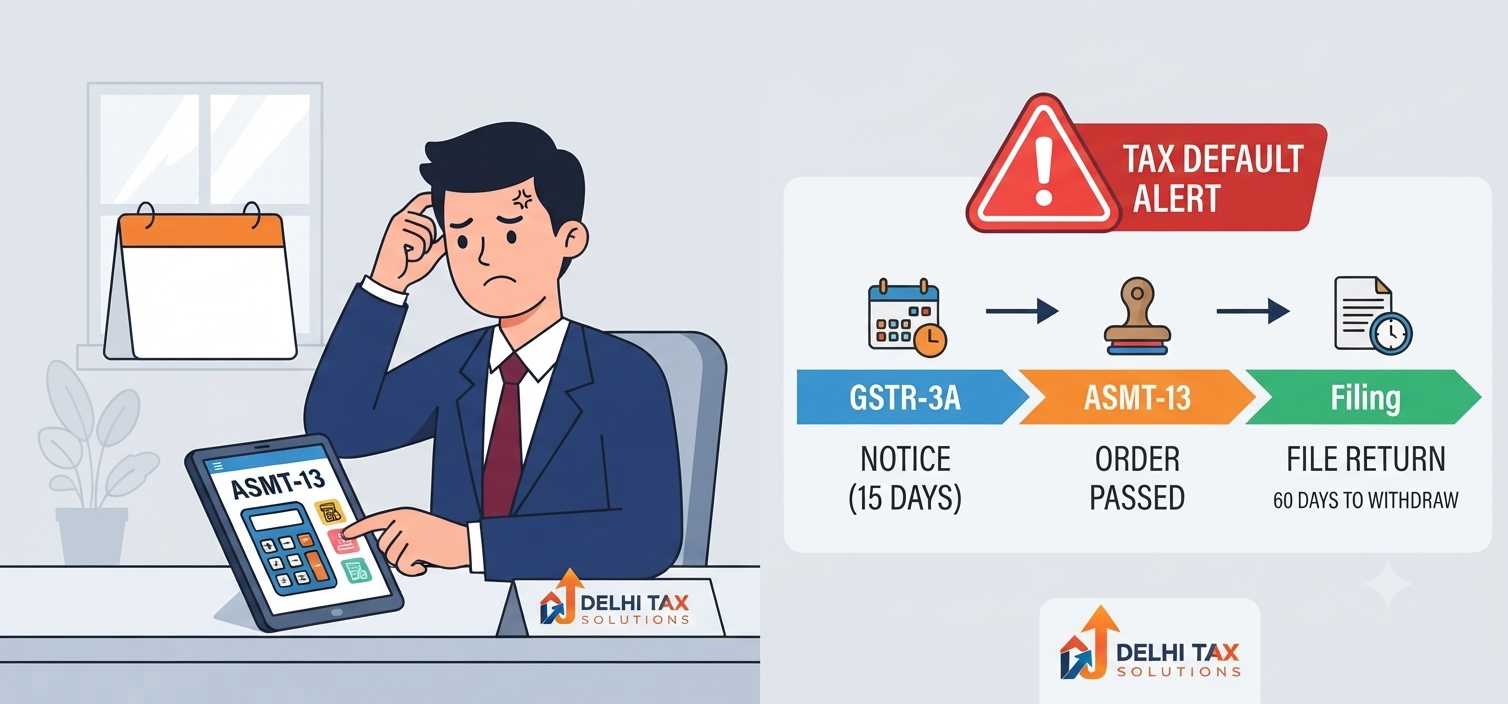
Before any assessment is made, the proper officer must issue a notice under Section 46 of the CGST Act in Form GSTR-3A. This notice serves as an official warning, directing the defaulting taxpayer to file the pending returns within 15 days from the date of the notice.
2. Passing the Assessment Order (Form ASMT-13)
If the taxpayer ignores the GSTR-3A notice and still fails to file the returns within the stipulated 15-day period, the officer will proceed with the Best Judgement Assessment. The officer will quantify the tax liability, add the applicable interest and late fees, and issue an official assessment order in Form GST ASMT-13. At this stage, a summary of the demand is also uploaded electronically in Form DRC-07.
The officer has a time limit of 5 years from the due date of furnishing the annual return for the financial year to which the unpaid tax relates, to pass this assessment order.
How to Withdraw or Cancel an ASMT-13 Order? (The 60-Day Rule)
Receiving an ASMT-13 order can be terrifying, as the assessed tax liability is often exaggerated based on estimates. However, the law provides a very straightforward “escape route” known as the withdrawal of the assessment order.
Historically, taxpayers had only 30 days to act. However, to provide relief to struggling businesses, the government amended the timelines via the Finance Act 2023. You can read the official circulars regarding these statutory changes directly on the Central Board of Indirect Taxes and Customs (CBIC) website.
Here is how you can nullify the Best Judgement Assessment:
- Filing within 60 Days: If the taxpayer furnishes a valid return for the default period within 60 days of the service of the ASMT-13 assessment order, the order is automatically deemed withdrawn.
- Extended 60 Days: If you miss the first 60-day window, you can still file the return within a further period of 60 days (total 120 days), provided you pay an additional late fee.
- Continuing Liability: Although the tax demand raised via the officer’s judgement is cancelled, the taxpayer must still pay the actual tax due as per their self-assessed return, along with applicable late fees and interest under Section 50.
Section 62 (Non-Filers) vs. Section 63 (Unregistered Persons)
While Section 62 applies to taxpayers who have a valid GSTIN but fail to file returns, the CGST Act also has a provision for entities that are liable to register but have unlawfully avoided doing so.
Under Section 63, if a person is liable to obtain GST registration but fails to do so, or if their registration has been cancelled but they were liable to pay tax, the officer can assess their tax liability to the best of their judgement. In such cases, the officer issues a notice in Form ASMT-14, granting 15 days for a reply, before passing a final order in Form ASMT-15. Unlike Section 62, simply applying for registration later does not automatically withdraw an order under Section 63.
To avoid getting caught in this complex web of assessments, notices, and heavy penalties, it is highly recommended to outsource your compliance to professionals. If you need help clearing your backlog, consider seeking expert GST return filing services to keep your business fully compliant.
Consequences of Ignoring Best Judgement Assessment
What happens if a taxpayer neither files the pending return within the 60-day window nor appeals the order? In such a scenario, the ASMT-13 order becomes final and binding.
Once finalized, the tax department will initiate aggressive recovery proceedings under Section 78 and Section 79 of the CGST Act. The recovery officers can freeze your bank accounts, attach your business property, detain your goods, or intercept payments due to you from third parties. Furthermore, the department will proceed to permanently cancel your GST registration. You can monitor your compliance status and notices by logging into the official GST Portal regularly.
Have You Received an ASMT-13 Assessment Order?
Ignoring a Best Judgement Assessment order can lead to bank account attachments and heavy financial penalties. Acting within the 60-day window is critical to getting the exorbitant tax demands withdrawn.
Do not let estimated tax demands cripple your business. Contact the experts at Delhi Tax Solutions immediately to help you prepare pending accounts, file valid returns, and legally nullify the assessment order before recovery proceedings begin.
Frequently Asked Questions (FAQs)
+ Q: What is Form ASMT-13 in GST?
A: Form ASMT-13 is the official assessment order issued by a GST officer under Section 62. It contains the tax, interest, and penalties calculated by the officer based on their “best judgement” when a taxpayer fails to file their returns.
+ Q: Can a Best Judgement Assessment order be cancelled?
A: Yes. If the defaulting taxpayer files a valid GST return for the pending period within 60 days of receiving the ASMT-13 order, the assessment order is automatically deemed to be withdrawn.
+ Q: What happens if I file the return after 60 days of the ASMT-13 order?
A: As per the latest amendments, you can still file the return within a further extended period of 60 days (making it a total of 120 days from the order). However, this extension requires the payment of an additional prescribed late fee.
+ Q: Does the withdrawal of ASMT-13 mean I don’t have to pay late fees?
A: No. Even if the Best Judgement Assessment order is withdrawn upon filing the return, you are still legally obligated to pay the standard late fees and the interest on the delayed payment of tax as per Section 50.
About this article: Based on Section 62 and Section 63 of the CGST Act, 2017, including the amendments introduced by the Finance Act 2023. Updated for 2026.
Disclaimer: This article is for educational and informational purposes only and does not constitute formal legal advice. Please consult a qualified GST advisor to resolve compliance defaults and assessment notices.