
💡 Key Takeaways
- Automating Indian tax compliance through ITR APIs streamlines high-volume corporate and individual return filings.
- Strict adherence to Central Board of Direct Taxes JSON schemas ensures error-free submission pipelines.
- Robust authentication and cryptographic signing protect sensitive taxpayer credentials during data transmission.
- Expert CA and developer oversight minimizes validation failures and accelerates processing cycles across assessment years.
Modern financial technology relies heavily on seamless data pipelines to eliminate manual bottlenecks. When businesses and software developers build platforms to handle tax filings at scale, interacting directly with government infrastructure becomes essential. Leveraging robust digital gateways transforms cumbersome paperwork into streamlined digital workflows. Our expert advisory and technical team at Delhi Tax Solutions examines the architectural blueprint for automating Indian tax compliance to empower your software engineering initiatives and secure flawless digital filings.
What are ITR APIs and tax automation frameworks?
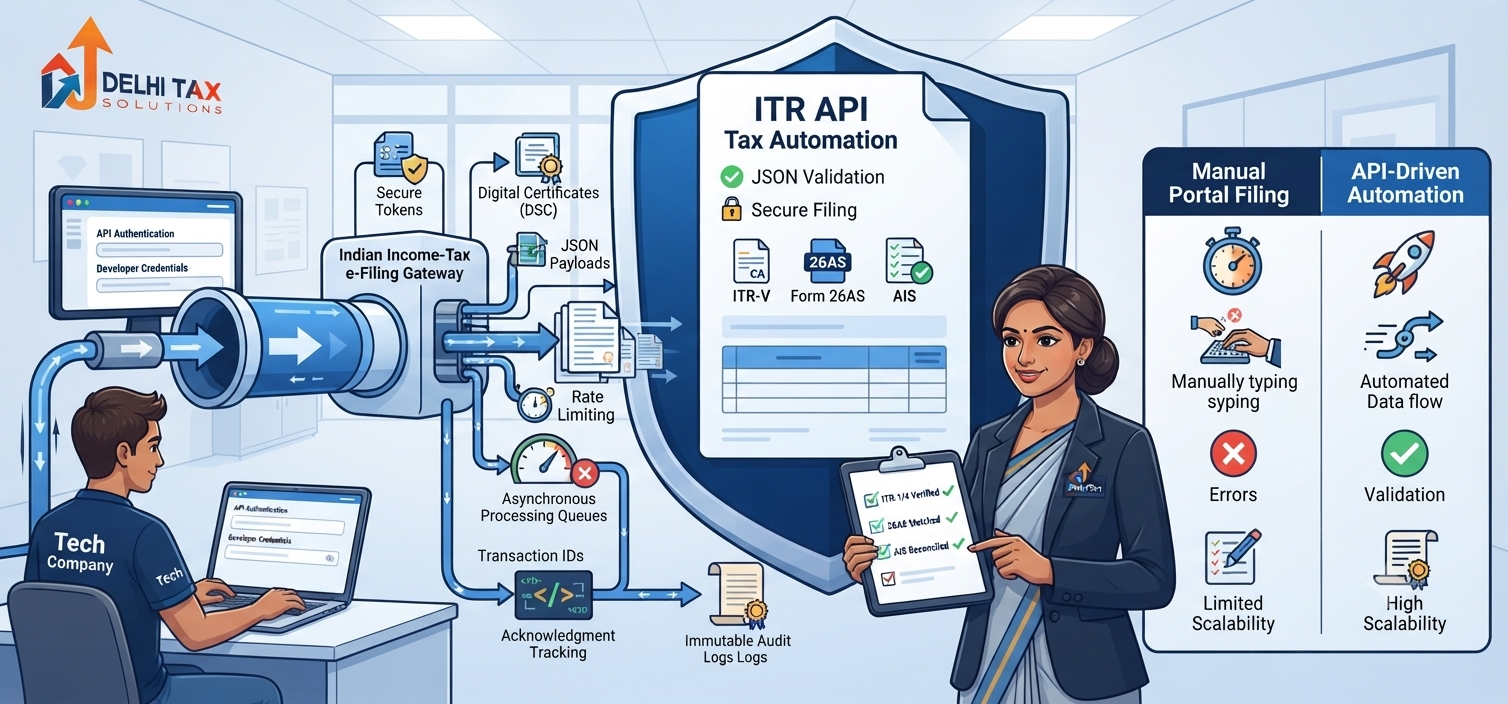
Automating Indian tax compliance developer guide to ITR APIs focuses on establishing secure programmatic connections between enterprise software applications and the official income tax e-filing ecosystem. These digital gateways allow authorized intermediaries and software platforms to upload return data, fetch pre-filled information, and track filing status without manual intervention on the portal. According to official updates from the Income Tax Department, API-driven architectures handle millions of returns securely each season. For enterprises structuring their technology operations, our guide on Company Registration – Delhi Tax Solution provides complete corporate setup support.
How does the e-filing portal handle API integrations?
Authentication Protocols and Developer Credentials
Establishing a secure connection requires rigorous authenticate mechanisms where software vendors register with the portal using authorized developer keys, secure tokens, and digital certificates.
JSON Schema Validation Standards
Every submitted payload must strictly match the official JSON schema released annually by tax authorities. Formatting errors instantly trigger automated rejection responses from the endpoint.
Submission Workflows and Asynchronous Processing
Large tax platforms manage submissions via asynchronous queuing systems to handle peak traffic volumes during filing deadlines without timing out server connections.
What are the core security and cryptographic requirements?
Digital Signature Certificates (DSC) Integration
Automated pipelines must programmatically append valid cryptographic signatures to verify the identity of the taxpayer before final submission to the central database.
Secure Payload Encryption Protocols
Transport Layer Security (TLS 1.3) and advanced encryption standards protect financial records while in transit across public networks and government gateways.
Rate Limiting and Error Handling Mechanisms
Developers must implement exponential backoff algorithms and robust exception handling to respect server rate limits and gracefully manage unexpected gateway errors.
Comparison of Manual Filing versus API-Driven Automation
| Compliance Parameter | Manual Portal Filing | API-Driven Automated Compliance |
|---|---|---|
| Processing Speed | Slow, prone to manual data entry bottlenecks | Near-instantaneous batch processing of records |
| Error Frequency | High risk of transcription and calculation mistakes | Automated pre-validation against strict schemas |
| Scalability | Limited by human capacity per filing cycle | Infinitely scalable for high-volume enterprise needs |
Strategic financial planning requires understanding how legislative updates impact long-term corporate growth, as detailed in our analysis of Income Tax Act 2025 vs 1961: Key Differences Explained. Furthermore, maintaining proper tax compliance across assessment cycles aligns with protocols in Income Tax – Delhi Tax Solution.
How do developers manage acknowledgment tracking and logs?
Polling Acknowledgment Numbers (ITR-V)
Once data transmits successfully, automated systems poll the tax server to retrieve acknowledgment numbers and generate signed electronic verification slips instantly.
Reconciling Tax Ledger Discrepancies
Automated software continuously compares submitted payloads against Form 26AS and AIS data to flag mismatches before final processing by the central tax authority.
Audit Trail Maintenance and Compliance Logs
Maintaining immutable logs of all API requests and responses ensures full accountability during regulatory reviews monitored by the Ministry of Corporate Affairs.
Conclusion and Professional CA Guidance
Automating tax compliance through robust API integrations revolutionizes how organizations handle regulatory obligations. By combining strict schema adherence, advanced cryptographic security, and expert CA oversight, development teams can build scalable, error-free financial applications. Partnering with seasoned professionals ensures your technical infrastructure remains fully aligned with statutory standards. Talk to a Delhi Tax Solutions expert to review your tax automation architecture and secure your compliance workflows within 3 days. Strategic technical advisory remains the bedrock of secure digital growth.
Frequently Asked Questions (FAQs)
Q: What is the technical architecture required for integrating with Indian ITR APIs?
A: Integrating with Indian income tax return APIs requires a secure cloud or on-premise infrastructure capable of handling HTTPS requests, TLS 1.3 encryption, and robust JSON payload formatting. Developers must register with authorized intermediaries or the Income Tax Department’s developer portal, obtain unique API keys, and set up secure worker queues to manage asynchronous data transmission, rate limiting, and automated error logging during peak filing seasons.
Q: How do developers handle JSON schema validations for income tax return filings?
A: Developers must download the latest annual JSON schemas and validation utilities provided directly by the Income Tax Department. Automated testing pipelines validate every outgoing taxpayer payload against these strict schema definitions before transmission. This pre-check prevents server-side rejections, catches missing mandatory fields early, and ensures absolute compliance with current income tax reporting standards.
Q: What authentication protocols are mandated by the Income Tax Department for developers?
A: The e-filing ecosystem mandates multi-factor authentication, including secure OAuth tokens, registered digital certificates, and authorized intermediary credentials. Every API request must carry cryptographic signatures and valid session identifiers issued after successful handshake procedures with the central tax gateway, ensuring that only verified software entities can submit sensitive financial data.
Q: How do automated systems manage error payloads and acknowledgment tracking during tax filing?
A: When an API request encounters formatting or validation errors, the tax server returns structured error payloads detailing exact node failures. Automated systems parse these error codes instantly, allowing developers or automated scripts to rectify data points. Upon successful submission, the system polls the server using transaction IDs to download official ITR-V acknowledgments and verification slips.
Q: What security and cryptographic standards must software developers follow when handling taxpayer data?
A: Software applications must encrypt all taxpayer data at rest and in transit using military-grade encryption algorithms such as AES-256 and TLS 1.3. Furthermore, integration with Digital Signature Certificates (DSC) requires secure hardware security modules (HSMs) or approved cryptographic token handlers to programmatically sign returns without exposing private keys to unauthorized users.
Disclaimer: This article is for general informational purposes and is not a substitute for personalised professional tax advice. About this article: Researched using official government sources and Delhi Tax Solutions’ in-house tax advisory team. Last updated September 2026.