💡 Key Takeaways
- The CBDT notified the new Income-tax Rules, 2026 via G.S.R. 198(E) on March 20, 2026.
- These rules officially take effect on April 1, 2026, replacing the 1962 framework.
- Tax limits for meal vouchers, education allowances, and gifts have increased significantly.
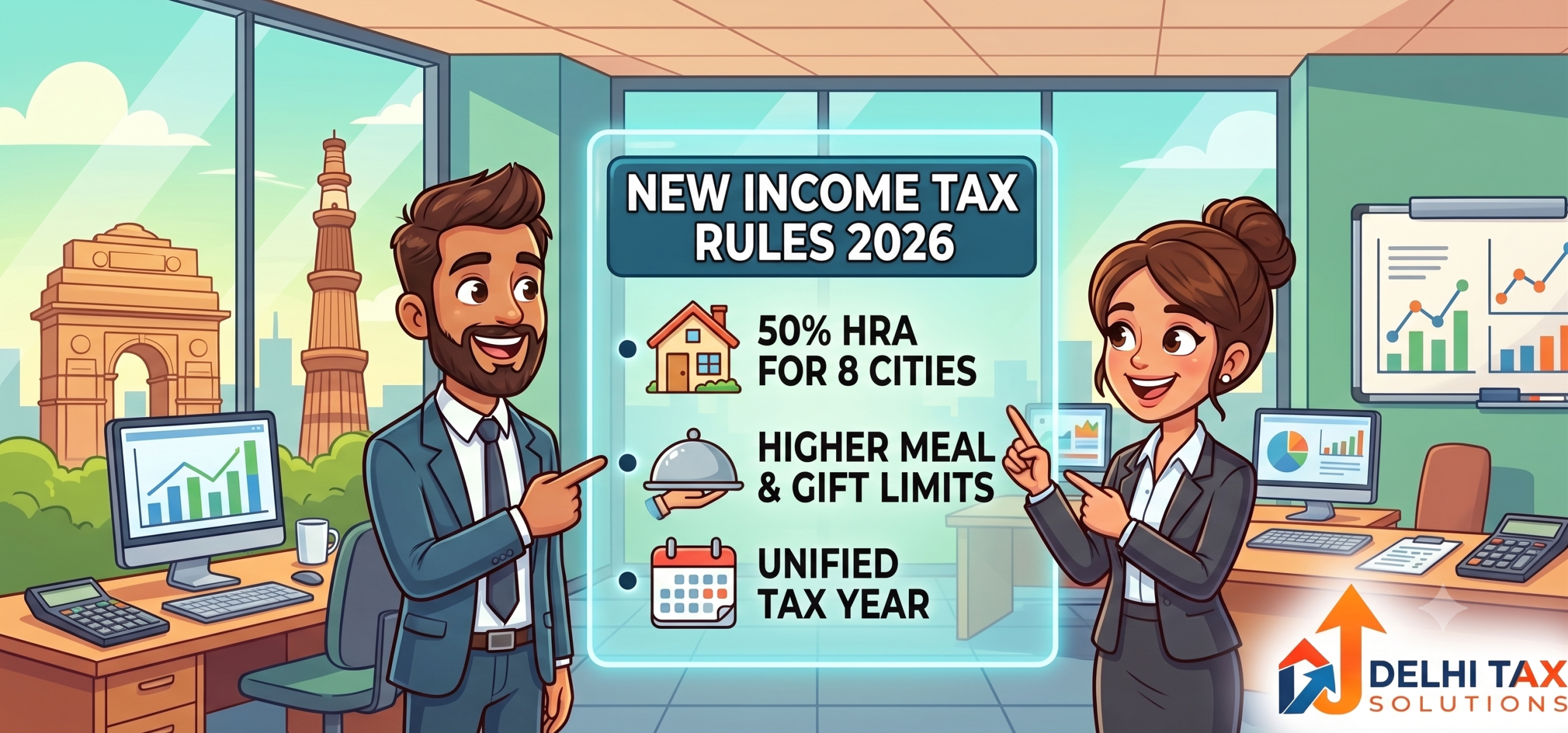
- The 50% HRA exemption now expands to 8 major Indian cities, adding Bengaluru and Pune.
- The total number of tax rules has been drastically cut from 511 down to 333.
The Indian taxation system has officially entered a new era. On March 20, 2026, the Central Board of Direct Taxes (CBDT) published a landmark notification that completely rewrites how individuals and businesses calculate their taxes. Having your Income-tax Rules 2026 explained accurately is no longer optional—it is a critical requirement for financial survival this year.
Replacing the six-decades-old 1962 rules, this massive regulatory overhaul operationalizes the newly enacted direct tax framework. From how your company values your office cab to the exact cities eligible for higher rent exemptions, the entire compliance landscape shifts on April 1, 2026. Ignorance of these changes will lead to incorrect salary structuring, defective tax returns, and severe automated penalties. This comprehensive guide breaks down the exact legal updates, translates the complex government notification into plain English, and outlines the precise steps you must take to protect your income.
Understanding the Income Tax Rules Notification 2026
The legal foundation for this change rests entirely on the income tax rules notification 2026. Published officially as G.S.R. 198(E) rules in the Gazette of India, this document serves as the operational machinery for the new Income-tax Act, 2025. While the Act outlines the broad legal framework, the Rules provide the exact mathematical formulas, administrative forms, and procedural deadlines.
The government focused heavily on simplification. The legacy 1962 framework contained a bloated 511 rules and 399 confusing forms. The 2026 update ruthlessly trims this down to just 333 rules and 190 streamlined forms. By aggressively cutting obsolete regulations, the Income Tax Department aims to make digital compliance faster, reducing the dependency on expensive litigation for basic tax interpretation.
Assessment Year is Dead: Welcome to the “Tax Year”
One of the most fundamentally important structural changes is the death of the dual-timeline system. For over 60 years, taxpayers struggled with the confusing difference between the “Previous Year” (when income was earned) and the “Assessment Year” (when taxes were filed).
Under the new framework, the government has entirely scrapped these terms. Starting April 1, 2026, every financial period is simply referred to as a “Tax Year”. The income you earn between April 1, 2026, and March 31, 2027, will be assessed and filed strictly as Tax Year 2026-27. This unified label guarantees that the dates on your accounting ledgers, tax challans, and final Income Tax / ITR Filing match perfectly, eliminating the primary cause of defective return notices.
Massive Changes to Salary Perquisites and Allowances
If you are a salaried employee or an HR manager, the CBDT new rules 2026 directly impact your monthly payroll. Rule 15 of the new framework recalibrates the valuation of employer-provided benefits (perquisites) to reflect current economic realities. The old limits, many of which had not been updated since the early 2000s, were notoriously outdated.
Direct Comparison of Old vs. New Limits
The following table highlights the exact monetary changes for common employee allowances:
| Perquisite / Allowance | Old Limit (1962 Rules) | New Limit (2026 Rules) | Impact |
|---|---|---|---|
| Meal Vouchers | ₹50 per meal | ₹200 per meal | 4x increase |
| Employer Gifts | ₹5,000 per year | ₹15,000 per year | 3x increase |
| Children Education | ₹100 / month / child | ₹3,000 / month / child | 30x increase |
| Hostel Allowance | ₹300 / month / child | ₹9,000 / month / child | 30x increase |
| Medical Loan (Employer) | ₹20,000 | ₹2,00,000 | 10x increase |
Note: Sourced directly from CBDT Notification G.S.R. 198(E) dated 20-3-2026.
Motor Car and Transport Allowances
The valuation for employer-provided vehicles has also undergone a steep revision. The taxable value added to your salary for using a company car for mixed purposes (official and personal) has increased, which will inadvertently raise your monthly Tax Deducted at Source (TDS) obligations. Conversely, transport sector employees (like pilots and drivers) see their monthly exemption limit jump from ₹10,000 to ₹25,000 (or 70% of the allowance, whichever is lower).
House Rent Allowance (HRA): 8 Cities Now Get 50%
For decades, only taxpayers residing in the four original metro cities (Delhi, Mumbai, Kolkata, Chennai) could claim a 50% exemption on their House Rent Allowance (HRA). Everyone else was capped at 40%.
The new rules finally acknowledge India’s modern urban expansion. The 50% HRA exemption bracket now explicitly includes eight cities. Bengaluru, Hyderabad, Pune, and Ahmedabad have been officially added to the top tier. If you rent a house in these newly upgraded IT hubs, your taxable salary will drop significantly, resulting in a higher take-home pay. HR departments must update their payroll processing software immediately to ensure employees receive this expanded legal benefit starting in April.
Compliance Impact for MSMEs and Startups
Small business owners and startup founders cannot afford to ignore these updates. The rules surrounding the maintenance of books of accounts (Rule 46) and mandatory digital payment modes for large transactions (Rule 133) have been streamlined.
If your business completed its Company Registration recently, you must align your accounting software with the new 190 forms. The government’s push for a digital-first economy means that any discrepancies between your declared income and your outward supplies filed on the GST Portal will trigger immediate, automated scrutiny under the new Faceless Assessment rules (Rule 176).
⚡ Quick Summary
The 2026 Rules do not create new taxes; they modernize the compliance machinery. Employers must overhaul their payroll systems by April 1 to implement the new perquisite valuations and HRA limits.
Entrepreneurs holding a GST Registration & Filing mandate should conduct a comprehensive internal audit. Ensuring your indirect tax data matches your new direct tax reporting perfectly is the only way to avoid the expanded powers of the Central Processing Centre.
Digital Reporting and Crypto-Assets
The new framework brings the tax system firmly into the digital age. The rules establish strict guidelines for the Crypto-Asset Reporting Framework (Rules 238–241), forcing exchanges and authorized dealers to report high-value virtual digital asset transactions directly to the government. According to the Press Information Bureau, these transparency mandates are designed to track offshore digital wealth and ensure all capital gains are taxed appropriately.
Furthermore, Non-Profit Organisations (NPOs) and trusts face updated registration procedures (Rules 181–191) to maintain their tax-exempt status. The new digitized forms require far more precise data regarding foreign contributions and domestic spending.
Conclusion
Having the Income-tax Rules 2026 explained is just the first step. Action must follow immediately. The implementation of G.S.R. 198(E) on April 1, 2026, represents the most significant shift in Indian tax compliance in our lifetime. By unifying the reporting timeline under a single “Tax Year,” expanding the 50% HRA exemption to modern tech hubs, and dragging outdated perquisite limits into the modern economy, the CBDT has created a structurally superior framework.
However, this structural modernization demands strict technical compliance. Employers must reprogram their payroll engines, and individual taxpayers must gather accurate data before their next filing cycle. Do not let outdated accounting practices trigger automated government penalties. Talk to a Delhi Tax Solutions expert to get your corporate compliance updated smoothly and ensure your tax strategy aligns perfectly with the 2026 legal framework.
About this article: Researched using official government sources and Delhi Tax Solutions’ in-house tax advisory team. Last updated August 2026.
Disclaimer: This article is for general informational purposes and is not a substitute for personalised professional tax advice.
Frequently Asked Questions (FAQs)
+ Q: What are the key changes in the Income-tax Rules 2026?
A: The Income-tax Rules 2026 completely overhaul India’s tax compliance machinery by reducing total rules from 511 to 333. Key changes include the formal replacement of the confusing “Assessment Year” with a unified “Tax Year”, massive increases in tax-free limits for employee perquisites (like meal and education allowances), and the expansion of the 50% House Rent Allowance (HRA) exemption to cover eight major cities.
+ Q: When do the G.S.R. 198(E) income tax rules come into effect?
A: The Central Board of Direct Taxes (CBDT) formally published the new rules via Notification No. G.S.R. 198(E) on March 20, 2026. These rules officially come into legal force on April 1, 2026. This strict deadline means all employers must update their internal payroll systems and taxpayers must adapt to the new digital forms for any income earned starting from this financial period.
+ Q: How is House Rent Allowance (HRA) calculated under the new 2026 rules?
A: Under the new 2026 framework, the government officially expanded the geographical list for higher HRA exemptions. Previously, only residents of Delhi, Mumbai, Kolkata, and Chennai could claim a 50% exemption on their basic salary. The new rules explicitly add Bengaluru, Hyderabad, Pune, and Ahmedabad to this top-tier list, providing immense tax relief to millions of IT and corporate professionals residing in these modern urban hubs.
+ Q: What is the new limit for meal and gift vouchers in 2026?
A: Acknowledging inflation, the new rules drastically increase outdated employee benefit limits. The tax-free limit for employer-provided meal vouchers jumps from a mere ₹50 per meal up to ₹200 per meal. Similarly, the annual tax-free threshold for employer gifts or vouchers increases from ₹5,000 to ₹15,000 per year, directly lowering the taxable salary burden for corporate employees.
+ Q: Will the new Income-tax Rules 2026 change my ITR filing process?
A: Yes, the administrative process becomes significantly more streamlined. The government reduced the total number of tax forms from 399 down to 190. Most importantly, you will no longer have to calculate a future “Assessment Year” when filing your return on the digital portal. You will simply select the exact 12-month “Tax Year” in which you earned your income, greatly reducing the risk of defective return notices caused by date-entry errors.
