💡 Key Takeaways: Consent-Based Data Sharing (Section 158A)
- Legal Foundation (Section 158A): Introduced via the Finance Act, Section 158A provides a statutory framework for sharing tax details furnished on the GST portal with outside systems upon explicit consent.
- Strict Consent Architecture: Tax data cannot be shared automatically or arbitrarily. The taxable person (and where applicable, the counterparty recipient) must explicitly authorize every data transfer request.
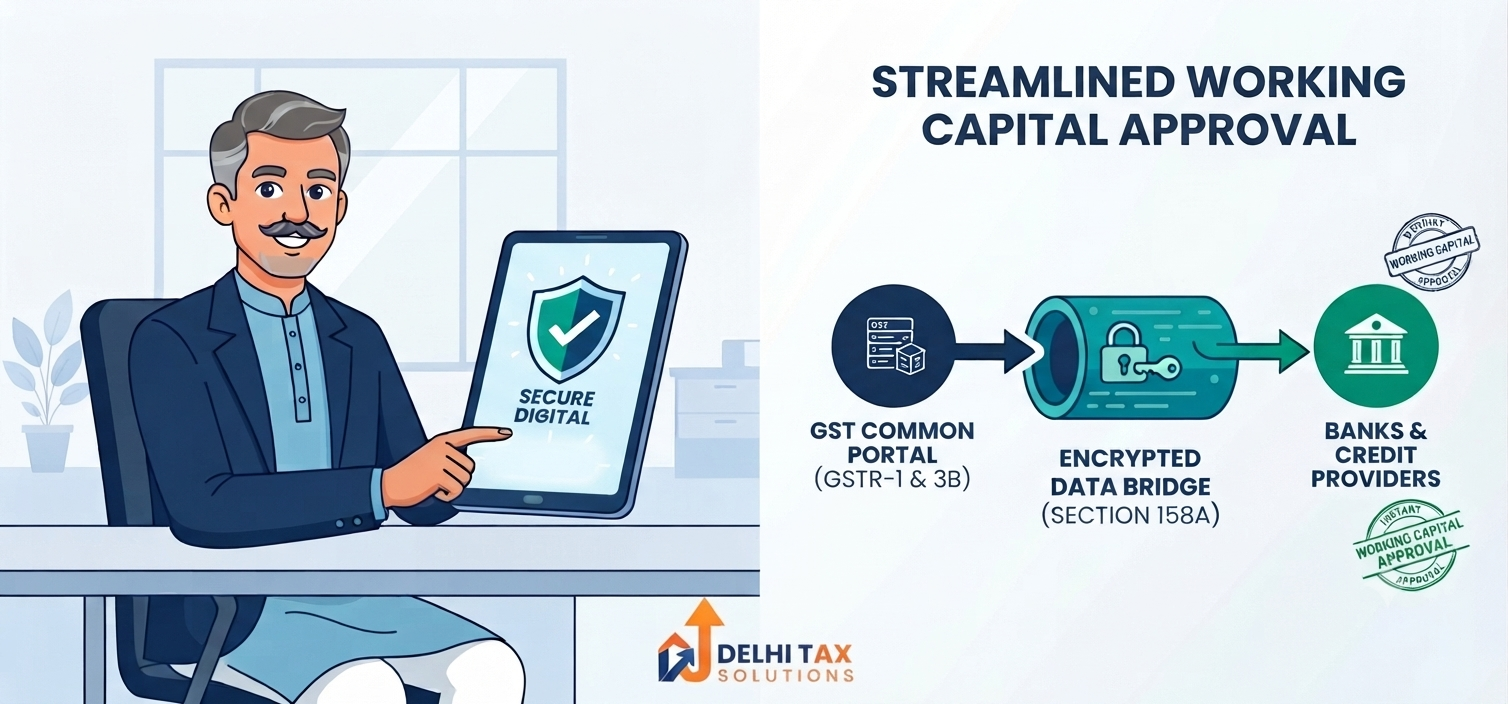
- Boost for MSME Credit: Verified sales data (GSTR-1), net turnover (GSTR-3B), and invoice logs can be transmitted instantly to banks, NBFCs, and TReDS platforms to secure cash-flow-based working capital loans.
- Integration with Account Aggregators: The GST Network (GSTN) acts as a Financial Information Provider (FIP) within RBI’s Account Aggregator network, eliminating paper-based audit delays.
For small and medium enterprises (MSMEs) in India, accessing timely working capital has historically been hindered by intensive paperwork, manual verification delays, and rigid collateral requirements. Traditional lenders often struggle to evaluate the real-time financial health of an enterprise without relying on audited balance sheets that are months out of date.
To bridge this structural gap, the Parliament enacted Section 158A of the Central Goods and Services Tax (CGST) Act. By establishing a legally backed, consent-driven data sharing mechanism, Section 158A enables taxpayers to leverage their verified GST filing history as digital financial collateral.
Understanding Section 158A of the CGST Act
Section 158A governs the “Consent-based sharing of information furnished by taxable person.” It authorizes the common GST portal to share specific sets of information uploaded by a registered business with designated recipient systems, provided strict consent protocols are met.
Under Section 158A(1), the following categories of GST information can be shared upon receiving consent:
- Registration Profile: Particulars furnished in the GST registration application (Form GST REG-01).
- Outward Supply Statements: Details of sales and tax invoices uploaded in GSTR-1 or via the Invoice Furnishing Facility (IFF).
- Summary Returns: Monthly/quarterly summary return figures declared in GSTR-3B.
- Annual & Audit Returns: Verified annual summary metrics from GSTR-9/9C.
- E-Way Bills & E-Invoices: Real-time logistics movement records and electronically authenticated B2B invoices.
How the Dual-Consent Mechanism Works
Privacy and data sovereignty are central to Section 158A. To prevent unauthorized data exploitation, the statute mandates a strict consent workflow depending on the nature of the data requested:
| Data Type | Required Consent Scope | Typical Use Case |
|---|---|---|
| GSTR-3B & Registration Profile | Consent of the Supplier (Taxable Person) alone. | General business assessment, revenue verification, and overdraft limit evaluations. |
| GSTR-1 / Specific Invoice Data | Consent of both the Supplier and the Recipient Buyer (in cases prescribed by rules). | Invoice discounting, supply chain financing, and TReDS platform factoring. |
Additionally, Section 158A(2) provides complete immunity to the government and the GST portal: no legal action or liability can be initiated against the common portal or tax officers for sharing data performed in accordance with the taxpayer’s valid consent.
The Role of RBI’s Account Aggregator (AA) Ecosystem
The practical execution of Section 158A relies heavily on the Account Aggregator (AA) framework supervised by the Reserve Bank of India (RBI). Under this architecture:
- GSTN as a Financial Information Provider (FIP): The GST Network functions as an official FIP, holding encrypted tax filing data.
- Lenders as Financial Information Users (FIUs): Banks, NBFCs, and fintech credit platforms act as FIUs requesting access to evaluate loan applications.
- Encrypted Transfer: Upon receiving explicit OTP-based consent from the business owner via an AA app, GSTN securely transmits digital tax data to the lender. The data cannot be viewed or stored by the intermediary aggregator.
Commercial Impact: Moving from Collateral to Cash-Flow Lending
Section 158A marks a paradigm shift in business financing across India:
- Instant Credit Approvals: Lenders can analyze months of verified GSTR-3B monthly turnover data in minutes, slashing loan sanction turnaround times from weeks to hours.
- Elimination of Fraudulent Documents: Because data is fetched directly from the GST common portal, lenders do not need to manually verify paper bank statements or tax returns, eliminating forged documents.
- Lower Borrowing Costs for MSMEs: Tamper-proof tax data reduces the risk premium assessed by banks, leading to lower interest rates on working capital facilities.
- Growth of Trade Receivables Discounting (TReDS): Factoring platforms can immediately verify buyer-seller invoice authenticity using GST portal data, enabling rapid invoice discounting for MSME suppliers.
Optimizing Tax Records for Financial Growth
As financial institutions increasingly evaluate credit lines using automated GST data feeds, maintaining error-free GSTR-1 and GSTR-3B filings is vital for your borrowing capacity.
The corporate tax advisors at Delhi Tax Solutions specialize in thorough GST reconciliation, return filing accuracy, and tax health audits to ensure your business remains credit-ready.
Frequently Asked Questions (FAQs)
+ Q: Can banks access my GST filing details without my knowledge under Section 158A?
A: No. Section 158A explicitly mandates that data sharing can occur only after receiving prior, explicit consent from the taxable person. Unilateral access by banks or credit agencies without user consent is illegal.
+ Q: Can I revoke consent after granting access to a credit provider?
A: Yes. Under the Account Aggregator framework governing consent-based data sharing, consents are time-bound and transaction-specific. You retain the legal right to revoke or modify active data-sharing consents through your Account Aggregator platform.
+ Q: Does sharing GST data under Section 158A increase my risk of tax audits?
A: No. Section 158A is designed for commercial credit facilitation, not tax administration or enforcement. The data shared is identical to the return filings already in possession of the tax authorities.
+ Q: What happens if there is a mismatch between my GSTR-1 and GSTR-3B when shared with a bank?
A: Automated underwriting algorithms flag turnover discrepancies between GSTR-1 (sales invoices) and GSTR-3B (tax paid summary). Significant un-reconciled gaps may raise risk flags with lenders, delaying credit approval.
About this article: Based on Section 158A of the Central Goods and Services Tax (CGST) Act, as inserted via the Finance Act, 2023, and RBI Account Aggregator framework rules. Updated for 2026.
Disclaimer: This article is strictly for educational purposes and should not be construed as legal or financial advice. Please consult a qualified tax consultant or legal counsel to assess your enterprise data privacy and compliance obligations.