💡 Key Takeaways: GST on Crypto & Virtual Digital Assets (VDA)
- Section 2(117A) of CGST Act: Officially integrates the definition of “Virtual Digital Asset” into GST law, aligning it precisely with Section 2(47A) of the Income-tax Act.
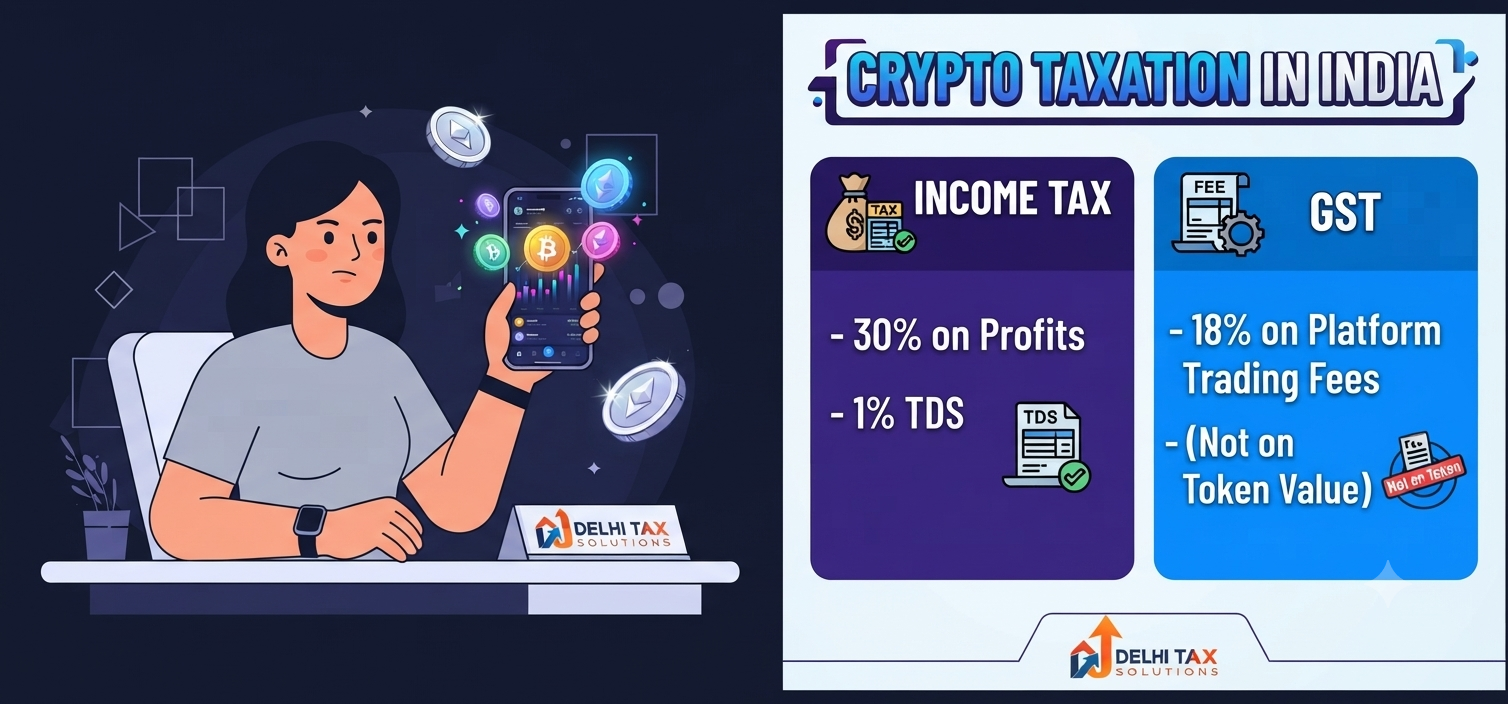
- 18% GST on Exchange Fees: GST is currently NOT levied on the gross value of the crypto traded. Instead, an 18% GST is charged on the intermediary services—trading fees, withdrawal fees, and commission—collected by the crypto exchange.
- Foreign Exchanges (OIDAR): Offshore crypto platforms offering services to Indian residents must register under OIDAR (Online Information Database Access and Retrieval) and pay 18% IGST on the fees they collect from Indian users.
- Crypto in Online Gaming: If VDAs (crypto) are deposited as a medium to play online money games or casinos, the transaction triggers the flat 28% GST rule on the initial deposit value, treating the VDA equivalent to cash.
When India introduced a flat 30% Income Tax and a 1% TDS on the transfer of Virtual Digital Assets (VDAs) in 2022, the direct tax framework for Web3 was cemented. However, the indirect tax implications—governed by the Goods and Services Tax (GST) framework—remained a gray area for much longer.
Through subsequent amendments, specifically the insertion of Section 2(117A) into the Central Goods and Services Tax (CGST) Act, the government has created a definitive bridge between crypto activities, intermediary platforms, and GST liabilities. Whether you are a day trader, an exchange operator, or a Web3 startup, understanding the GST mechanics on VDAs is crucial to avoid severe compliance penalties.
Defining VDA under GST: The Role of Section 2(117A)
To eliminate ambiguity, the government introduced the CGST (Amendment) Act in August 2023, which inserted Section 2(117A) into the GST laws. The section states:
“Virtual digital asset shall have the same meaning as assigned to it in clause (47A) of section 2 of the Income-tax Act, 1961.”
By importing the Income Tax definition directly into the GST framework, the law confirms that any information, code, number, or token (not being Indian or foreign fiat currency) generated through cryptographic means—like Bitcoin, Ethereum, and NFTs—are officially recognized as VDAs under GST law. This standardized definition allows the GST Council to draft specific taxation rules surrounding the supply, transfer, or facilitation of these assets.
How is GST Levied on Crypto Today?
A common misconception among retail investors is that they must pay GST on the value of the cryptocurrency they purchase. This is incorrect. Currently, the GST Council has not classified the underlying cryptocurrency itself unequivocally as “Goods” or “Actionable Claims” for standard trading purposes.
Instead, GST targets the services facilitating the trade.
- Trading & Brokerage Fees: When you execute a trade on platforms like CoinDCX, WazirX, or Mudrex, the exchange charges a maker/taker fee (e.g., 0.2%). The exchange must levy 18% GST on that specific 0.2% fee, treating it as an intermediary financial service or software service (SAC Code 9971 or 9973).
- Deposit & Withdrawal Fees: Any fiat or crypto withdrawal fees charged by the platform are similarly treated as taxable services attracting 18% GST.
- Listing Fees for Web3 Startups: If a token project pays a crypto exchange to list their coin, the listing fee is treated as a B2B service supply and is fully taxable at 18% GST.
Offshore Exchanges and OIDAR Compliance
To level the playing field for domestic Indian exchanges, the Directorate General of GST Intelligence (DGGI) heavily scrutinizes foreign crypto exchanges (like Binance, KuCoin, or Kraken) serving Indian retail users.
Under the GST framework, foreign crypto exchanges fall under Online Information Database Access and Retrieval (OIDAR) services. Because these platforms provide digital services over the internet with minimal human intervention to unregistered individuals in India, they are legally required to:
- Obtain a mandatory OIDAR GST registration in India.
- Collect 18% IGST on the trading/withdrawal fees charged to Indian resident users.
- Remit this IGST directly to the Indian government.
Failure to comply has historically resulted in URL blocking by the Ministry of Electronics and Information Technology (MeitY) and heavy tax notices from the DGGI.
Income Tax vs. GST on Crypto Transactions
It is vital to separate your direct tax (Income Tax) and indirect tax (GST) obligations. Here is a clear comparison for an Indian crypto trader:
| Parameter | Income Tax (Direct Tax) | GST (Indirect Tax) |
|---|---|---|
| Applicable On | Profits made from selling/swapping crypto. | Service fees charged by the exchange/platform. |
| Tax Rate | 30% flat tax on net profits (Section 115BBH). | 18% on the platform’s transaction/service fees. |
| TDS Element | 1% TDS on the total transaction (sale) value. | No TDS under GST for retail (TCS may apply for e-commerce). |
| Who Pays the Gov? | The Trader/Investor (via ITR). | The Exchange (collected from the trader). |
Crypto & VDAs in Online Gaming and Casinos
The insertion of Section 2(117A) was largely driven by the boom in offshore online money gaming and casinos. The GST Council noted that many users were bypassing the domestic banking system by using cryptocurrency to fund their gaming wallets.
According to the recent amendments under Schedule III of the CGST Act, “Specified Actionable Claims” (which include online money gaming, casinos, and betting) attract a strict 28% GST on the initial entry value. The law explicitly clarifies that if a player deposits Virtual Digital Assets into a gaming platform instead of fiat currency, the monetary equivalent of that crypto deposit is subject to the 28% GST levy. The platform must value the VDA at the time of deposit and remit the tax.
Operating a Web3 Startup or Offshore Platform?
The intersection of FEMA, Income Tax, and GST creates a complex compliance labyrinth for blockchain enterprises. DGGI notices for OIDAR non-compliance carry severe financial penalties.
The digital asset tax specialists at Delhi Tax Solutions provide comprehensive entity structuring, OIDAR registration, and GST advisory for crypto exchanges, Web3 gaming companies, and blockchain infrastructure providers.
Frequently Asked Questions (FAQs)
+ Q: Do I have to pay 28% GST when I buy Bitcoin as an investment?
A: No. The 28% GST rate applies only to “Specified Actionable Claims” like online money gaming, casinos, and lottery. Standard purchasing of Bitcoin for investment purposes on a crypto exchange does not attract 28% GST. You only pay 18% GST on the trading fee charged by the exchange.
+ Q: Is Input Tax Credit (ITC) available for GST paid on crypto exchange fees?
A: For retail individual investors, GST paid on exchange fees is a sunk cost. However, if a GST-registered corporate entity (like an institutional trading desk or Web3 company) pays GST on crypto exchange fees in the course of furthering their taxable business, they may be eligible to claim ITC, subject to standard Section 16 & 17 blockages.
+ Q: Does selling an NFT attract GST?
A: The GST treatment of the direct sale of NFTs by creators remains heavily debated, as it blurs the line between a good, a service (licensing intellectual property), or an actionable claim. Most NFT marketplaces currently charge 18% GST on their platform commission/minting fees. Creators earning over the ₹20 Lakh turnover threshold should consult a tax expert regarding the GST applicability on their core NFT sales.
+ Q: How are crypto P2P (Peer-to-Peer) transactions treated under GST?
A: Individual P2P trading between unregistered persons is typically outside the scope of GST registration requirements, provided the individuals are not running a “business” of trading that exceeds the ₹20 Lakh threshold. If an exchange platform facilitates the P2P escrow, the platform will charge 18% GST on its escrow/facilitation fee.
About this article: Based on the CGST Act, 2017, the CGST (Amendment) Act, 2023 (Insertion of Section 2(117A)), and prevailing OIDAR guidelines. Updated for 2026.
Disclaimer: This article is strictly for educational purposes and should not be construed as official legal or professional tax advice. Cryptocurrency regulations and GST rulings are subject to continuous legislative updates. Please consult a qualified Chartered Accountant to assess your specific Web3 operations.