
💡 Key Takeaways: Withholding of GST Refund
- The Power to Stop Refunds: Even if a refund is sanctioned, the GST proper officer can withhold (stop) the disbursement under specific legal conditions.
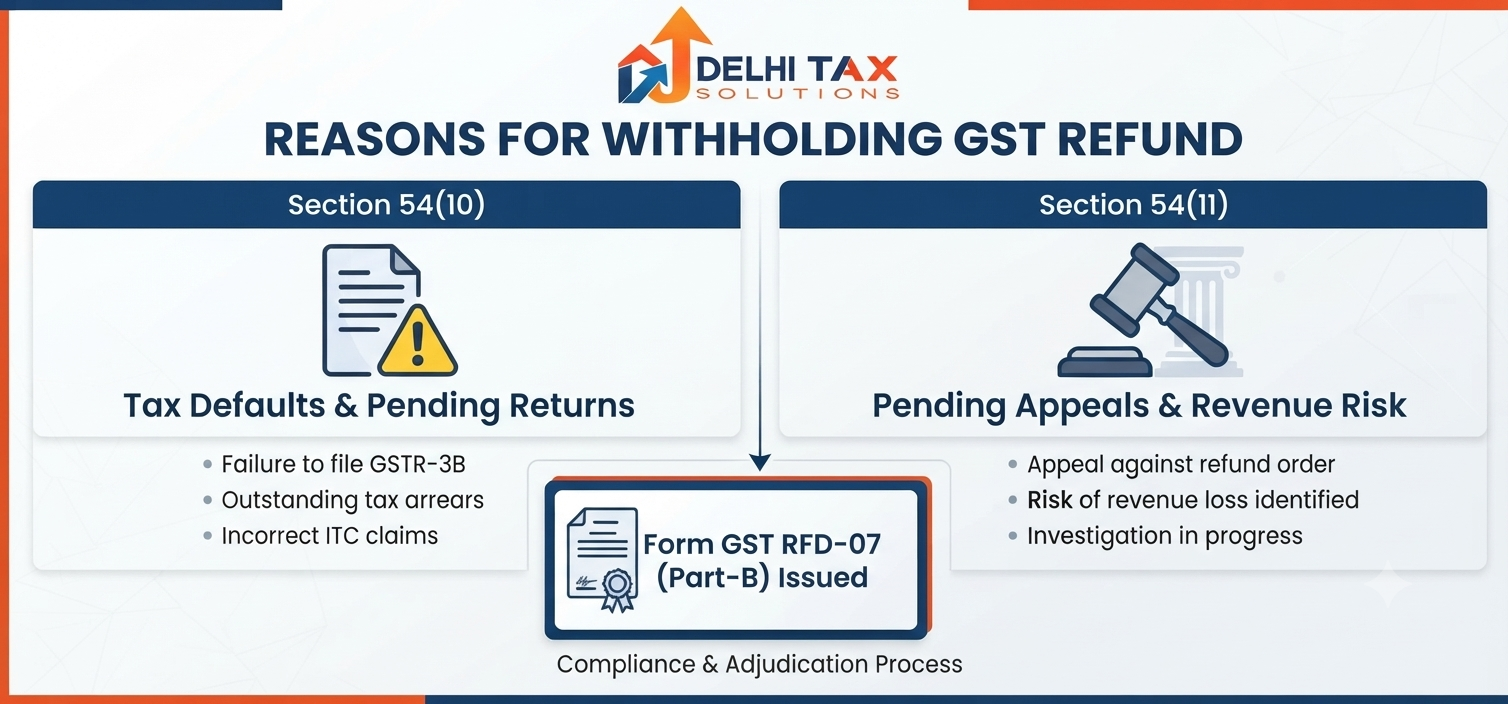
- Section 54(10): Refunds can be withheld if the taxpayer has not filed pending GST returns or has outstanding tax dues/penalties. The officer can also deduct these dues directly from the refund.
- Section 54(11): The Commissioner can withhold a refund if the refund order is being appealed and releasing the money would “adversely affect the revenue” (e.g., risk of fraud or non-recovery).
- Form Used: The order for withholding a refund is communicated to the taxpayer via Part-B of Form GST RFD-07.
Securing a GST refund approval feels like crossing the finish line. You receive the sanction order (RFD-06), but days pass and the money is not credited to your bank account. Upon checking the GST portal, you discover a notice stating your refund has been withheld.
Under the Central Goods and Services Tax (CGST) Act, 2017, the tax authorities possess the legal power to pause or completely withhold the payment of a sanctioned refund. This measure is designed to protect government revenue from defaults and ongoing legal disputes. Let’s break down the two primary provisions that govern the withholding of GST refunds: Section 54(10) and Section 54(11).
1. Withholding Due to Tax Defaults: Section 54(10)
Section 54(10) is invoked when there is a compliance failure or an outstanding financial liability on the taxpayer’s part. According to this section, a Proper Officer can withhold your refund if:
- Pending Returns: You have failed to furnish any necessary return required by the GST law.
- Unpaid Tax or Penalty: You are required to pay tax, interest, or penalty, but have failed to do so. This includes demands that have not been stayed by an appellate authority.
💰 The Power of Deduction
Under Section 54(10)(b), the officer doesn’t just withhold the refund; they have the authority to deduct the unpaid tax, interest, or penalty directly from your sanctioned refund amount. You will only receive the remaining balance, if any.
2. Withholding Due to Pending Appeals: Section 54(11)
Section 54(11) is more complex. It applies in situations where a refund is sanctioned (perhaps by an adjudicating authority or an appellate authority), but the GST department decides to challenge that order in a higher court or tribunal.
The Commissioner can withhold the refund if:
- An order giving rise to the refund is the subject matter of an appeal, or further proceedings.
- The Commissioner forms an opinion that granting such a refund would “adversely affect the revenue” in the said appeal or proceedings on account of malfeasance or fraud committed.
In simpler terms, if the department is fighting the refund decision in court and fears that if they pay you now, they won’t be able to recover the money if they win the case later, they can withhold the payment.
The Procedural Aspect: Form GST RFD-07
A tax officer cannot withhold your refund verbally or without documentation. If a decision is made to withhold a sanctioned refund under either Section 54(10) or 54(11), the officer must issue an official order.
This is done using Part-B of Form GST RFD-07. This form will detail the reasons why the refund has been stopped and, in the case of Section 54(10), detail any deductions made against outstanding liabilities.
What Happens to Interest on Withheld Refunds?
Normally, if a GST refund is not paid within 60 days of application, the taxpayer is entitled to interest at 6% per annum under Section 56.
However, if a refund was withheld under Section 54(11) (pending appeals) and, ultimately, the appeal is finalized in favor of the taxpayer, the taxpayer is entitled to receive interest on the delayed refund. In such specific cases (resulting from an order of an Adjudicating Authority or Appellate Tribunal/Court), the interest rate is elevated to 9% per annum from the date immediately after the expiry of sixty days from the date of receipt of the application till the date of refund.
Is Your GST Refund Stuck Due to a Withholding Order?
Receiving an RFD-07 (Part-B) order can disrupt your cash flow. Whether your refund is withheld due to a technical default, a disputed liability, or a pending departmental appeal, navigating the unblocking process requires expert legal strategy.
Connect with Delhi Tax Solutions. Our GST litigation experts can help you file representations, settle pending dues, or challenge unlawful withholdings to get your funds released.
Frequently Asked Questions (FAQs)
+ Q: Can the GST officer withhold my refund without prior notice?
A: The officer must issue an order in Part-B of Form GST RFD-07 explicitly stating the reasons for withholding the refund. However, if they are deducting outstanding liabilities from the refund under Section 54(10), they generally must give you an opportunity of being heard (via SCN) before finalizing the adjustment.
+ Q: How do I get my withheld refund released?
A: If withheld under Section 54(10) for non-filing of returns, you must file the pending returns. If withheld for unpaid dues, you must pay the dues (or the officer will deduct them). If withheld under Section 54(11), the refund will typically be released once the pending appeal or proceeding is concluded in your favor.
+ Q: What is Form GST RFD-07 Part-A?
A: While Part-B of RFD-07 is an order for withholding the refund, Part-A of Form GST RFD-07 is an order for the complete rejection of a refund claim.
+ Q: Will I get interest on a refund that was withheld but later released?
A: Yes. If the refund is ultimately released after the conclusion of an appeal (which caused the withholding under Sec 54(11)), you are entitled to interest at 9% p.a. for the delayed period beyond 60 days from the original application date.
About this article: Based on Section 54(10), Section 54(11), and Section 56 of the CGST Act, 2017. Updated for 2026.
Disclaimer: This article is for informational and educational purposes only and should not be considered legal or financial advice.