
💡 Key Takeaways: Interest on Delayed GST Refunds
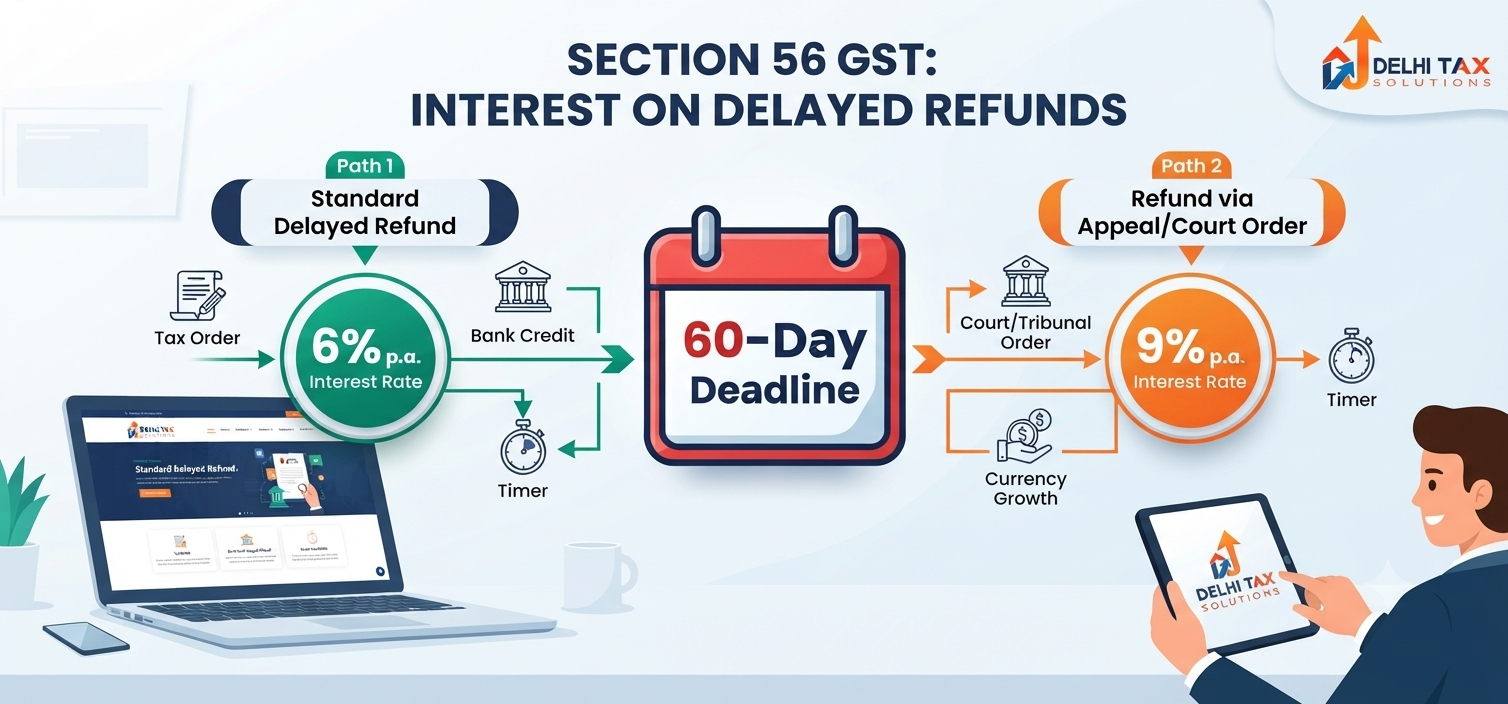
- Section 56 of the CGST Act mandates government interest payments if your GST refund is delayed beyond 60 days from the receipt of application.
- Standard Interest Rate (6% p.a.): Applies to routine refund delays after the expiration of the 60-day statutory window.
- Higher Interest Rate (9% p.a.): Applies when a refund is sanctioned following an order passed by an Appellate Authority, Tribunal, or Court.
- Interest is calculated on a daily basis from day 61 until the exact date the refund amount is credited to your bank account.
- Ensuring proper filing in Form GST RFD-01 and obtaining a valid acknowledgment (RFD-02) is essential to start the 60-day clock.
A major concern for businesses claiming GST refunds—whether on exports, inverted duty structures, or excess cash ledger balances—is processing delay. Working capital gets blocked, putting pressure on day-to-day operations. To ensure tax officers process claims promptly, the law provides a safety mechanism for taxpayers under Section 56 of the CGST Act, 2017: Interest on Delayed Refunds.
When the tax authorities fail to refund the due amount within the legally prescribed time limit, they are required by law to pay interest to the taxpayer alongside the principal refund amount.
The 60-Day Golden Rule under Section 56
Under Section 54(7) of the CGST Act, proper tax officers must issue the final refund order (Form GST RFD-06) within 60 days from the date of receipt of a complete refund application.
If the refund is not sanctioned and credited within this 60-day window, Section 56 automatically triggers interest liability for the government. The clock starts from the date of issuance of the formal acknowledgment in Form GST RFD-02.
⏱️ How the 60-Day Timeline Works
Day 1: You submit RFD-01 and receive acknowledgment (RFD-02).
Days 1 to 60: Statutory processing window for tax officers.
Day 61 onwards: Interest starts accumulating daily until payment credit!
Interest Rates: 6% vs. 9% Scenarios
Section 56 prescribes two distinct annual interest rates depending on the nature of the refund claim:
1. Standard Delay Interest Rate – 6% p.a.
For standard refund applications (export without tax, inverted duty structure, excess cash balance, etc.), if the refund is delayed beyond 60 days, interest is payable at 6% per annum. This rate was notified under Notification No. 13/2017-Central Tax.
2. Appellate/Court Order Refund Interest Rate – 9% p.a.
In cases where a taxpayer’s initial refund claim was rejected by a proper officer, but later allowed upon filing an appeal before the Appellate Authority, Appellate Tribunal, or a High Court/Supreme Court, a higher interest rate of 9% per annum applies (as per the Proviso to Section 56). The 60-day clock in this case is measured from the receipt of the refund application filed pursuant to the appellate order.
Comparison: Standard Delay vs. Appellate Order Delay
| Parameter | Standard Refund Claim | Appellate / Court Order Refund |
|---|---|---|
| Governing Provision | Section 56 (Main Provision) | Proviso to Section 56 |
| Applicable Interest Rate | 6% p.a. | 9% p.a. |
| Trigger Point | Delay beyond 60 days of filing RFD-01 | Delay beyond 60 days of application after appeal order |
| Calculation Period | From Day 61 till date of bank credit | From Day 61 till date of bank credit |
How is Interest Calculated on Delayed Refund?
Interest on delayed GST refund is calculated on a daily pro-rata basis using the following standard formula:
Example Scenario:
Suppose ABC Pvt Ltd files a GST export refund claim of ₹10,000,000 on 1st April 2026 and receives an acknowledgment on the same day. The 60-day limit expires on 31st May 2026. The department grants the refund on 20th June 2026 (a delay of 20 days).
- Delayed Days = 20 Days
- Applicable Rate = 6% per annum
- Interest Calculation: ₹10,000,000 × (6/100) × (20/365) = ₹32,877
⚠️ Important Note: Deficiency Memos (RFD-03)
If tax officers issue a Deficiency Memo (Form GST RFD-03) within 15 days of filing, your original application is treated as invalid. You will need to file a fresh application, and the 60-day clock resets from the new date of submission!
Common Hurdles & Practical Solutions
While the law guarantees interest, in practice, tax authorities often disburse the principal refund amount without automatically adding the interest component. Taxpayers must proactively track timelines and follow up if interest is omitted.
- Track RFD-02 Date: Always store the official acknowledgment receipt (RFD-02) showing the exact date of submission.
- Monitor Bank Credit: Ensure the bank account details in your GST profile are verified and active to prevent disbursement failures.
- File Representations: If interest is omitted in RFD-06 order, file a formal grievance or written representation pointing out Section 56 compliance.
Is Your GST Refund Delayed Beyond 60 Days?
Facing unnecessary delay from tax authorities or received a refund without statutory interest? Our experienced GST legal consultants help businesses navigate complex refund claims, issue formal legal notices, and ensure complete interest compliance under Section 56.
Get in touch with Delhi Tax Solutions today to expedite your pending GST refunds and claim legitimate interest!
Frequently Asked Questions (FAQs)
+ Q: From which date is interest on delayed GST refund calculated?
A: Interest is calculated starting from the date immediately following the expiry of 60 days from the date of receipt of application (RFD-02 acknowledgment) until the date the refund is credited to the taxpayer’s bank account.
+ Q: What is the interest rate for standard delayed GST refunds?
A: The standard interest rate prescribed under Section 56 of the CGST Act is 6% per annum, as notified by Notification No. 13/2017-Central Tax.
+ Q: When does the higher 9% interest rate apply under Section 56?
A: The 9% p.a. interest rate applies under the proviso to Section 56 when a refund claim arises due to an order passed by an Appellate Authority, Appellate Tribunal, or Court, and is delayed beyond 60 days from the fresh refund application.
+ Q: Does receiving a Deficiency Memo (RFD-03) affect the 60-day calculation?
A: Yes. If a Deficiency Memo (RFD-03) is issued within 15 days, the original application is considered incomplete. You must submit a fresh application, and the 60-day period will reset from the date of the new submission.
+ Q: What should I do if the government pays the refund but forgets to pay interest?
A: You can submit a written representation to the jurisdictional Proper Officer referencing Section 56 along with proof of RFD-02 date and payment credit date. If unaddressed, a writ petition or grievance on the GST Portal can be filed.
About this article: Prepared using statutory provisions of Section 56 of CGST Act, 2017 and Notification No. 13/2017-Central Tax. Updated for 2026.
Disclaimer: This blog post is for informational purposes only and does not constitute official legal or financial advice.