
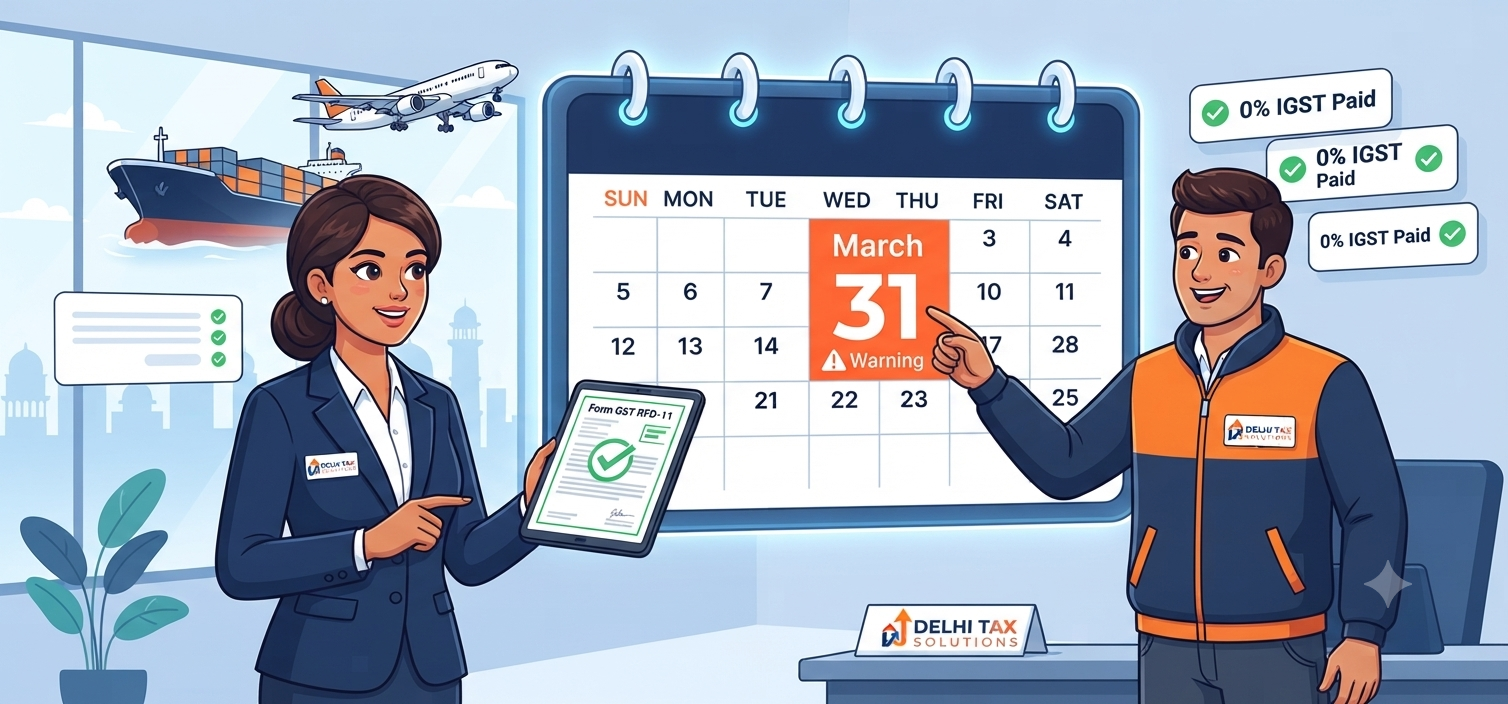
💡 Key Takeaways: LUT in GST
- A Letter of Undertaking (LUT in GST) allows registered taxpayers to export goods or services without the upfront payment of Integrated Tax (IGST).
- Filing Form RFD-11 is mandatory to execute an export without tax. It must be filed before the actual export transaction takes place.
- LUTs are strictly valid for a single financial year. You must renew your LUT by March 31 to ensure seamless exports from April 1 of the new financial year.
- If an exporter fails to realize the export proceeds within the time limit prescribed by FEMA/RBI, the LUT facility can be withdrawn, and IGST with 18% interest becomes payable.
- Any registered taxpayer is eligible to file an LUT, provided they have not been prosecuted for tax evasion exceeding ₹2.5 Crores.
For Indian exporters, managing working capital is critical to maintaining a competitive edge in global markets. The GST framework classifies exports as “zero-rated supplies” under Section 16 of the IGST Act. This means you do not have to pass on domestic tax burdens to your international clients.
However, to legally execute an export without tax, the government requires a formal commitment. This commitment is known as a Letter of Undertaking (LUT in GST). If you prefer not to pay IGST upfront and wait months for a customs refund, filing Form RFD-11 is the ultimate solution to protect your cash flow.
The Critical March 31 LUT Renewal Deadline
The most common compliance error exporters make is forgetting that a Letter of Undertaking is not a lifetime registration. An LUT is only valid for one Financial Year (April 1 to March 31).
To continue exporting without paying IGST into the next financial year, a fresh application for Form RFD-11 must be filed on or before March 31. If you issue an export invoice on April 1 without renewing your LUT on the GST portal, the system will deem it as an export with payment of tax, forcing you to pay IGST out of your pocket or Electronic Credit Ledger.
⚠️ Pro Tip: File Early
The GST portal opens the window for the next financial year’s LUT filing around January or February. Smart businesses file their RFD-11 well ahead of the March 31 rush to avoid server downtime and ensure zero disruptions to shipments on April 1.
How to File LUT for Exports Online (Form RFD-11)
Filing a Letter of Undertaking is now a completely digital, paperless process. You do not need to physically visit a tax office. Follow these simple steps on the GST Services Portal:
Step 1: Log in and Navigate
Log in to your GST dashboard. Navigate to Services → User Services → Furnish Letter of Undertaking (LUT).
Step 2: Select Financial Year
From the drop-down menu, select the Financial Year for which you are applying. If you are doing this in March for the upcoming year, select the next FY.
Step 3: Upload Previous Document (If Applicable)
If you had manually filed an LUT offline in previous years, you might be prompted to upload it. Otherwise, you can proceed directly.
Step 4: Check the Undertaking Declarations
You must tick three mandatory checkboxes declaring that you undertake to:
- Export the goods/services within the time limit prescribed under the CGST Rules (usually 3 months for goods, 1 year for services).
- Pay IGST along with interest at 18% per annum if you fail to export or fail to realize payment within the prescribed timeframe.
- Abide by all the provisions of the GST Act and Rules.
Step 5: Add Independent Witnesses
You are required to provide the Name, Occupation, and Address of two independent witnesses. (Note: The witnesses do not need to physically sign the online document, but their details must be accurate).
Step 6: Submit with DSC or EVC
Select the Authorized Signatory, enter the place of filing, and sign the application using a Digital Signature Certificate (DSC) or Electronic Verification Code (EVC via OTP). Once submitted, an Application Reference Number (ARN) is generated instantly, confirming your active LUT status.
Seamless Export Compliance with Delhi Tax Solutions
Missing an LUT renewal deadline or making errors in your export declarations can lead to blocked shipments at customs and heavy IGST penalties.
Our expert team manages your entire export tax lifecycle—from annual LUT renewals and Form RFD-11 compliance to claiming refunds for unutilized ITC. Keep your global supply chain moving by partnering with Delhi Tax Solutions today.
Frequently Asked Questions (FAQs)
+ Q: Can a newly registered business file an LUT for exports immediately?
A: Yes. Any registered taxpayer can file an LUT on the GST portal immediately after obtaining their GSTIN, provided they haven’t been convicted of tax evasion over ₹2.5 Crores. No prior export history is required.
+ Q: What happens if I forget to renew my LUT by March 31?
A: If you export goods or services on or after April 1 without a valid LUT, the transaction will be treated as a standard taxable supply. You will have to pay the applicable IGST out of pocket or via ITC. You can claim a refund later, but your working capital will be temporarily blocked.
+ Q: Do I need to wait for a tax officer to approve my Form RFD-11?
A: No. The process is completely auto-approved on the GST portal. Once you submit the form using EVC or DSC, an ARN is generated instantly, and the LUT is considered valid and accepted.
+ Q: Does filing an LUT mean I cannot claim a refund of accumulated ITC?
A: No. In fact, filing an LUT is the very mechanism that allows you to claim a refund of your “Unutilized Input Tax Credit” under Rule 89(4) of the CGST Rules, since you did not utilize it to pay IGST on the outward supply.
+ Q: Are SEZ supplies covered under LUT?
A: Yes. Supplies made to a Special Economic Zone (SEZ) developer or an SEZ unit are also considered zero-rated supplies under Section 16 of the IGST Act. You can supply to an SEZ without tax by filing an LUT in Form RFD-11.
About this article: Authored using statutory provisions of Section 16 of IGST Act and Rule 96A of CGST Rules, 2017. Last updated September 2026.
Disclaimer: This blog post is for educational purposes and does not constitute formal legal or tax advisory opinion.