
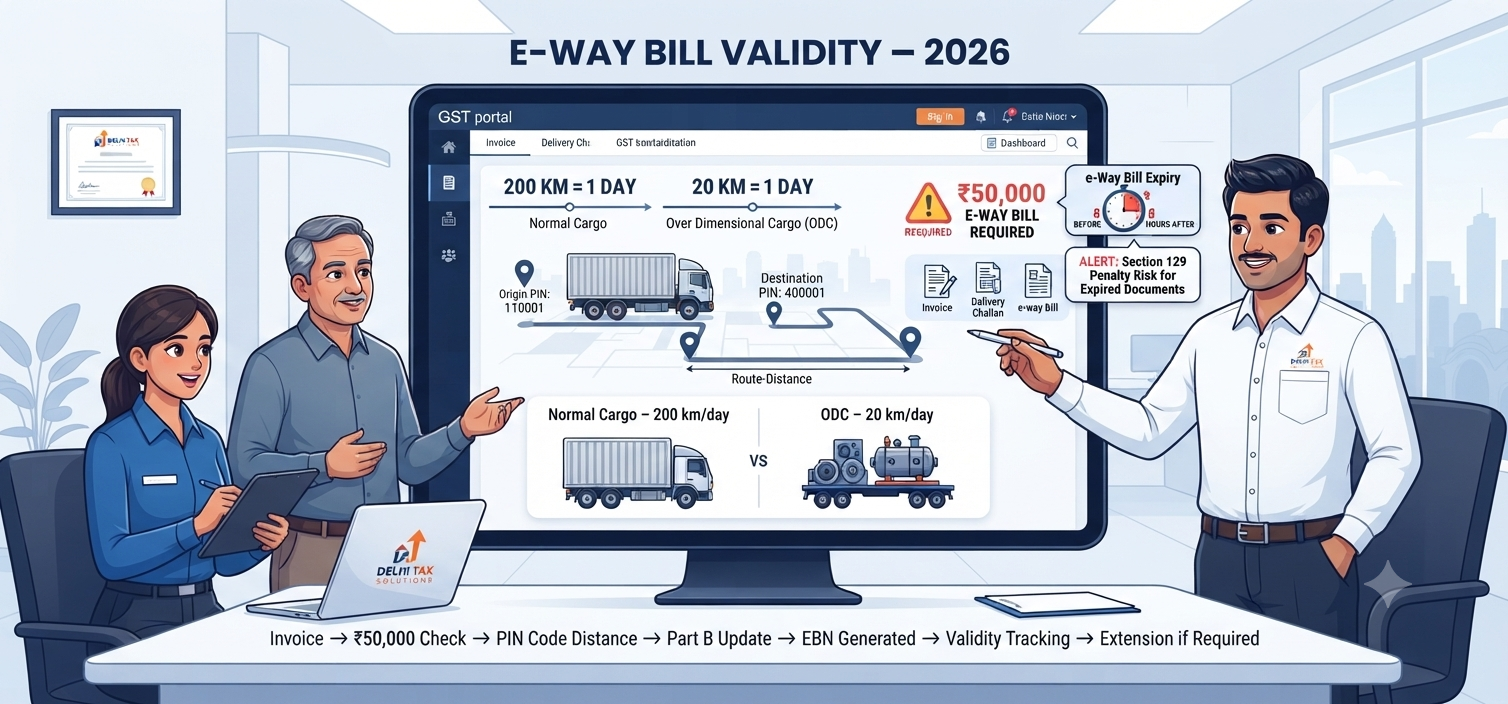
💡 Key Takeaways
- Normal cargo requires 1 day of validity for every 200 km of travel distance.
- Over Dimensional Cargo (ODC) gets 1 day for every 20 km of travel.
- The general threshold to generate a bill is a consignment value exceeding ₹50,000.
- You can only extend validity within 8 hours before or 8 hours after expiration.
- Driving with an expired bill invites a massive 200% penalty under Section 129.
An expired transit document is one of the fastest ways to trigger a devastating GST penalty. Indian tax authorities enforce strict monitoring on the movement of goods, and a simple miscalculation in e way bill validity can cost you thousands in fines. Whether you are a small business owner sending goods across Delhi or a transporter handling interstate logistics, understanding these timelines is non-negotiable.
The rules dictate precisely WHO needs a bill, WHAT thresholds apply, WHERE it must be generated, and WHY timing matters. The government has aggressively updated these metrics, shifting from older 100 km limits to the modern 200 km daily mandate. If you get caught off guard by a vehicle breakdown or a transit delay, the clock does not stop ticking.
This guide breaks down exactly how to navigate the 50000 limit, calculate your pin code distance accurately, and extend your documents legally before the tax officer intercepts your cargo.
What is E-Way Bill Validity?
E-way bill validity is the legally permitted time frame during which goods can be transported from a supplier to a recipient under a single generated GST document. For standard cargo, the validity is one day for every 200 kilometers of travel. The timer starts the exact moment the Part B update is completed and the final bill is generated on the GST portal.
Understanding the 50000 Limit
Before worrying about the timeline, you must determine if you even need to generate the document. Under CGST Rule 138, any registered person causing the movement of goods must generate an e-way bill if the consignment value exceeds the 50000 limit. This ₹50,000 threshold applies to a single invoice, delivery challan, or bill of supply.
How is this value calculated? The consignment value includes the cost of the goods plus any applicable CGST, SGST, IGST, and cess. However, it completely excludes the value of any exempt goods being shipped in the same conveyance. If you are shipping ₹40,000 of taxable goods and ₹20,000 of exempt goods, your taxable consignment value is only ₹40,000. You do not legally cross the threshold.
Inter state vs intra state rules can sometimes differ. While the ₹50,000 limit applies strictly to interstate (between two states) movement, certain states have modified the intra-state (within the same state) limit for specific goods. Always check your specific state notifications, but defaulting to ₹50,000 ensures safe compliance.
If the taxable goods + GST amount on your invoice is ₹50,001 or higher, generate the bill. If it is ₹50,000 or lower, generation is optional but recommended for smoother transit.
How to Calculate Validity: Pin Code Distance
The GST portal calculates the allowed transit time based strictly on pin code distance. You cannot simply guess the distance or rely on a Google Maps driving route. The NIC e-Way Bill Portal uses a proprietary auto-calculation system based on the origin and destination postal codes.
When you enter the two PIN codes, the system automatically displays the exact distance. Based on this system-generated number, your e way bill validity is determined. If the actual driving distance is slightly longer due to a detour, you cannot override the system’s baseline calculation.
Based on cases handled by our CA team, businesses frequently panic when the NIC portal shows a distance shorter than the actual highway route. The rule is simple: rely on the portal’s PIN-to-PIN calculation. If the distance is 390 km, the portal will grant you 2 days of validity (1 day for the first 200 km, and 1 day for the remaining 190 km).
Rules for Over Dimensional Cargo
Not all shipments travel at the same speed. The government recognizes that massive, heavy machinery cannot cover 200 km in a single day. Therefore, the rules for over dimensional cargo (ODC) are drastically different from standard freight.
ODC refers to a single, indivisible cargo unit that exceeds the standard dimensions prescribed under the Central Motor Vehicles Rules. If your vehicle requires a specialized trailer or pilot vehicles, it likely qualifies. Here is how the validity compares:
| Cargo Type | Distance Block | Validity Granted |
|---|---|---|
| Normal Cargo (Non-ODC) | Up to 200 km | 1 Day |
| Normal Cargo (Non-ODC) | Every additional 200 km or part thereof | 1 Additional Day |
| Over Dimensional Cargo (ODC) | Up to 20 km | 1 Day |
| Over Dimensional Cargo (ODC) | Every additional 20 km or part thereof | 1 Additional Day |
For example, transporting an ODC boiler across 100 km grants the transporter 5 full days of validity. A standard truck carrying electronics over the same 100 km receives only 1 day. Proper classification during the part b update is critical to avoid illegal expiration.
How to Extend E Way Bill Validity
Vehicles break down. Traffic jams happen. Natural disasters block highways. When delays occur, you must secure an eway bill extension before the current document expires. The rules around this timeline are unforgiving.
You only have a strict 16-hour window to act. You can extend the validity either 8 hours before expiration or within 8 hours after the expiration time. Once the 8-hour post-expiry window closes, the portal physically locks you out. You cannot extend it. You cannot generate a new one for the same invoice. The goods are legally stranded.
To extend it, the transporter must log into the portal, enter the current e-way bill number, and select a valid reason (e.g., Natural Calamity, Law and Order Issue, Transshipment, or Accident). The system will then prompt for the current location’s PIN code and calculate the new distance remaining to the final destination. A new validity period is granted solely for this remaining distance.
If you need assistance ensuring your business is fully compliant with these strict timelines, GST Registration and compliance services can automate your tracking and generation process.
Common Mistakes and Penalties
Driving with an expired document is treated the same as driving with no document at all. Under Section 129 of the CBIC Official Site guidelines, the penalty for moving goods without a valid transit document is severe.
If the owner comes forward to pay, the penalty is 200% of the tax payable on the goods. If the goods are exempted, the penalty is 2% of the value of goods or ₹25,000, whichever is lower. If the owner does not come forward, the penalty jumps to 50% of the total value of the goods, or 200% of the tax payable, whichever is higher.
Our tax advisory team routinely rescues businesses facing massive fines simply because a driver fell asleep and missed the 8-hour extension window. Treat the expiry timestamp as an absolute deadline.
About this article: Researched using official government sources, real-time competitor and search-trend analysis, and Delhi Tax Solutions’ in-house tax advisory team. Last updated September 2026. This article is for general informational purposes and is not a substitute for personalised professional tax advice.
Frequently Asked Questions
Q: How to extend e way bill validity?
A: To extend the validity, log into the GST e-way bill portal and navigate to the extension section. You must request the extension within a strict 16-hour window: up to 8 hours before the exact expiration time, or within 8 hours after it expires. You must select a specific reason for the delay, such as a vehicle breakdown or accident, and provide the current PIN code to calculate the remaining distance.
Q: What happens if e-way bill expires during transit?
A: If the document expires during transit and you fail to extend it within the 8-hour grace period, the movement of those goods becomes legally unauthorized. If intercepted by a GST officer, your vehicle and goods can be seized under Section 129. You will face a mandatory penalty amounting to 200% of the applicable tax on the transported goods before they are released.
Q: Is e way bill required for less than 50000?
A: Generally, no. If the total consignment value—which includes the taxable value of goods plus all applicable GST amounts—is exactly ₹50,000 or less, generating an e-way bill is optional for interstate transport. However, certain goods like specific handicrafts may require it regardless of value, and individual states may have customized intra-state limits. We advise generating one anyway to avoid unnecessary roadside delays.
Q: How is pin code distance calculated for e way bill?
A: The system calculates distance automatically using a proprietary mapping tool on the NIC portal. You input the origin PIN code and the destination PIN code, and the portal locks in the direct mapped distance. You cannot manually edit this number based on actual highway routes or Google Maps driving data. If the portal calculates 350 km, your validity is strictly based on that 350 km figure.
Q: What is the validity for Over Dimensional Cargo?
A: Over Dimensional Cargo (ODC) receives significantly more transit time due to its size and speed restrictions. For ODC shipments, the validity is one full day for every 20 kilometers of travel distance, plus one additional day for every part thereof. This is a massive increase compared to standard cargo, which only receives one day for every 200 kilometers traveled.