💡 Key Takeaways
- An e-way bill is mandatory for inter-state goods movement exceeding ₹50,000.
- The primary e-way bill generation process happens on the official GST portal.
- Part A captures invoice details; Part B captures transporter vehicle data.
- Bills are valid for 1 day for every 200 km travelled.
- Failure to generate the bill attracts a penalty of 100% of the tax amount due.
Moving goods across India without the right documentation is a fast track to heavy financial penalties. As a business owner, getting your products from point A to point B safely relies entirely on one digital document. Mastering the e-way bill generation process is no longer optional for Indian MSMEs—it is a critical daily compliance task.
Tax authorities are actively intercepting commercial vehicles. A missing or expired document immediately results in detained goods and disrupted supply chains. You need a system to generate these bills accurately and quickly.
In this guide, you will learn the exact 2026 e-way bill limit, who is responsible for creating the document, and a simplified step-by-step breakdown of how to generate an e way bill online without errors.
What is the E-Way Bill Generation Process?
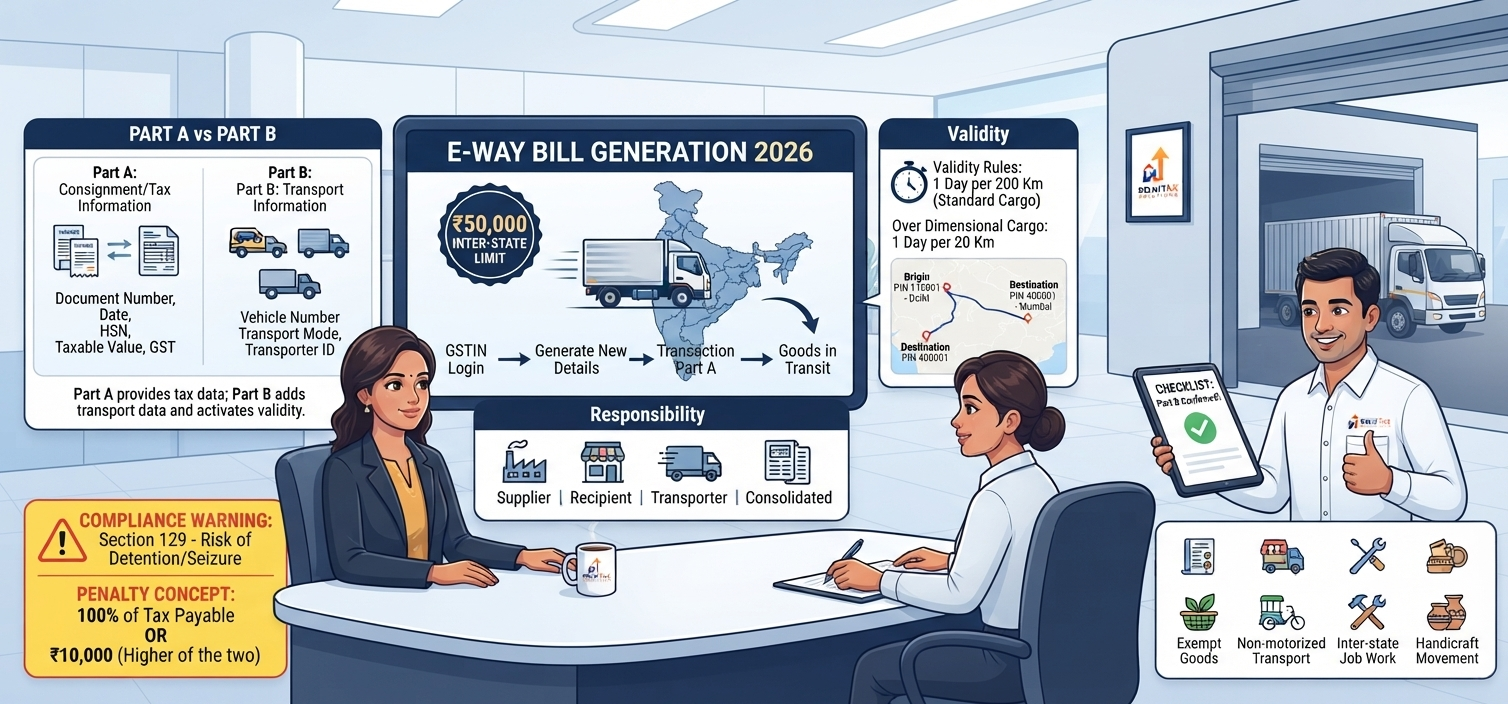
The e-way bill generation process is the mandatory online procedure of creating an Electronic Way Bill on the official GST portal before moving goods worth more than ₹50,000. It requires the supplier, recipient, or transporter to log into the portal, enter the invoice details in Part A, update the vehicle number in Part B, and generate a unique 12-digit E-Way Bill Number (EBN) to authorize the transit.
E Way Bill Limit 2026: Thresholds Explained
Knowing your financial thresholds is the foundation of GST compliance. The government uses strict monetary values to decide when a shipment requires tracking. If you are operating a growing business, keeping track of the e way bill limit 2026 saves you from unnecessary compliance headaches.
Inter-State vs Intra-State Limits
For inter-state movement (crossing state borders), the rule is absolute. If the consignment value exceeds ₹50,000, you must generate an e-way bill. This ₹50,000 limit includes the value of the goods plus the applicable GST amount, but excludes any exempt goods shipped on the same invoice.
However, intra-state limits (movement within the same state) vary wildly. While the default limit is ₹50,000, several states have modified this threshold. For example, Delhi and Maharashtra maintain a ₹1,00,000 limit for intra-state movement. Always verify your specific state’s notification through official CBIC Guidelines before dispatching goods locally.
Specific Exemptions to the Rule
Not every shipment requires this documentation. If you are transporting specified exempt goods (like fresh milk, meat, or uncut wood), the bill is not required regardless of the value. Furthermore, if you are transporting goods via a non-motorized vehicle, the e-way bill applicability drops entirely.
Who Should Generate E Way Bill?
Responsibility for the documentation depends entirely on the logistics arrangement. The GST law defines exactly who carries the legal burden. Misunderstanding this assignment leads to detained trucks and angry clients.
The Supplier or Recipient
If the supplier is registered under GST and handles the transportation, they must initiate the e-way bill generation process. Conversely, if the recipient purchases goods from an unregistered supplier, the law shifts the compliance burden entirely onto the registered recipient. Getting proper GST Registration ensures you have the necessary credentials to handle this online.
The Transporter’s Role
If neither the buyer nor the seller generates the document, the responsibility falls squarely on the transporter. Transporters must enroll on the e-way bill portal to get a unique Transporter ID. If they consolidate multiple consignments into one vehicle, they must generate a consolidated bill linking all individual EBNs.
Based on cases handled by our tax advisory team, the most common dispute occurs when a supplier completes Part A, but the transporter forgets to update the vehicle details in Part B before moving. If the vehicle is intercepted, the GST officer treats it as an invalid bill. We advise business owners to always confirm Part B is updated before the truck leaves the loading bay.
Step-by-Step E-Way Bill Generation Process
Generating the document does not have to be complicated. By following a structured routine, your logistics team can clear shipments in minutes. Here is exactly how to generate e way bill data online.
- Log into the Portal: Access the official E-Way Bill Portal using your username and password. If you are a new business, you must register on this portal using your existing GSTIN first.
- Initiate the Bill: Navigate to the left-hand dashboard. Click on ‘E-waybill’ and select ‘Generate New’ from the dropdown menu. This opens the main entry form.
- Enter Transaction Details: Select the transaction type as ‘Outward’ for sales or ‘Inward’ for purchases. Choose the appropriate sub-type, such as ‘Supply’ or ‘Export’. This categorizes the movement for tax assessment.
- Fill Part A (Item Data): Input the document type (Tax Invoice, Bill of Supply), document number, and date. Enter the item details, including the HSN code, taxable value, and corresponding GST rates. The portal auto-calculates the total tax.
- Fill Part B (Transport Data): Select the mode of transport (Road, Rail, Air, or Ship). Enter the transporter’s ID or the exact vehicle number. Click ‘Submit’ to officially generate your unique 12-digit EBN and print the final document.
Part A vs Part B of E Way Bill
The document is divided into two strict sections. Understanding the distinction between Part A and part b of e way bill requirements is vital for smooth logistics.
| Feature | Part A (Consignment Details) | Part B (Transporter Details) |
|---|---|---|
| Purpose | Captures invoice, value, and GST details. | Captures vehicle number and transport mode. |
| Who Fills It? | The registered supplier or recipient. | The transporter or the supplier (if self-transporting). |
| Validity Activation | Does not activate validity period. | Activates the bill’s validity period upon submission. |
| Requirement | Mandatory for all applicable shipments. | Can be skipped temporarily if transport distance is under 50 km within the same state. |
A common error happens when a business updates Part A but delays updating Part B. Until Part B contains the vehicle number, the document is legally incomplete for transit. Managing this hand-off is a core part of comprehensive GST Services for scaling product businesses.
Validity Period and E-Way Bill Penalty
Once you complete the e-way bill generation process, the clock starts ticking. The government strictly limits how long this document remains valid to prevent tax evasion through repeated trips on the same invoice.
Calculating Validity
For standard cargo, the validity of e way bill is exactly one day for every 200 kilometers travelled. For Over Dimensional Cargo (ODC), the rule tightens to one day for every 20 kilometers. The validity period starts the exact minute you update Part B. If a truck breaks down, the transporter must proactively extend the validity on the portal before the original time expires.
Penalties for Non-Compliance
Moving goods without a valid document is treated as outright tax evasion under Section 129 of the CGST Act. The standard e-way bill penalty is a fine equal to 100% of the tax amount payable on the goods, or ₹10,000, whichever is higher. According to rules set by the GST Portal, officials will seize the truck and goods until this penalty is cleared. If you repeatedly fail to file your GSTR-3B returns, the system will block e way bill generation entirely, freezing your supply chain.
If your account is frozen due to pending returns, you cannot manually unblock eway bill access. You must clear the pending GST returns first.
Final Thoughts on E-Way Bill Compliance
Mastering the e-way bill generation process keeps your trucks moving and your cash flow secure. Remember that the baseline threshold is ₹50,000 for inter-state transit, Part B is required to activate the validity period, and penalties run high for expired documents. Do not let minor administrative errors cost you heavy fines.
Talk to a Delhi Tax Solutions expert to get your compliance systems streamlined and ensure you never face unnecessary transit delays. Staying proactive means your business can focus on growth, not government notices.
About this article: Researched using official government sources, real-time competitor and search-trend analysis, and Delhi Tax Solutions’ in-house tax advisory team. Last updated September 2026. This article is for general informational purposes and is not a substitute for personalised professional tax advice.
Frequently Asked Questions
Q: What is the limit for e-way bill in 2026?
A: For inter-state movement across India, the mandatory limit for generating an e-way bill is ₹50,000 in 2026. This value includes the goods’ price plus applicable GST. For intra-state movement (within the same state), the limit varies by local government notifications; for example, states like Delhi and Maharashtra have a higher threshold of ₹1,00,000.
Q: How to generate an e-way bill online?
A: You must log into the official ewaybillgst.gov.in portal. Select ‘Generate New’ under the E-waybill tab. You will fill out Part A with your tax invoice details (like HSN code and GST value) and Part B with the transporter’s vehicle number. Once submitted, the system provides a unique 12-digit E-Way Bill Number (EBN) to carry during transit.
Q: What happens if the e-way bill expires during transit?
A: If the document expires during transit, it becomes legally invalid. You must extend the validity on the portal within 8 hours of the expiry time, citing a valid reason like a vehicle breakdown or natural calamity. If intercepted by an officer with an expired bill, you face a penalty equal to 100% of the tax due or ₹10,000, whichever is higher.
Q: Is an e-way bill required for goods under ₹50,000?
A: Generally, no. If the total consignment value (including GST) is under ₹50,000, generating the document is entirely optional. However, there are exceptions: an e-way bill is mandatory regardless of value if you are transporting handicraft goods across state lines, or if goods are sent by a principal to a job worker located in a different state.
Q: Who is responsible for updating Part B of the e-way bill?
A: The responsibility for updating Part B falls on the party moving the goods. If the supplier is transporting the items in their own vehicle, they update it. If a third-party transporter is hired, the transporter must log in using their Transporter ID and enter the vehicle details before the truck begins its journey.