
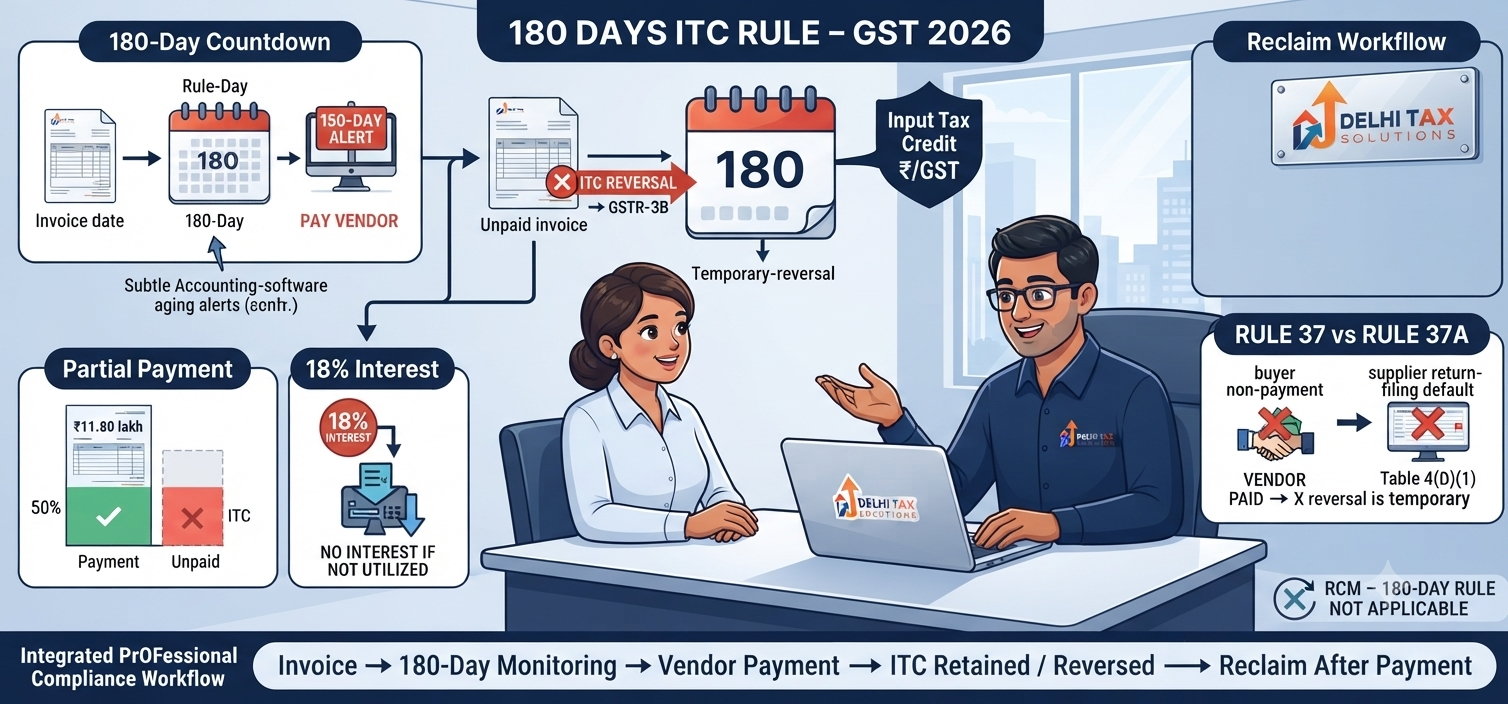
💡 Key Takeaways:
- You must pay your vendor (tax + value) within 180 days of the invoice date to keep the ITC.
- Failure triggers a mandatory ITC reversal in Table 4(B)(2) of your next GSTR-3B.
- An 18% per annum interest penalty applies only if you actually utilized the credit.
- Partial payments require only a proportionate reversal of the unpaid balance.
- You can fully reclaim the reversed credit in Table 4(A)(5) once you finally pay the vendor.
You claimed the Input Tax Credit (ITC) successfully. You filed your GSTR-3B on time. You assume your compliance is perfectly intact. But if you have not paid your vendor’s invoice within 180 days, the GST department wants that credit back immediately—often with a hefty 18% interest penalty attached.
Cash flow delays are a reality for Indian small businesses. However, the GST framework does not tolerate indefinite credit periods. Second proviso to Section 16(2) of the CGST Act strictly dictates that immediate tax offsets granted to buyers must be backed by actual commercial payments to suppliers. Whether you are dealing with a disputed invoice, a temporary cash crunch, or an oversight by your accounts payable team, ignoring the 180 days ITC rule is a guaranteed way to trigger automated scrutiny notices. In this guide, we break down exactly how to calculate your deadlines, report an unpaid invoice itc reversal, and legally reclaim your money later.
Featured Snippet: What is the 180 Days ITC Rule?
The 180 days ITC rule under GST requires a buyer to pay their supplier the total invoice value (including tax) within 180 days from the invoice issuance date. If the buyer fails to make this payment, Rule 37 mandates an immediate reversal of the previously claimed Input Tax Credit. This reversal must be reported in the buyer’s GSTR-3B return, and 18% per annum interest is levied if the credit was already utilized.
How the 180-Day ITC Reversal Clock Works Under Rule 37
Rule 37 gst provisions are designed to prevent buyers from exploiting long credit terms while immediately enjoying tax benefits from the government. The moment a supplier issues an invoice, a statutory timer begins.
Calculating the Exact Deadline
The 180-day limit starts strictly from the date of invoice issuance, not the date you received the goods, nor the date you claimed the ITC. Weekends and public holidays are included in this count. If the 180th day passes and the vendor remains unpaid, the compliance burden shifts directly onto the buyer.
When Does the Reversal Happen?
According to the latest CGST Rules under CBIC, the buyer must add the reversed ITC amount to their output tax liability in the GSTR-3B filed for the month immediately following the expiry of the 180-day period. Delaying this reversal automatically invites escalating interest charges.
Calculating Reversals on Partial Invoice Payments
The 180 days itc rule is not an all-or-nothing penalty. The GST framework allows for proportionate reversal. If you have made a partial payment to your vendor within the permitted window, you only reverse the credit linked to the outstanding balance.
A Practical Business Example
Imagine a Delhi-based marketing startup signs a contract. They receive an invoice for ₹11,80,000 (Taxable value ₹10,00,000 + GST ₹1,80,000). Due to cash flow issues, the startup pays only ₹5,90,000 (50% of the total value) within 180 days. Because they paid half the consideration, they are entitled to keep exactly half the ITC (₹90,000). The remaining ₹90,000 must be reversed. This proportionate calculation protects businesses from catastrophic tax hits when making staggered payments.
The 18% Interest Trap: Availment vs. Utilization
When executing an unpaid invoice itc reversal, the biggest point of confusion for business owners is calculating interest under section 50 gst. The rules have evolved significantly, and getting this wrong can cost you heavily.
The Crucial Amendment
Historically, merely claiming (availing) the ITC incorrectly attracted interest. However, retrospective amendments to Section 50(3) of the CGST Act clarified a vital distinction: interest is only payable if the wrongly availed credit was actually utilized to offset output tax liability.
Calculating the Penalty
If you claimed the ITC and it sat untouched in your Electronic Credit Ledger, you simply reverse it. No interest is due. However, if you used that ITC to reduce your monthly tax payment, you must pay an interest rate of 18% per annum. This interest is calculated from the date you originally utilized the credit down to the date you officially execute the reversal.
Comparison: Rule 37 (Buyer Default) vs. Rule 37A (Supplier Default)
It is easy to confuse Rule 37 with its newly introduced counterpart, Rule 37A. Both result in an ITC reversal, but the triggers and deadlines are entirely different.
| Feature | Rule 37 (Buyer Default) | Rule 37A (Supplier Default) |
|---|---|---|
| The Trigger | Buyer fails to pay the invoice within 180 days. | Supplier fails to file their GSTR-3B return. |
| Reversal Deadline | The month immediately following the 180-day expiry. | By 30th November of the following financial year. |
| Interest Penalty | 18% per annum from the date of utilization. | No interest if reversed before 30th November. |
| Reclaim Condition | When the buyer finally pays the vendor. | When the supplier finally files their GSTR-3B. |
Reporting the Reversal in GSTR-3B (Table 4B)
The GST portal demands extreme precision. Throwing a reversed amount into the wrong column can permanently lock you out of reclaiming it later. According to the GSTR-3B reporting guidelines from the government, proper categorization is mandatory.
Using Table 4(B)(2)
An ITC reversal triggered by the 180 days itc rule is inherently temporary, because you plan to pay the vendor eventually. Therefore, you must report this gstr 3b table 4b reversal strictly under Table 4(B)(2) – “Others”. Never put this under Table 4(B)(1), which is meant for permanent, non-reclaimable reversals (like blocked credits under Section 17(5)). Failing to use the correct table means the GST portal will not recognize the credit in your Electronic Credit Reversal and Re-claimed Statement, creating massive reconciliation headaches.
How to Reclaim ITC After Vendor Payment
The most reassuring aspect of Rule 37 is that the reversal is not permanent. Once your cash flow recovers and you finally settle the outstanding invoice, you have the legal right to reclaim itc after payment.
No Time Limits on Reclaims
Unlike standard ITC claims, which are strictly barred after 30th November of the subsequent financial year, reclaiming reversed credit under Rule 37(4) carries no time limit. Whether you pay the vendor in day 190 or three years later, you can take the credit back.
Filing the Reclaim
To execute the reclaim, you report the amount in Table 4(A)(5) – “All other ITC”. Simultaneously, to ensure the portal’s algorithms balance your ledgers correctly, you must also declare the exact same amount in Table 4(D)(1) – “ITC reclaimed which was reversed under Table 4(B)(2) in earlier tax period”. If you are struggling with complex portal logic, consulting experts for GST advisory services can save you from costly reporting errors.
What Our CA Team Sees in Practice
Based on cases handled by our CA team at Delhi Tax Solutions, the GST department has heavily automated its scrutiny systems. Officers no longer wait for annual audits to spot a 180 days itc rule violation. By cross-referencing MSME Samadhaan portal complaints, bank ledger APIs, and e-invoicing data, the department issues auto-generated ASMT-10 notices for suspected buyer defaults. We strongly advise our clients performing their GST registration status checks to simultaneously implement a “shadow ledger” in their accounting software. This ledger specifically isolates unpaid invoices aging past 150 days, ensuring no accidental utilization occurs before a forced reversal.
About this article: Researched using official government sources, real-time competitor and search-trend analysis, and Delhi Tax Solutions’ in-house tax advisory team. Last updated September 2026. For more insights, browse our latest GST compliance guides. Disclaimer: This article is for general informational purposes and is not a substitute for personalised professional tax advice.
Frequently Asked Questions
Q: What happens if I pay only half the invoice amount within 180 days?
A: Under Rule 37 of the CGST Rules, if you make a partial payment to your vendor within the 180-day deadline, you are required to execute a proportionate ITC reversal. You retain the input tax credit equivalent to the portion of the invoice you actually paid, and you only reverse the ITC corresponding to the outstanding unpaid balance in your next GSTR-3B return.
Q: Does the 180-day ITC rule apply to reverse charge (RCM) transactions?
A: No, the 180 days ITC rule explicitly does not apply to supplies where the tax is payable on a reverse charge basis (RCM). Because the recipient pays the tax directly to the government rather than through the supplier, the statutory requirement to pay the vendor within 180 days to claim input tax credit is waived under the provisos of Section 16(2) of the CGST Act.
Q: From which date is the 18% interest calculated for delayed vendor payments?
A: If you fail to pay your vendor within 180 days, the 18% per annum interest under Section 50 of the GST Act is calculated starting from the specific date you utilized the ITC to offset your output tax liability, down to the actual date you execute the reversal in your GSTR-3B. If the credit remained unutilized in your electronic credit ledger, no interest is applicable.
Q: How do I report the 180-day ITC reversal in my GSTR-3B?
A: You must report an unpaid invoice ITC reversal in Table 4(B)(2) – “Others” of your GSTR-3B. This categorizes the action as a temporary reversal. You must never report this under Table 4(B)(1), which is reserved for permanent blockages. Proper reporting in 4(B)(2) is mandatory to ensure you can legally reclaim the credit in the future once the vendor is finally paid.
Q: Can I reclaim the reversed ITC in the next financial year?
A: Yes, you can absolutely reclaim the reversed ITC in the next financial year or even later. Unlike the standard November 30th deadline for taking fresh credit, Rule 37(4) dictates that there is no statutory time limit for reclaiming credit that was reversed due to non-payment. Once you clear the vendor’s invoice, report the reclaim in Table 4(A)(5) and Table 4(D)(1) of GSTR-3B.