💡 Key Takeaways:
- Section 17(5) overrides general ITC rules, blocking credits on specific business expenses.
- Tax paid on motor vehicles under 13-seat capacity is generally blocked, with narrow exceptions.
- ITC on civil construction or office renovations is strictly denied, even if used for business.
- Food, beverages, and gym memberships for employees are blocked unless mandated by a specific law.
- Wrongfully claiming ineligible credit attracts heavy interest penalties under Section 73/74.
Indian business owners often assume that if an expense is for the business, the GST paid on it can be claimed back. This assumption destroys working capital every single month. The government actively denies tax credits on specific categories of goods and services, regardless of how essential they are to your daily operations.
The rules governing these restrictions sit squarely in section 17(5) of the CGST Act. This specific legal provision acts as a filter. It identifies certain high-risk, personal-leaning, or heavily regulated expenses and completely cuts off your ability to claim tax benefits on them. Claiming these restricted credits by mistake is the single fastest way to trigger a tax audit. The tax department’s automated systems actively look for mismatches in your returns. This guide breaks down exactly what constitutes restricted credit, the rare exceptions you can legally leverage, and how our CA team navigates these rules during active audits.
What is Blocked ITC Under Section 17(5)?
Blocked ITC (Input Tax Credit) refers to specific business expenses listed under Section 17(5) of the CGST Act where the government strictly prohibits taxpayers from claiming GST credit. Even if you hold a valid tax invoice and use the goods or services entirely for business purposes, you cannot use the tax paid on these items to reduce your output GST liability.
These rules exist primarily to prevent businesses from claiming tax benefits on items that are prone to personal consumption. To file accurate returns, you must actively segregate your purchase data into eligible and ineligible itc buckets.
ITC on Motor Vehicles and Conveyances
This is the most heavily scrutinized category by tax officers. Business owners frequently buy cars in the company’s name, assuming they can claim the 28% GST plus cess. The law expressly forbids this in most cases.
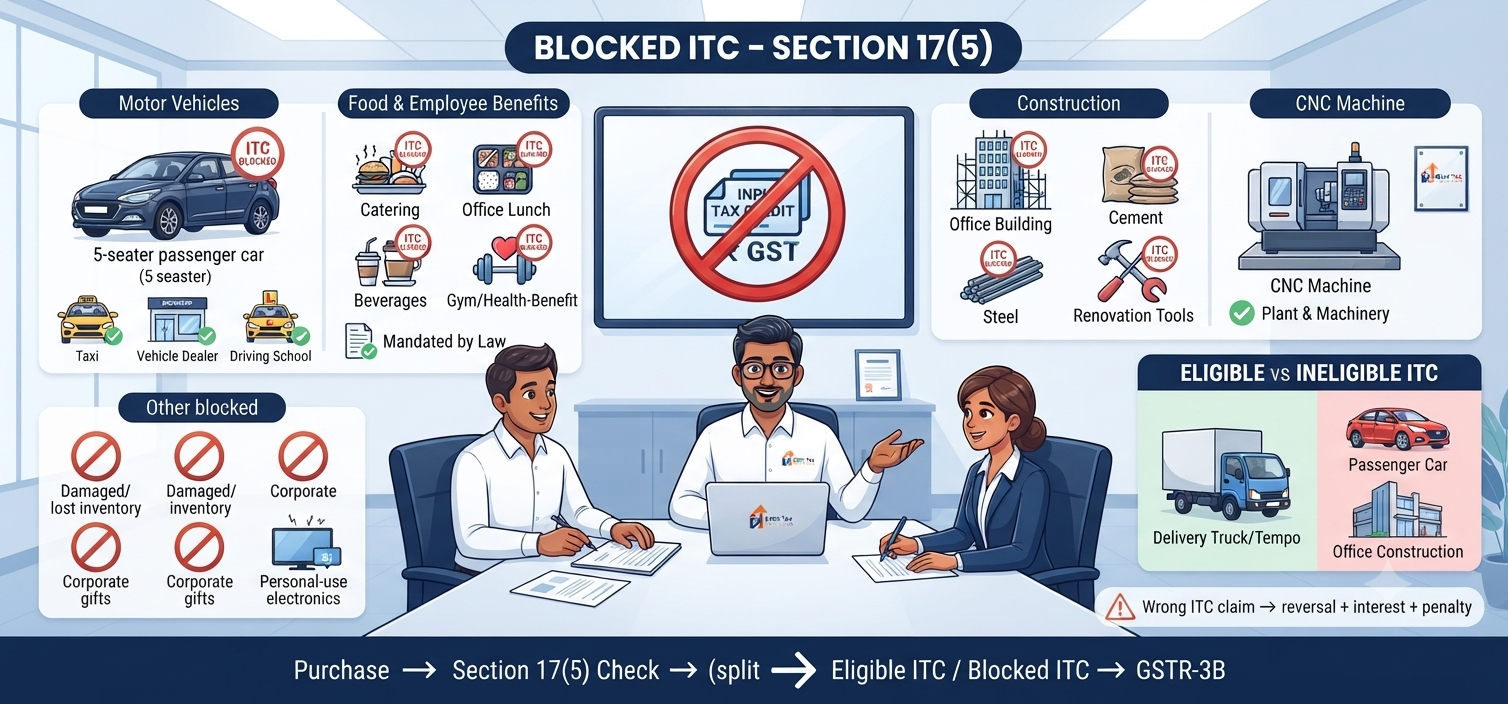
Under the current rules, you cannot claim tax credit on motor vehicles designed to transport persons if they have an approved seating capacity of 13 persons or fewer (including the driver). This instantly blocks credits on almost all standard sedans, SUVs, and hatchbacks purchased by a company for its directors or sales staff.
Allowed Exceptions for Passenger Vehicles
However, the government allows exceptions. You can claim the credit on a 5-seater car ONLY if you use it for one of three specific purposes:
- Making a further taxable supply of the vehicle (e.g., you are a car dealer).
- Transporting passengers for hire (e.g., you run a taxi or cab service).
- Imparting training on driving such motor vehicles (e.g., you operate a driving school).
If your business involves moving freight, the rules change entirely. Vehicles purchased specifically for the transportation of goods (like trucks, tempos, or delivery vans) are fully eligible for credit, regardless of seating capacity. Additionally, services related to blocked vehicles—such as insurance, servicing, and repairs—also suffer the same fate. If the vehicle’s credit is blocked, the repair credit is blocked too.
Food, Beverages, and Employee Benefits
Providing perks to employees keeps morale high, but the tax department offers no relief here. Section 17(5) explicitly blocks credit on food and beverages, outdoor catering, beauty treatment, health services, and cosmetic or plastic surgery.
If you hire a caterer for a company Diwali party or provide free daily lunches in the office cafeteria, the GST paid on those catering bills is entirely ineligible. Similarly, if you buy gym memberships or health insurance for your staff, those credits are also blocked.
Statutory Mandate Exception
There is exactly one major exception to this rule. You can claim the credit if providing that specific facility is mandated by a law currently in force. For example, under the Factories Act, 1948, any factory employing more than 250 workers must maintain a canteen. In this highly specific scenario, the GST paid on the canteen contractor’s services becomes eligible because the employer is legally obligated to provide it.
If you are registering a new factory through Company Registration in India, ensure your tax advisor maps out exactly which employee benefits qualify as statutory obligations versus voluntary perks.
ITC on Construction of Immovable Property
Real estate and construction costs involve massive GST outlays, making them a prime target for audits. The law states that goods or services received by a taxable person for the construction of an immovable property (other than plant and machinery) on their own account are strictly blocked.
This means if you buy cement, steel, and architectural services to build a new corporate office or renovate a warehouse, you cannot claim the credit. This block applies even if the building is used 100% for the furtherance of your business. If the expenses are capitalized in your books of accounts under the Income Tax Department rules, the GST credit is dead.
The critical exception here is “Plant and Machinery.” You are allowed to claim credits on structural supports, foundations, and installations that are specifically required to hold machinery in place. For example, building a concrete foundation specifically to anchor a heavy CNC machine qualifies for credit. Building a concrete wall around the factory does not.
Other Common Ineligible ITC Categories
Beyond cars and construction, section 17(5) of cgst act lists several other daily expenses where credits are completely denied.
- Goods lost, stolen, or destroyed: If your inventory is destroyed in a fire, or you write off obsolete stock, you must reverse the tax credit previously claimed on those raw materials. You cannot claim tax benefits on goods that never made it to the final consumer.
- Free samples and corporate gifts: Distributing free diaries, pens, or product samples during Diwali is a standard marketing tactic. However, because you are not charging output tax on free items, the government denies the input tax credit on their purchase.
- Personal consumption: If a business owner buys a laptop through the company account but gives it to their child for college, the credit is blocked. The tax department frequently scrutinizes consumer electronics purchases to verify actual business deployment.
Summary Table: Eligible vs Ineligible ITC
To ensure your next GST Return Filing Online is error-free, use this quick reference table to segregate your expenses:
| Expense Type | ITC Status | Statutory Exception (When Allowed) |
|---|---|---|
| 5-Seater Director’s Car | Blocked | Allowed only if used for taxi service, driving school, or vehicle resale. |
| Delivery Truck / Tempo | Eligible | Vehicles designed for transporting goods are always fully eligible. |
| Office Building Construction | Blocked | Allowed only for plant and machinery structural supports. |
| Employee Lunch Catering | Blocked | Allowed only if mandated by a specific labor law (e.g., Factories Act). |
| Diwali Corporate Gifts | Blocked | No exceptions. Goods given free of cost lose their tax credit. |
Failing to adhere to these rules results in severe penalties under Section 73 and 74 of the GST Act. The department can demand the reversal of the wrongly claimed credit, apply an 18% per annum interest charge, and levy a penalty equal to 10% to 100% of the tax amount, depending on whether fraud or suppression of facts is proven.
Conclusion
Protecting your cash flow means knowing exactly which taxes you can recover and which ones you must absorb. Section 17(5) is rigid; it blocks credits on motor vehicles, employee food, corporate gifts, and civil construction, regardless of their business utility. The only way to survive a department audit without heavy interest penalties is to correctly identify and reverse these ineligible credits before filing your monthly GSTR-3B.
Do not rely on guesswork when handling high-value purchases like cars or office renovations. Talk to a Delhi Tax Solutions expert today to ensure your Online GST Registration Services and monthly filings are completely compliant with the latest government directives. Precise accounting today prevents massive penalty demands tomorrow.
About this article: Researched using official government sources, real-time competitor and search-trend analysis, and Delhi Tax Solutions’ in-house tax advisory team. Last updated September 2026. Disclaimer: This article is for general informational purposes and is not a substitute for personalised professional tax advice.
Frequently Asked Questions (FAQ)
Q: What is blocked ITC under section 17(5)?
A: Blocked ITC refers to specific categories of business expenses where the government strictly denies tax credits, even if the goods or services are used entirely for business purposes. Listed under Section 17(5) of the CGST Act, these include passenger motor vehicles under 13 seats, food and beverages, outdoor catering, health insurance, free samples, and the construction of immovable property. The tax paid on these items cannot be used to reduce your final GST liability.
Q: Can I claim ITC on purchasing a car for my business?
A: Generally, no. Section 17(5) blocks the tax credit on motor vehicles designed to transport persons with a seating capacity of 13 or fewer, including the driver. This covers almost all standard business cars and SUVs. You can only claim this credit if you are in the specific business of selling cars, running a passenger transport service (like a taxi fleet), or operating a motor driving school.
Q: Is ITC allowed on office building construction or renovation?
A: No, the GST paid on goods and services used for the construction, reconstruction, or renovation of an immovable property (like an office building or warehouse) is strictly blocked. This applies even if the building is essential for your business operations. The only exception is for expenses related directly to the installation of “Plant and Machinery,” such as building a concrete foundation specifically to anchor heavy industrial equipment.
Q: Can we claim ITC on employee food and beverages?
A: Credit on food, beverages, and outdoor catering is explicitly blocked under the standard GST rules. If you buy lunch for your office staff or hire a caterer for a corporate event, you cannot claim the tax back. The only time this credit becomes eligible is if you are legally mandated to provide the food facility under a current law, such as a mandatory canteen required by the Factories Act for large manufacturing units.
Q: What happens if I wrongly claim ineligible ITC?
A: If the tax department catches a wrongful claim during an audit, you will face severe consequences under Sections 73 or 74 of the CGST Act. You will be forced to reverse the claimed amount immediately. Additionally, you will be charged an 18% per annum interest penalty calculated from the date you wrongly utilized the credit, plus a monetary penalty ranging from 10% to 100% of the tax amount, depending on the severity of the violation.