💡 Key Takeaways:
- ITC lets you reduce the GST you owe by deducting the GST you paid on business purchases.
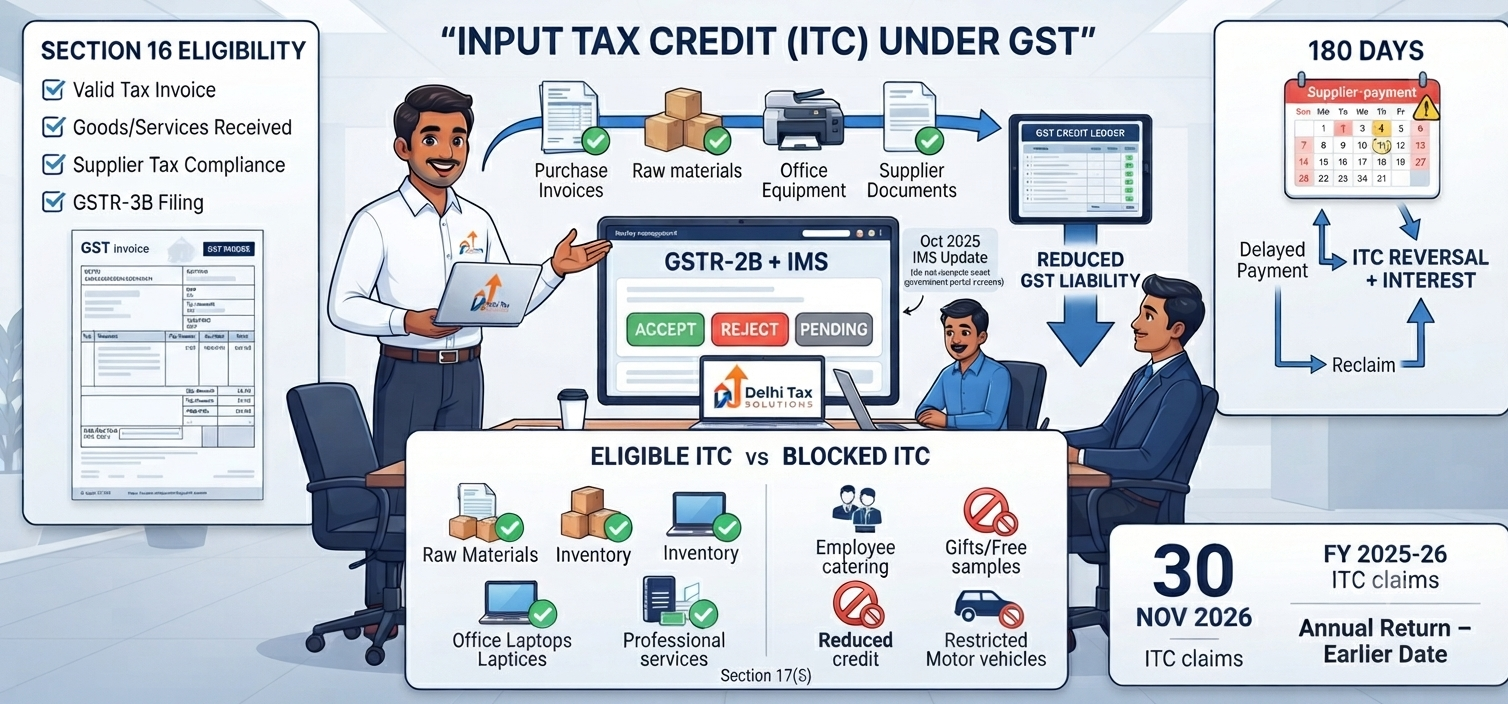
- Section 16 requires a valid invoice, actual receipt of goods, and your supplier to pay the tax.
- You must pay your supplier within 180 days of the invoice date, or face ITC reversal with interest.
- The October 2025 IMS update requires you to manually accept/reject invoices to claim credit.
- Claims for FY 2025-26 must be filed by 30th November 2026 or the annual return date.
Every year, Indian small businesses lose millions of rupees simply because they fail to claim the tax credits owed to them. If you run a GST-registered business, you pay tax twice: once when buying raw materials, and again when selling the finished product. Without the right framework, this completely ruins cash flow.
This is where the concept of input tax credit steps in to save your margins. It is the backbone of the Goods and Services Tax framework. The rules governing these claims, however, are strict. From the October 2025 Invoice Management System (IMS) rollout to the rigid 180-day payment rule, the tax department closely monitors every rupee you claim. Make a mistake, and you are hit with demand notices and heavy interest penalties. This guide breaks down exactly how to secure your credits legally using the current Section 16 rules.
What is ITC?
Input Tax Credit (ITC) is a mechanism that allows GST-registered businesses to reduce their output tax liability by claiming credit for the GST already paid on their business-related purchases. Instead of paying tax on the full sale value, you only pay tax on the value you added to the product.
This system eliminates the cascading effect of taxes—tax on tax. It keeps prices fair for the end consumer and protects the working capital of Indian entrepreneurs. However, this credit is a conditional benefit, not an absolute right. To utilize it, you must follow the rulebook.
Core Section 16 Conditions You Must Satisfy
The CBIC GST Taxpayer Portal clearly outlines the statutory rules under section 16 of the CGST Act. You cannot simply deduct tax based on a receipt. You must clear all of the following hurdles.
1. Possession of a Valid Tax Document
You must hold a valid tax invoice or debit note issued by a registered supplier. Proforma invoices or basic estimates do not work. The invoice must clearly show your GSTIN, the tax amount, and the HSN/SAC codes. If you are handling Company Registration in India for a new subsidiary, ensure all vendor billing updates to the new company’s GSTIN immediately.
2. Actual Receipt of Goods or Services
You cannot claim credit just because you paid an advance. You must have physically received the goods or services. If you order materials in installments, the credit is only available after the final lot arrives at your facility.
3. The Supplier Paid the Tax
This is where most businesses struggle. You are only eligible for credit if your supplier actually deposits that specific tax amount with the government. If your vendor collects the tax from you but runs away without filing their returns, the government will deny your claim.
4. Mandatory GSTR-2B Matching & New IMS Rules
Your supplier must upload the invoice in their GSTR-1, which auto-populates into your GSTR-2B statement. Starting from the October 2025 tax period, the government linked credit availability directly to the Invoice Management System (IMS). You must log into the Goods and Services Tax Portal and actively mark invoices as “Accept”, “Reject”, or “Pending”. Only accepted invoices flow into your eligible credit ledger.
The 180 Days Rule in GST Explained
One of the most heavily audited areas of compliance is the payment timeline. If you receive goods and an invoice, you must pay the supplier the full value of the supply—plus the tax—within 180 days from the invoice issue date.
Reversal and Interest Penalties
If you fail to make this payment on time, you face the reversal of itc. The previously claimed tax amount gets added back to your output tax liability, and you will be charged an 18% per annum interest penalty. Once you finally pay the vendor, you can reclaim the credit, but the interest paid is a permanent loss.
Blocked Credit: When is ITC Eligibility in GST Denied?
Not every business expense qualifies. Section 17(5) lists specific items known as blocked credit. Even if you use these items strictly for your business, the government strictly prohibits you from claiming tax benefits on them. Common examples include motor vehicles with a seating capacity of under 13 persons (unless you run a driving school or taxi service), food and beverages for employees, gym memberships, and goods distributed as free samples or gifts.
Furthermore, if you claim depreciation on the GST component of capital goods under the Income Tax Department rules, you cannot claim GST credit on that same amount. You must choose one benefit.
Comparing Eligible vs Blocked Credits
To make the rules clearer, here is a breakdown of what qualifies versus what gets rejected when preparing your data for GST Return Filing Online:
| Expense Category | ITC Status | Reason / Condition |
|---|---|---|
| Raw Materials & Inventory | Eligible | Used directly to further the business. |
| Office Laptops & Furniture | Eligible | Considered capital goods; eligible if depreciation is not claimed on the tax portion. |
| Employee Lunch / Catering | Blocked | Blocked under Section 17(5) unless mandated by a specific labor law. |
| Corporate Gifts & Samples | Blocked | Items given away for free do not qualify. |
| Freelancer Services | Eligible | Professional fees are fully eligible. |
Time Limits for Claiming ITC
You cannot hold onto purchase invoices indefinitely. The government enforces a strict cut-off. Under Section 16(4), you must claim your credits by the 30th of November of the next financial year, or the date you file your annual return—whichever happens earlier.
For example, if you have a purchase invoice dated 15th August 2025 (Financial Year 2025-26), the absolute last day you can claim that tax credit is 30th November 2026. Miss that date, and the money stays with the government forever. No exceptions.
Conclusion
Mastering tax credits keeps your business cash-flow positive. To summarize: you can lower your tax payouts by claiming credit on business purchases, provided you possess a valid invoice, physically receive the goods, and pay your vendor within 180 days. The introduction of the Invoice Management System means passive compliance is over; you must actively review and accept invoices to see them hit your electronic credit ledger.
Do not let minor filing errors drain your working capital. Talk to a Delhi Tax Solutions expert today to get your Online GST Registration and filing processes perfectly aligned with the latest rules. The tax landscape is tightening, and proactive compliance is the only way to protect your margins.
About this article: Researched using official government sources, real-time competitor and search-trend analysis, and Delhi Tax Solutions’ in-house tax advisory team. Last updated September 2026. Disclaimer: This article is for general informational purposes and is not a substitute for personalised professional tax advice.
Frequently Asked Questions (FAQ)
Q: What are the 4 conditions to claim input tax credit under Section 16?
A: To legally claim this credit, you must satisfy four primary conditions: you must hold a valid tax invoice from a registered supplier, you must have physically received the goods or services, your supplier must have deposited the collected tax with the government, and you must file your own GSTR-3B return accurately. Starting recently, the invoice must also clear the GSTR-2B matching requirements.
Q: How does the new Invoice Management System (IMS) affect my ITC?
A: Implemented from October 2025, the IMS forces buyers to actively manage inward supplies. You can no longer just rely on auto-populated GSTR-2B data. You must log into the portal and mark invoices as “Accept”, “Reject”, or “Pending”. Only the invoices you explicitly accept will flow into your eligible credit ledger for utilization.
Q: What happens if I don’t pay my supplier within 180 days?
A: If you fail to pay the invoice value and the tax amount to your supplier within 180 days of the invoice issue date, you must reverse the claimed credit. This amount gets added back to your output tax liability, and you must pay an 18% per annum interest penalty. You can reclaim the tax credit once you finally make the payment, but the interest is a permanent loss.
Q: Can I claim ITC on office laptops and furniture?
A: Yes, office laptops, computers, and furniture qualify as capital goods used for business purposes. You are fully eligible to claim the tax paid on them. However, if you choose to claim depreciation on the GST component of these assets under the Income Tax Act, you cannot simultaneously claim the GST credit. You must pick one benefit.
Q: What is the last date to claim ITC for the previous financial year?
A: The strict deadline under Section 16(4) is the 30th of November following the end of the relevant financial year, or the actual date you file your annual GST return, whichever is earlier. For example, any unclaimed invoices from Financial Year 2025-26 will completely expire on 30th November 2026, and the credits will be permanently lost.