
💡 Key Takeaways
- Exclusive GST calculations add tax directly to the base price using standard percentage formulas.
- Inclusive GST extraction requires reverse-engineering the gross amount to uncover base value.
- Intra-state supplies split tax equally between CGST and SGST, while inter-state applies IGST.
- Accurate decimal rounding to the nearest rupee prevents automated portal rejection errors.
- Regular compliance reviews safeguard input tax credit claims across monthly filing cycles.
Managing commercial transactions requires absolute precision when computing indirect tax liabilities. Whether you operate a retail storefront or a digital startup, understanding how to calculate gst correctly prevents costly billing discrepancies and audit notices. Manual calculation errors can disrupt cash flow and jeopardize monthly return filings.
India’s unified tax framework relies on standardized rate slabs ranging from 5 percent to 28 percent under Section 9 of the CGST Act. Knowing the exact mathematical gst formula for both exclusive and inclusive pricing empowers business owners to generate flawless invoices. Mastering these computations ensures seamless compliance across every commercial exchange.
This guide breaks down mathematical formulas, explores practical computation workflows, and highlights critical operational traps observed by our advisory practice. Let us examine how tax rate computation operates under current regulatory standards.
How to Compute GST on Exclusive Prices
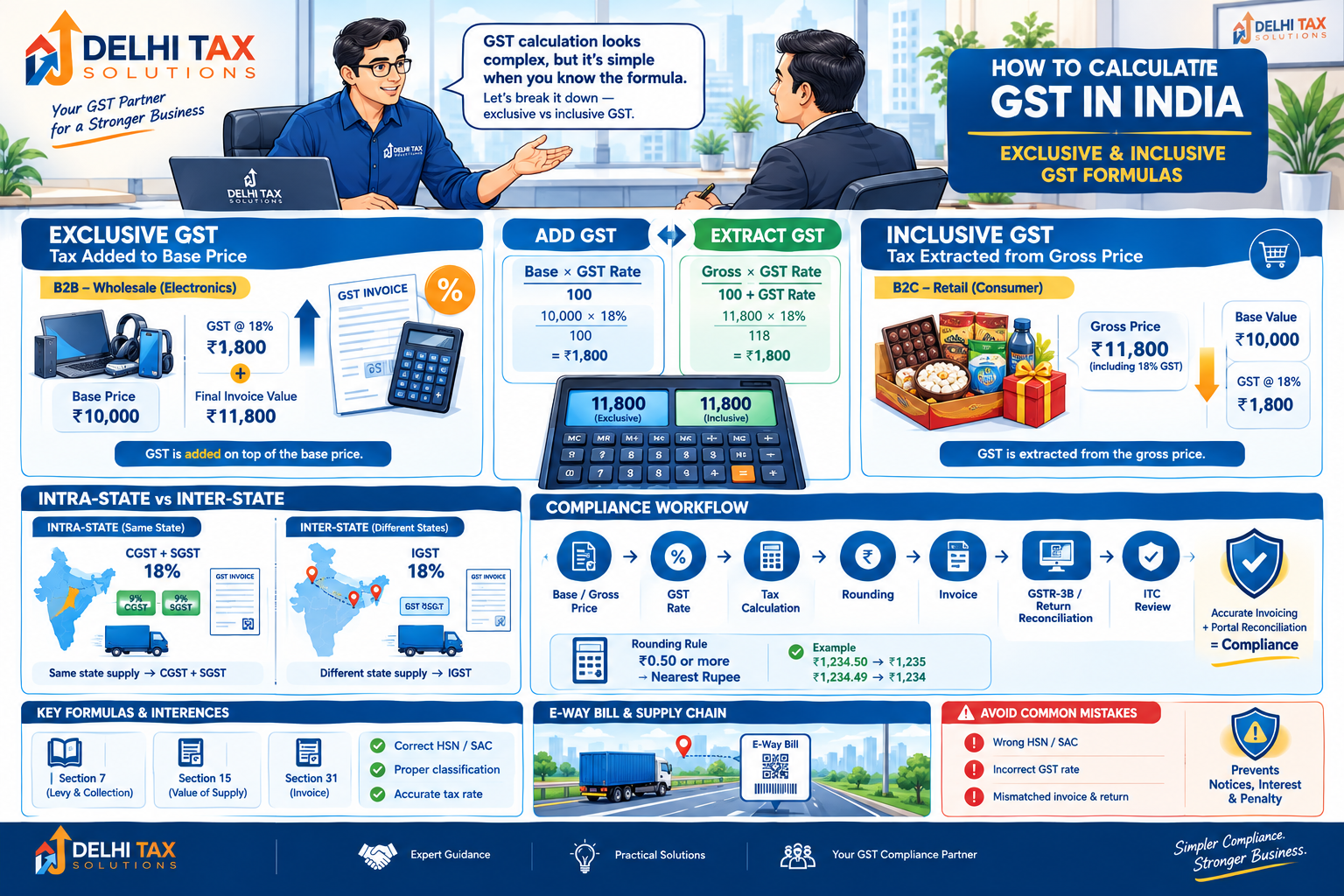
Calculating tax on an exclusive price is straightforward when applying standard multiplier equations. To determine the total invoice value, multiply the net base amount by the applicable tax rate percentage and add the product back to the original price. For instance, if a business sells wholesale electronics with a base value of ₹10,000 under an 18 percent rate slab, the tax computation yields ₹1,800, bringing the total gross invoice value to ₹11,800.
This straightforward calculation forms the backbone of standard B2B invoicing frameworks across India. According to guidelines published by the Press Information Bureau, automated portal validation relies heavily on accurate tax segregation between base prices and output levies during return processing.
Extracting Tax from Inclusive Pricing Models
When dealing with retail pricing where tax is already embedded in the final sticker price, a reverse gst calculator formula is required to separate the base value from the government levy. The mathematical formula divides the gross inclusive amount by 100 plus the tax rate, then multiplies that result by the tax rate percentage. For example, if a retail product sells for ₹11,800 inclusive of an 18 percent tax slab, dividing ₹11,800 by 1.18 reveals a base price of ₹10,000, leaving an embedded tax component of ₹1,800.
Failing to extract these figures accurately distorts revenue reporting and invalidates input tax credit calculations. Reviewing official notifications hosted on the Official GST Portal helps founders verify current rate classifications. New businesses often streamline these complex billing setups by engaging professional GST Registration advisory services.
| Calculation Parameter | Exclusive Price Model | Inclusive Price Model |
|---|---|---|
| Core Formula | Base Amount × (Tax Rate ÷ 100) | Gross Amount × [Tax Rate ÷ (100 + Tax Rate)] |
| Application Focus | B2B wholesale commercial billing | B2C retail consumer pricing |
| Tax Extraction | Tax is added on top of base price | Tax is extracted from gross price |
Intra-State Versus Inter-State Tax Computation
Determining the destination of a supply dictates whether the tax liability splits into Central and State components or consolidates into an Integrated levy. For intra-state transactions where goods move within the same state, the computed tax divides equally into Central Goods and Services Tax (CGST) and State Goods and Services Tax (SGST). For instance, an 18 percent tax on an intra-state supply splits into 9 percent CGST and 9 percent SGST.
Conversely, inter-state transactions involving the movement of goods across state boundaries attract Integrated Goods and Services Tax (IGST) equal to the combined rate. Corporations structuring new operating entities through Company Registration frameworks should implement automated tax-zone routing rules within their billing software to prevent misallocations.
Decimal Rounding Rules and Invoicing Workflows
Commercial transactions frequently generate fractional decimal values during tax computations, requiring strict adherence to statutory rounding protocols. Under standard financial rules, decimal amounts ending in 50 paisa or more must be rounded up to the nearest whole rupee, while amounts below 50 paisa are rounded down. Failing to apply these rounding standards creates minor ledger imbalances that accumulate across thousands of monthly transactions.
Maintaining clean financial ledgers supports broader corporate compliance across annual Income Tax Filing schedules and required Business Licenses to preserve full statutory alignment.
What Our CA Team Sees In Practice
Theoretical tax formulas operate differently during live audits. Based on cases handled by our CA team, the most frequent operational error occurs when retail merchants misapply inclusive pricing formulas, treating gross receipts as net taxable turnover and underreporting net liabilities on monthly returns.
Another recurring pitfall involves service providers failing to separate inter-state supply locations correctly when billing remote clients, triggering sudden interest demands under Section 50. We routinely advise clients utilizing our Start a Business advisory pathways to institute rigid monthly ledger reconciliations before submitting GSTR-3B filings.
Furthermore, maintaining clean financial ledgers supports broader corporate compliance. Founders should review ledger balances regularly alongside GST Hub resources, monitor TDS Filing requirements, and review state-specific Property Tax obligations to maintain complete regulatory health.
Conclusion
Mastering both exclusive and inclusive GST calculations ensures your business invoices accurately reflect statutory liabilities without triggering portal reconciliation errors. Consistent application of proper formulas safeguards your cash flow and regulatory standing.
Need specialized assistance with complex invoicing structures or tax ledger reconciliations? Consult with a Delhi Tax Solutions professional today to keep your compliance framework bulletproof.
Frequently Asked Questions (FAQs)
Q: How do you calculate GST on a product when the tax amount is exclusive?
A: Calculating exclusive tax requires multiplying the net base amount by the applicable tax rate percentage and adding the product back to the original price. For example, a base price of ₹10,000 with an 18 percent tax slab yields ₹1,800 in tax, resulting in a total gross invoice value of ₹11,800.
Q: What is the exact mathematical formula to extract GST from an inclusive price?
A: The exact formula for extracting tax from an inclusive price divides the gross amount by 100 plus the tax rate, then multiplies the result by the tax rate percentage. For an item priced at ₹11,800 inclusive of an 18 percent rate, dividing by 1.18 reveals a base price of ₹10,000 and a tax component of ₹1,800.
Q: How are CGST, SGST, and IGST divided during intra-state and inter-state sales?
A: Intra-state transactions divide the computed tax equally into Central Goods and Services Tax (CGST) and State Goods and Services Tax (SGST), such as a 9 percent split each for an 18 percent slab. Inter-state transactions across state boundaries consolidate the entire levy into Integrated Goods and Services Tax (IGST).
Q: What are the standard GST rate slabs applicable to business transactions in India?
A: Commercial transactions across India generally fall under four primary tax rate slabs established by the GST Council: 5 percent, 12 percent, 18 percent, and 28 percent, alongside specific exempted items and special rates designated for precious metals and rough stones.
Q: How do decimal rounding rules apply when computing final tax amounts on invoices?
A: Under standard commercial financial practices in India, decimal tax amounts ending in 50 paisa or higher must be rounded up to the nearest whole rupee, while fractional amounts falling below 50 paisa are rounded down to maintain accurate ledger balancing.
This article is for general informational purposes and is not a substitute for personalised professional tax advice. About this article: Researched using official government sources, real-time competitor and search-trend analysis, and Delhi Tax Solutions’ in-house tax advisory team. Last updated September 2026.
