
💡 Key Takeaways
- Composite supplies involve naturally bundled goods where one item serves as the principal supply.
- Section 8 of the CGST Act mandates taxing the entire package at the principal item’s rate.
- Mixed supplies combine distinct items artificially, attracting the highest applicable tax bracket.
- Billing systems must accurately identify principal items to prevent short-payment penalty notices.
- E-way bills for bundled consignments must reflect the primary HSN code of the main supply.
Managing commercial invoicing requires precise tax classification for every item sold to consumers. When businesses bundle multiple products or services together, determining the correct tax rate becomes a complex legal puzzle. Misjudging how items are grouped triggers immediate audit flags and severe penalty notices from tax authorities.
India’s indirect tax framework establishes strict statutory boundaries for commercial bundling. Knowing whether your product package qualifies as a composite supply or a separate grouping determines your monthly tax output liability. Mastering these rules protects your profit margins and maintains flawless compliance.
This guide examines Section 8 statutory provisions, breaks down billing workflows, and highlights critical operational traps caught by our advisory practice. Let us explore how tax rate determination functions under current regulations.
What Is a Composite Supply Under GST?
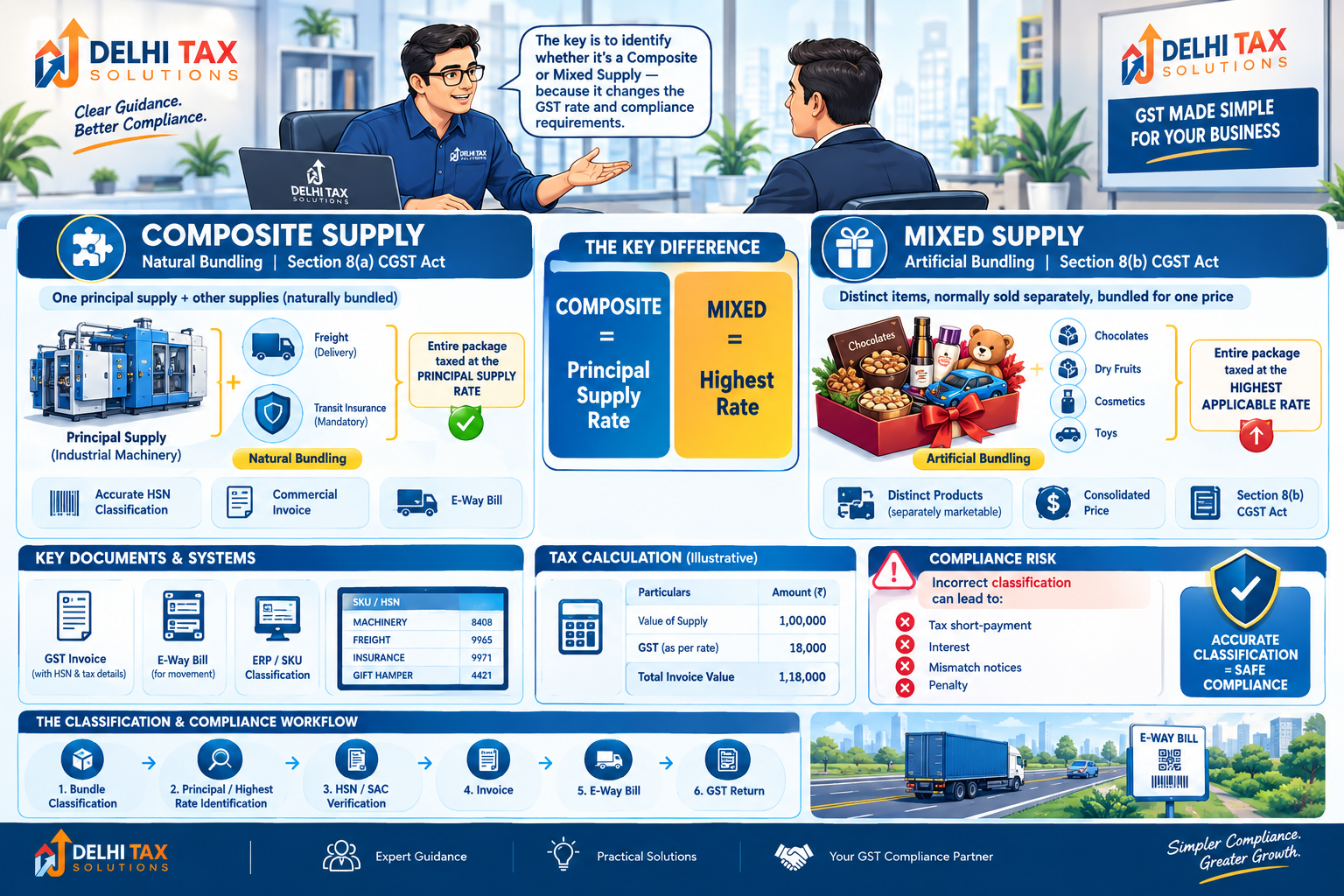
A composite supply consists of two or more taxable goods or services bundled together naturally in the ordinary course of business, where one item acts as the principal supply while others are ancillary. Under Section 8 of the Central Goods and Services Tax Act, the entire transaction is treated as a supply of the principal item and taxed at its specific rate. For instance, when a manufacturer sells machinery packaged with mandatory transit insurance and freight delivery, the machinery is the primary supply, making the package a composite transaction.
This natural bundling ensures that businesses do not need to bifurcate invoices into fractional tax components for minor ancillary elements. According to updates published by the Press Information Bureau, automated portal validation relies heavily on accurate HSN code reporting for these primary shipments to verify cross-credit chains seamlessly.
Understanding Mixed Supply and Tax Rate Rules
A mixed supply involves two or more individual goods or services combined together by a vendor for a single composite price, where the combination is not naturally bundled in the ordinary course of business. Under statutory provisions, if any single item in that artificial bundle attracts a higher tax bracket, the entire package is taxed at that highest rate. For example, a festive gift hamper containing chocolates, dry fruits, luxury cosmetics, and plastic toys sold for a consolidated price is treated as a mixed supply.
Because these items can easily be sold separately, tax authorities treat the bundle strictly as a high-rate commercial package. Reviewing official notifications hosted on the Official GST Portal helps founders verify current rate classifications. New businesses often streamline these complex billing setups by engaging professional GST Registration advisory services.
| Compliance Parameter | Composite Supply | Mixed Supply |
|---|---|---|
| Statutory Governance | Section 8(a) of the CGST Act | Section 8(b) of the CGST Act |
| Bundling Nature | Naturally bundled in ordinary commerce | Artificially combined for a single price |
| Tax Rate Application | Taxed at the rate of the principal supply | Taxed at the highest rate among all items |
Section 8 Statutory Provisions and Liability Determination
Determining tax liability requires meticulous application of Section 8 rules. When evaluating a commercial transaction, accountants must assess whether the components can logically exist independently in the market. If a hotel offers a package combining room accommodation with breakfast, standard industry practice treats lodging as the principal supply, applying room tax rates to the entire bill under composite rules.
Conversely, if a vendor bundles a television set with a discounted vacuum cleaner, the items are independent commercial products, shifting the transaction into mixed supply evaluation. Corporations structuring new operating entities through Company Registration frameworks should implement automated SKU classification rules within their ERP software to ensure accurate tax calculations.
E-Way Bill Generation and Multi-Item Invoicing Workflows
Generating e-way bills for bundled shipments demands precision. For composite shipments, the e-way bill must display the HSN code and tax rate of the principal supply. In contrast, consignments containing mixed supply packages must be generated using the HSN code of the item carrying the highest tax rate to avoid transit discrepancies during highway interceptions.
Failing to align invoice HSN codes with e-way bill declarations triggers automated portal mismatch notices and detention by mobile inspection squads. Enterprises managing extensive supply chains also coordinate these logistics with annual Income Tax Filing schedules and required Business Licenses to maintain full statutory alignment.
What Our CA Team Sees In Practice
Theoretical statutory rules operate differently during live audits. Based on cases handled by our CA team, the most frequent operational error occurs when retail e-commerce sellers bundle luxury items with basic groceries into promotional hampers, billing the entire package at a lower average tax rate instead of applying the highest bracket required for mixed supplies.
Another recurring pitfall involves manufacturing firms failing to separate ancillary freight charges properly when contracts lack explicit composite bundling clauses, triggering short-payment interest demands under Section 50. We routinely advise clients utilizing our Start a Business advisory pathways to institute rigid monthly SKU reviews before filing monthly returns.
Furthermore, maintaining clean financial ledgers supports broader corporate compliance. Founders should review ledger balances regularly alongside GST Hub resources, monitor TDS Filing requirements, and review state-specific Property Tax obligations to maintain complete regulatory health.
Conclusion
Accurately separating composite shipments from artificial mixed packages protects your enterprise from short-payment penalties and transit inspection detentions. Ensuring proper HSN mapping on your invoices and e-way bills maintains complete reporting compliance.
Need expert assistance with product classification or optimizing your invoicing structures? Connect with a Delhi Tax Solutions professional today to streamline your commercial tax compliance.
Frequently Asked Questions (FAQs)
Q: What is a composite supply under GST, and how does it differ from a regular sale?
A: A composite supply is a transaction where two or more goods or services are naturally bundled together in the ordinary course of business, with one item serving as the principal supply. Unlike a standard single-item sale or artificial grouping, Section 8 of the CGST Act mandates that the entire package takes the tax rate of the main component.
Q: What is the difference between a composite supply and a mixed supply under GST?
A: The fundamental difference lies in how items are bundled: composite supplies involve natural pairings encountered in standard commerce, taxed at the principal item’s rate. In contrast, mixed supplies combine distinct items artificially for a single price, attracting the highest applicable tax rate among all items in the bundle.
Q: How does Section 8 of the CGST Act determine the tax rate for bundled goods and services?
A: Section 8 of the Central Goods and Services Tax Act establishes that a composite supply comprising two or more supplies shall be treated as a supply of the principal component. Under statutory rules, the entire invoice value is taxed at the specific rate assigned to that primary item by the GST Council.
Q: What tax rate applies to a mixed supply containing items in multiple tax brackets?
A: When a vendor creates an artificial mixed supply combining products across different tax brackets—such as 5 percent and 28 percent items sold for a single consolidated price—statutory regulations require the entire package to be taxed at the highest applicable rate of 28 percent.
Q: How should businesses generate e-way bills for multi-item composite supply packages?
A: Businesses generating e-way bills for composite supply consignments must utilize the HSN code and tax rate corresponding to the principal supply. For mixed supply packages, the e-way bill must declare the HSN code of the item carrying the highest tax bracket to prevent transit inspection penalties.
This article is for general informational purposes and is not a substitute for personalised professional tax advice. About this article: Researched using official government sources, real-time competitor and search-trend analysis, and Delhi Tax Solutions’ in-house tax advisory team. Last updated September 2026.
