💡 Key Takeaways
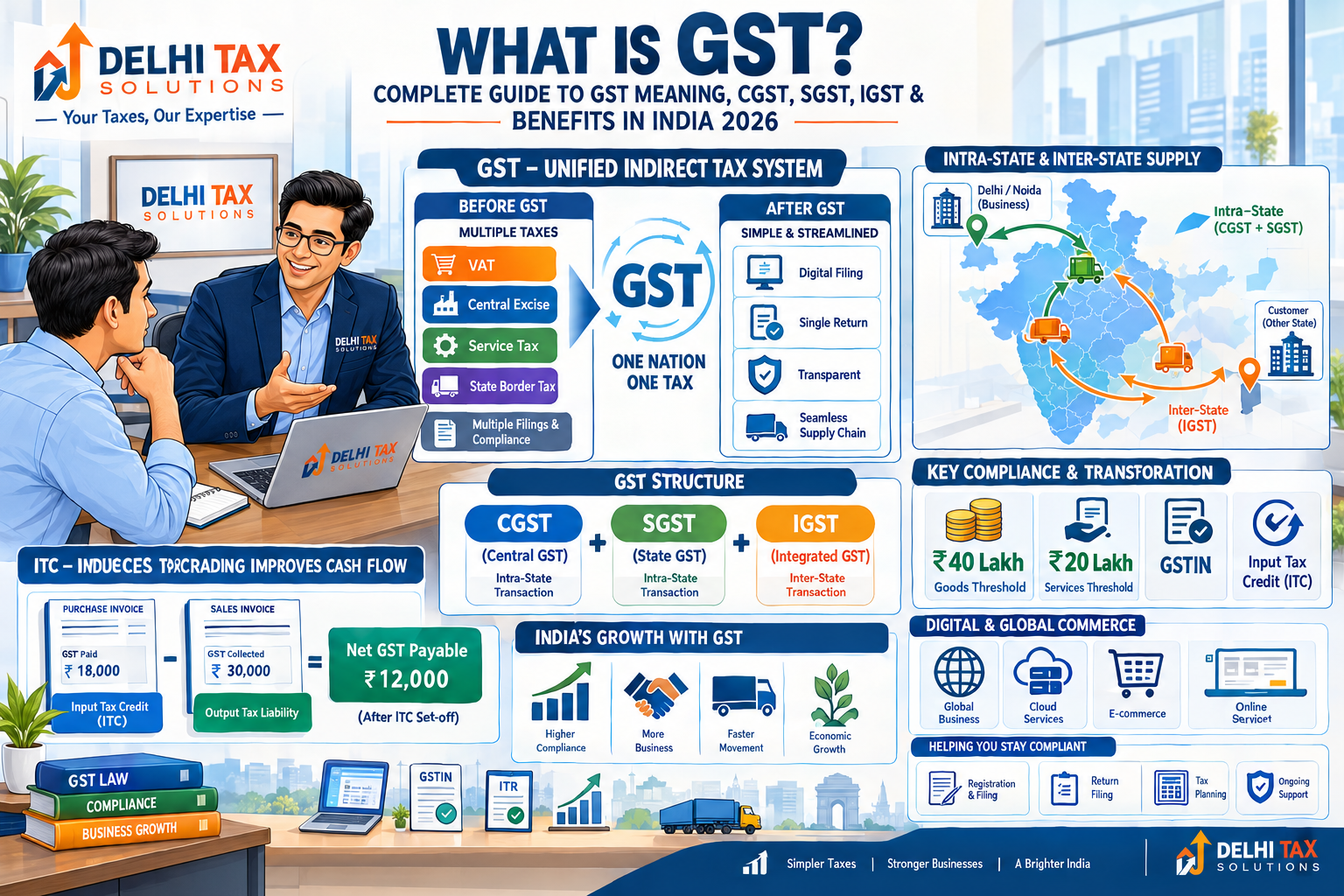
- GST is a single indirect tax replacing multiple older state and central taxes.
- India operates on a dual GST model involving CGST, SGST, and IGST.
- Businesses selling goods over ₹40 Lakh annually must legally register.
- Service providers cross the mandatory registration threshold at ₹20 Lakh.
- Input Tax Credit allows businesses to offset taxes paid on purchases.
Before 2017, starting a business in India meant fighting a terrifying maze of taxes. You paid Excise Duty to manufacture a product, VAT to sell it, and Service Tax if you offered consulting. Every state had its own hidden charges. Goods moving from Delhi to Haryana would sit at state borders for days waiting for octroi clearances. It was a logistical nightmare.
Then came a massive indirect tax reform. The government wiped the slate clean. They combined all those fragmented charges into one unified system. No cascading taxes. Just one clean, digital network designed to make doing business smoother across the country.
Yet, nearly a decade later, many new entrepreneurs still struggle to grasp the actual GST meaning. When exactly do you charge it? How does the billing work across state lines? This guide strips away the heavy financial jargon. You will learn exactly how this tax system operates, what the current 2026 rules demand, and how it impacts your daily cash flow.
What is GST? The Direct Answer
Goods and Services Tax (GST) is a comprehensive, multi-stage, destination-based indirect tax levied on every value addition in India. It replaced a complex web of older indirect taxes like VAT, Central Excise Duty, and Service Tax. Consumers pay this tax when buying products or services, but businesses are responsible for collecting it and remitting it to the government. The system officially launched on July 1, 2017, unifying India into a single common market.
Understanding the Dual GST Model
Because India is a federal country, both the Centre and the State governments have the right to collect taxes. To balance this power, India adopted a dual GST system. Every transaction is taxed by both authorities simultaneously, but the way it appears on your invoice changes based on where the sale happens.
This is where most beginners get confused. When a business in Noida sells a laptop to a customer in Noida, the tax is split equally between the Central government and the Uttar Pradesh government. But if that same business sells the laptop to someone in Mumbai, a different tax component applies entirely.
CGST, SGST, IGST Difference Explained
To operate legally, you must apply the correct tax head on your bills. Applying the wrong one means your client cannot claim their tax benefits, which ruins business relationships quickly.
| Tax Component | Full Form | When is it applied? | Revenue goes to |
|---|---|---|---|
| CGST | Central GST | Intra-state sales (within same state) | Central Government |
| SGST | State GST | Intra-state sales (within same state) | State Government |
| IGST | Integrated GST | Inter-state sales (between two states) | Shared centrally, then passed to destination state |
Current GST Threshold Limits for 2026
You do not need to register for this tax the day you open your business. The government protects tiny startups by setting a minimum turnover threshold. Only once your annual sales cross this specific limit do you legally need to apply for a GSTIN (your unique 15-digit registration number).
For the financial year starting April 2025 (FY 2025-26), the gst threshold limits 2026 remain steady based on previous council structures. If your business exclusively sells physical goods, you must register once your annual turnover hits ₹40 Lakh. If you provide services—like consulting, web design, or marketing—the limit is strictly ₹20 Lakh.
Special Category States
The rules change depending on geography. For businesses operating in certain North-Eastern and hilly states (like Manipur, Mizoram, and Tripura), the limits are halved to ₹10 Lakh or ₹20 Lakh depending on the sector. Attempting to bypass these rules attracts hefty penalties. If you are unsure where your turnover stands, using professional GST Registration services ensures you never miss a mandatory deadline.
Core Benefits of GST in India
Despite the initial compliance learning curve, the system was designed to aggressively promote business growth. The benefits of gst in india extend far beyond simple tax collection; it completely transformed how goods move across the country.
First, it eliminated the cascading tax effect—often called “tax on tax.” Previously, a manufacturer paid excise duty, and then the wholesaler paid VAT on the final price which already included that excise duty. Today, the tax is strictly levied only on the value added at each stage. According to data from the Press Information Bureau, transit time for cargo trucks dropped by nearly 20% after the removal of state border check-posts.
The Magic of Input Tax Credit
The biggest financial advantage for any registered business is the Input Tax Credit (ITC) mechanism. If you buy raw materials worth ₹1,00,000 and pay an 18% tax (₹18,000) to your supplier, you can subtract that ₹18,000 from the taxes you owe the government when you sell your final product. You only pay the net difference. This keeps working capital flowing inside the business rather than sitting in government accounts.
What Our CA Team Sees In Practice
Textbook definitions are helpful, but the reality of running a business involves practical hurdles. Based on cases handled by our CA team, the most common mistake new founders make involves voluntary registration. Many startups rush to register on the official Official GST Portal before hitting the ₹20 Lakh threshold simply because it looks professional.
Here is what happens next: they suddenly have to file regular monthly returns, even if they have zero sales. If they forget, late fees accumulate daily. We strongly advise clients mapping out their plans via our Start a Business hub to only opt for voluntary registration if their B2B clients strictly demand a tax invoice to pass on the ITC.
Additionally, small businesses often confuse their tax filing rules with their Income Tax Filing obligations. Remember, indirect taxes are paid continuously throughout the year on sales, while direct income tax is calculated annually on your final net profit.
Conclusion
Understanding the basics of India’s taxation system protects your bottom line. You now know that this unified system eliminates cascading taxes, utilizes a dual center-state model, and relies heavily on the Input Tax Credit mechanism to keep goods affordable. Crossing the ₹40 Lakh or ₹20 Lakh turnover marks the moment your compliance journey officially begins.
Do not let filing complexities stall your startup’s growth. Talk to a Delhi Tax Solutions expert to get your GST registration filed within 3 days. As the regulatory landscape continues evolving into 2026, partnering with seasoned professionals keeps your focus exactly where it belongs—on scaling your business.
Frequently Asked Questions (FAQs)
Q: What is the simple meaning of GST in India?
A: The Goods and Services Tax (GST) is a single, national indirect tax applied on the supply of goods and services. It replaced older, cascading taxes like VAT and Central Excise. Simply put, it is the tax consumers pay on purchases, which business owners collect and pass on to the government, creating a unified domestic market across India.
Q: What is the difference between CGST, SGST, and IGST?
A: These three components manage revenue sharing in India’s dual tax model. CGST (Central) and SGST (State) are charged together on sales made within your own state, splitting the revenue equally. IGST (Integrated) is charged as a single combined amount when you sell goods or services across state borders, which the central government then apportions to the destination state.
Q: Who is legally required to register for GST?
A: Registration becomes legally mandatory when a business exceeds specific annual turnover limits. For businesses exclusively selling physical goods, the threshold is ₹40 Lakh. For service providers, the threshold is ₹20 Lakh. Additionally, any business making inter-state sales, operating as a casual taxable person, or selling through e-commerce operators like Amazon must register regardless of their turnover.
Q: How does the Input Tax Credit (ITC) actually work?
A: Input Tax Credit allows a business to deduct the tax they paid on raw materials from the total tax they collect on their final sales. For example, if you paid ₹10,000 tax to buy supplies and collected ₹25,000 tax from selling your finished product, you can claim ITC to subtract the initial ₹10,000. You will only pay the government the remaining ₹15,000.
Q: Which goods and services are exempt from this tax?
A: The government exempts certain essential items to protect consumers from high living costs. Common exempt goods include fresh fruits, vegetables, unbranded flour, milk, and salt. Exempt services typically encompass basic healthcare, educational services provided by schools, and agricultural labor. Always check the official tariff codes to confirm if your specific product falls under the zero-rated or exempt category.
This article is for general informational purposes and is not a substitute for personalised professional tax advice. About this article: Researched using official government sources, real-time competitor and search-trend analysis, and Delhi Tax Solutions’ in-house tax advisory team. Last updated September 2026.
