
💡 Key Takeaways
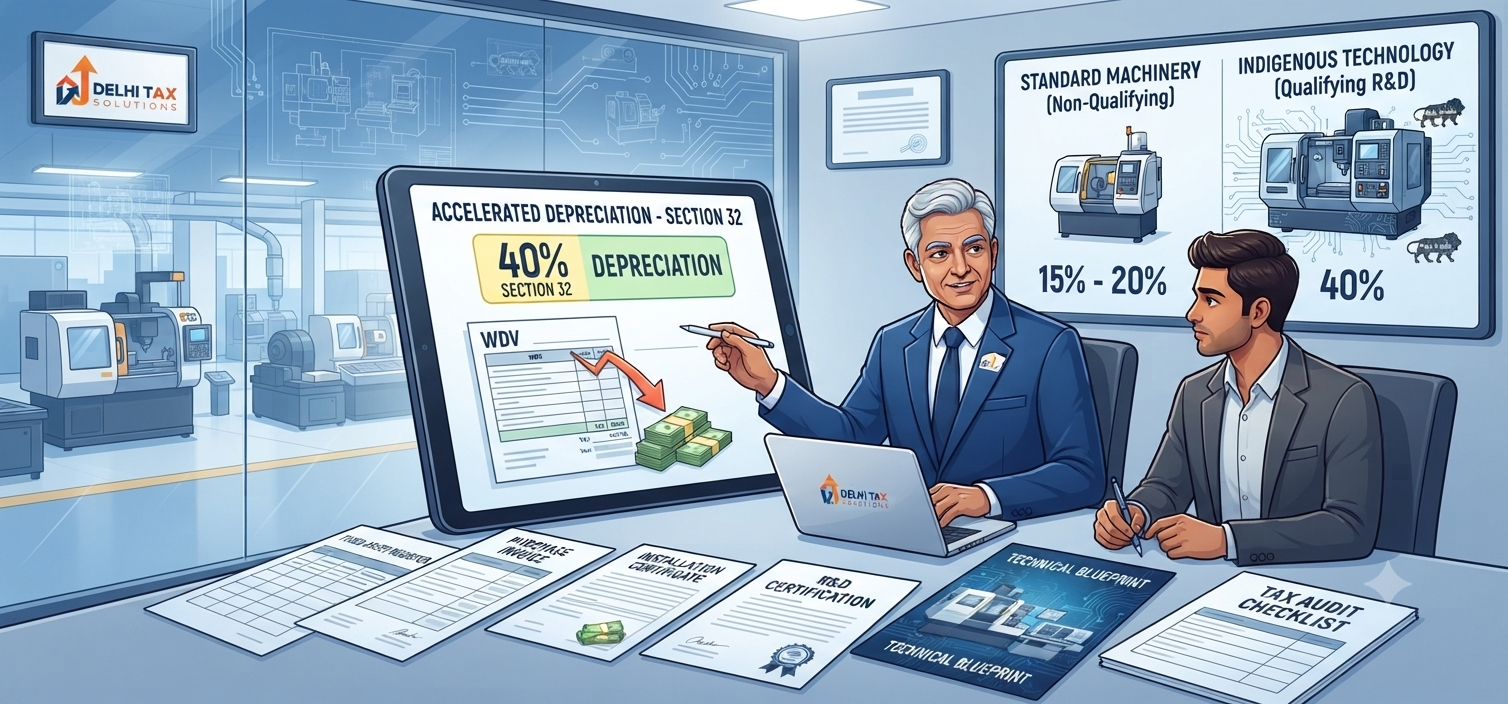
- Section 32 permits a 40% depreciation rate on machinery using indigenous technology.
- Eligible assets must be designed and developed in India by certified bodies.
- Substantial corporate tax savings accrue in the initial years of capital deployment.
- Rigorous CA documentation and audit trails prevent tax disallowances during assessments.
Accelerating business growth while minimizing tax outflows is a primary goal for modern Indian manufacturing enterprises and technology-driven startups. When companies invest heavily in domestic research, machinery design, and in-house innovation, the financial returns extend beyond operational efficiency. Under Indian tax statutes, substantial fiscal incentives reward domestic innovation. Our expert tax advisory team at Delhi Tax Solutions examines how businesses harness the 40% accelerated depreciation on indigenous technology to optimize their tax liabilities under the Income-Tax Act.
What is 40% accelerated depreciation on indigenous technology?
The 40% accelerated depreciation on indigenous technology is a specialized tax provision under Section 32 of the Income-Tax Act, 1961, allowing eligible corporate entities to claim higher wear-and-tear deductions on plant and machinery. By permitting a 40% write-off on the written down value (WDV) or actual cost of qualifying assets, the Income Tax Department encourages companies to adopt domestically engineered hardware and manufacturing systems. For businesses structuring new operational setups, our guide on Start Business – Delhi Tax Solution offers comprehensive corporate registration support.
How does Section 32 govern higher depreciation rates?
Statutory Framework of Asset Blocks
Section 32 groups capital assets into specific blocks of assets sharing identical depreciation rates. While general plant and machinery attract standard rates ranging from 15% to 20%, assets incorporating cutting-edge domestic R&D qualify for the elevated 40% tier.
Qualifying Criteria for Machinery and Plant
To qualify for this enhanced tax benefit, the machinery or plant must be installed in premises used for business purposes. Furthermore, the technology embedded within the equipment must be certified as homegrown rather than purely imported OEM hardware.
Harmonizing with Corporate Compliance
Corporate tax officers scrutinize capital expenditure ledgers to ensure proper asset categorization. Maintaining transparent asset registers aligns with reporting standards monitored by the Ministry of Corporate Affairs, ensuring seamless annual filing cycles.
What defines qualifying indigenous technology assets?
Design and Development Standards
Qualifying technology must be designed, engineered, and developed within India by recognized scientific research institutions, government laboratories, or authorized corporate R&D divisions.
Exclusion of Imported Sub-Components
While minor imported raw components do not automatically disqualify an asset, the core intellectual property, manufacturing design, and engineering framework must originate domestically. Tax auditors evaluate patent filings and design blueprints during corporate assessments.
Supporting MSME Innovation Ecosystems
Innovative manufacturing enterprises often register their operational units to leverage government schemes. Securing an Udyam Registration strengthens an enterprise’s credibility when claiming advanced technology deductions.
Comparison of Standard versus Accelerated Tech Depreciation
| Depreciation Parameter | Standard Machinery Rate | Indigenous Technology Rate |
|---|---|---|
| Depreciation Percentage | 15% to 20% on written down value | 40% accelerated write-off allowance |
| Technology Origin | Imported or general commercial machinery | Locally designed, researched, and engineered |
| Tax Impact | Gradual tax shielding over multiple years | Aggressive upfront corporate tax liability reduction |
Official policy updates published by the Press Information Bureau highlight that domestic manufacturing incentives drive Atmanirbhar Bharat initiatives. Additionally, businesses must manage their multi-jurisdictional indirect tax obligations using strategies outlined in GST – Delhi Tax Solution.
What are the audit and compliance requirements for tech claims?
Maintaining Detailed Fixed Asset Registers
Tax auditors require comprehensive fixed asset registers detailing purchase dates, invoice numbers, serial numbers, and specific tech certification documents. Incomplete asset tracking frequently triggers scrutiny.
Reconciliation with Core Accounting Standards
Financial officers must reconcile tax depreciation schedules with statutory company law depreciation. Managing temporary and permanent tax differences requires diligent oversight by qualified chartered accountants.
Streamlining Annual Tax Filings
Coordinating complex asset schedules across various corporate entities demands standardized compliance workflows. Maintaining absolute clarity across all assessment years aligns with protocols detailed in Assessee & Assessment Year Explained.
Conclusion and Professional CA Guidance
Maximizing corporate tax savings through the 40% accelerated depreciation on indigenous technology requires rigorous adherence to statutory asset classification and R&D verification rules. By maintaining meticulous fixed asset records and aligning with current income tax laws, businesses can significantly reduce their tax burden while fostering domestic innovation. Talk to a Delhi Tax Solutions expert to review your capital asset schedules and secure your corporate filings within 3 days. Looking ahead, strategic tax planning will remain the cornerstone of sustainable enterprise growth.
Frequently Asked Questions (FAQs)
Q: How does a company qualify for the 40% accelerated depreciation on indigenous technology under Section 32?
A: To qualify for the 40% accelerated depreciation rate under Section 32 of the Income-Tax Act, 1961, a company must acquire and install new plant and machinery that utilize technology designed, developed, and engineered entirely within India by recognized scientific research institutions or approved domestic R&D bodies, verified through certified asset documentation.
Q: What certification or approval is required to prove that machinery uses indigenous technology?
A: Taxpayers claiming advanced tech depreciation must maintain comprehensive technical blueprints, design IP documentation, and certificates from approved government scientific bodies or Department of Scientific and Industrial Research (DSIR) recognized institutions confirming that the machinery incorporates proprietary Indian technological innovations.
Q: How is the 40% depreciation calculated on new additions versus the existing block of assets?
A: Depreciation is computed on the written down value (WDV) of the specific block of assets at the beginning of the financial year plus the actual cost of assets acquired during the year, adjusted for assets put to use for less than 180 days, ensuring accurate tax shielding during corporate assessments administered by the Income Tax Department.
Q: Can startups and manufacturing MSMEs combine accelerated depreciation with other R&D tax incentives?
A: Yes, innovative startups and registered manufacturing MSMEs can integrate accelerated depreciation benefits with various state and central incentives, provided they maintain distinct accounting ledgers, comply with Udyam registration guidelines, and satisfy all statutory conditions prescribed under the Income-Tax Act and corporate regulations.
Q: What documentation and audit reports must corporate taxpayers maintain to substantiate tech depreciation claims?
A: Corporate taxpayers must preserve audited fixed asset registers, vendor invoices, purchase orders, installation certificates, technological R&D reports, and tax audit reports under Section 44AB, ensuring complete transparency and compliance during scrutiny by assessing tax officers.
Disclaimer: This article is for general informational purposes and is not a substitute for personalised professional tax advice. About this article: Researched using official government sources and Delhi Tax Solutions’ in-house tax advisory team. Last updated September 2026.